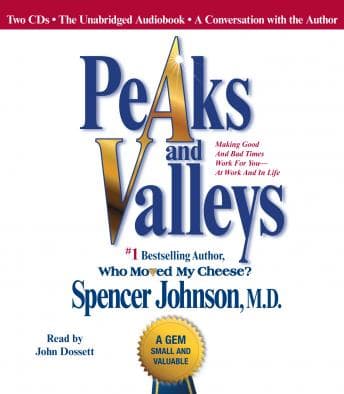

So here's the thing about Spencer Johnson. Everyone and their manager's manager has read Who Moved My Cheese? and nodded sagely during some corporate retreat. I actually went back and revisited Who Moved My Cheese?: An A-Mazing Way to Deal with Change in Your Work and in Your Life recently and was struck by how much more elegant its central metaphor feels. I went into Peaks and Valleys expecting the same formula — deceptively simple parable, life lesson wrapped in a story thin enough to read on a lunch break — and yeah, that's pretty much exactly what I got. But what surprised me was how much I found myself interrogating the psychology underneath it. Not because Johnson goes deep. He doesn't. But because the framework he builds is genuinely interesting if you bother to sit with it for more than two hours.
I listened to this while making chana masala on a Saturday afternoon — one of those lazy cooking sessions where you're dicing onions and letting the pressure cooker do its thing. Two hours. That's all this is. Shorter than my last therapy session felt.
The Old Man on the Mountain Is Doing Cognitive Reframing and Nobody's Saying It
The setup: a young man living unhappily in a valley meets a wise old man on a mountain peak. Classic archetype, right? The mentor-student dynamic that Joseph Campbell would nod at. But here's what I found myself asking: why does the young man keep going back to the mountain? Johnson presents it as curiosity and growth, but psychologically, the young man exhibits classic anxious attachment to authority figures — he can't internalize the lessons until the old man essentially forces him to by withdrawing access.
The core concept — that peaks and valleys are connected, that how you behave in good times determines how soon the next valley arrives, and how you respond in bad times determines how quickly you reach the next peak — is basically cognitive behavioral therapy dressed up in hiking metaphors. The research actually shows that reappraisal strategies (reframing negative events as learning opportunities) do correlate with better outcomes and emotional regulation. Johnson's B.A. in psychology from USC is showing, whether he intended it or not. He's not citing Lazarus and Folkman, but the stress-and-coping framework is right there under the surface.
The problem? The characters aren't really characters. They're delivery mechanisms for principles. The young man has no interior life beyond "unhappy, then less unhappy." The old man has no flaws, no contradictions, no moments where his own philosophy fails him. Psychologically, this doesn't track. Real wisdom comes from people who've been broken by their own advice at least once. Johnson gives us a fortune cookie dispenser on a mountaintop.
John Dossett's Voice Does the Heavy Lifting Johnson Won't
This is a fascinating case study in how narration can save thin material. Dossett's delivery is crisp, no-nonsense, with this understated quality that keeps the parable from tipping into saccharine territory. I've heard him narrate material with far more psychological substance — Authentic Happiness: Using the new Positive Psychology to Realize Your Potential for Lasting Fulfillment comes to mind — and his restraint there made the ideas land harder. He doesn't oversell the emotional beats — and honestly, thank god, because if he'd gone heavy on the pathos this would've been unbearable. Instead there's this quality of wistful contemplation, like a man remembering advice he wishes he'd taken sooner.
With only two real characters (young man, old man) and a couple of peripheral figures, there's not a ton of vocal range required. Dossett handles it with a businesslike authority that feels appropriate. He's not performing theater. He's telling you something practical over a cup of coffee. For a two-hour listen, that restraint is exactly right.
Where the Psychology Gets Sloppy
Here's my issue, and it's the same issue I have with most self-help parables: the model assumes emotional valleys are primarily attitudinal problems. "You create your valleys by how you respond to events." Sure, sometimes. But sometimes you're in a valley because systemic forces put you there, or because you have clinical depression, or because the cheese actually did move and nobody's giving you a map to the new cheese.
Johnson's framework works beautifully for the mildly dissatisfied professional who needs a perspective shift. The book that actually wrestles with that limitation — the gap between reframing and real suffering — is one I keep returning to: Crown Jewel handles its emotional terrain without flattening it into fortune-cookie wisdom. It's less useful — potentially even harmful — for someone whose valley is poverty, grief, chronic illness. The book never acknowledges this limitation, and that bothers me. My therapist would have thoughts about this character, the old man, dispensing universal truths without ever asking the young man what specifically is wrong.
That said. The principle of not making peak moments worse by fearing the next valley? That's genuinely good psychological advice. Present-moment focus during positive experiences is well-supported. I'll give Johnson that.
Who Needs This, Who Doesn't
If you've never encountered CBT concepts, if you're in your first management role and feeling the whiplash of good quarters and bad quarters — this is a decent primer wrapped in a story you can finish before dinner. At two hours, it's basically a long podcast episode. The bar for commitment is low.
If you've done any real reading in psychology, self-help, or even just listened to a Brené Brown talk, you already know everything here. You'll spend the two hours going "yes, and?" waiting for depth that never arrives.
The Prescription Pad
Spencer Johnson writes self-help the way my mother makes chai — the same way every time, exactly the right amount of sweet, nothing that will challenge your palate. Peaks and Valleys is comfort reading for people who want their personal growth digestible and quick. Dossett's narration elevates it from forgettable to pleasant. But I kept wanting the book to surprise me, to complicate its own thesis, to let the young man fail in a way the framework couldn't explain. It never did. And that — the refusal to sit with mess — is the most psychologically unrealistic thing about it.