
Can you actually study happiness scientifically, or is that like trying to measure love with a thermometer?
I was stirring a pot of dal at 10 PM—the kind of elaborate cooking I do when I'm avoiding grading papers—when Seligman started breaking down his signature strengths inventory. And I found myself pausing, wooden spoon mid-stir, genuinely reconsidering twenty years of assumptions about what psychology can and cannot quantify.
The Founder Makes His Case (And It's Surprisingly Solid)
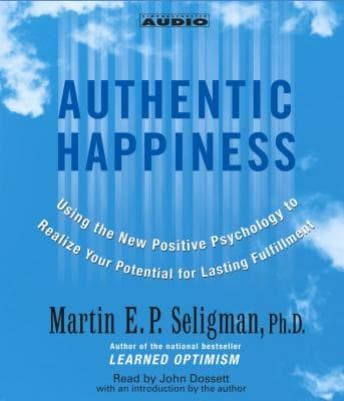
Here's what you need to understand about this book: Martin Seligman isn't some self-help guru who read a few studies and decided to write about happiness. The man was president of the American Psychological Association. He essentially invented learned helplessness as a concept before pivoting to ask—wait, what about the opposite? What makes people flourish instead of flounder?
The research shows something counterintuitive. Seligman argues that happiness isn't about eliminating negatives but amplifying positives—specifically, identifying your "signature strengths" and deploying them strategically. The VIA classification he presents (wisdom, courage, humanity, justice, temperance, transcendence) reads like a personality assessment you'd actually want to take. Open Book explores similar territory in translating research into lived experience, though through a completely different lens.
What makes this compelling is the evidence base. Seligman doesn't just assert that gratitude exercises work—he cites specific studies, effect sizes, replication attempts. My therapist would have thoughts about some of his claims (the "three blessings" exercise sounds almost too simple), but the man shows his work.
The Abridgment Question—And John Dossett's Steady Hand
Here's where I need to be honest: this is an abridged audiobook. Four and a half hours. The full text is substantially longer. So you're getting Seligman-lite, which means some of the deeper research dives and nuanced qualifications probably hit the cutting room floor.
John Dossett's narration is... competent? Clean? He reads like a very good audiobook narrator reading a psychology textbook, which is exactly what's happening. No dramatic flourishes, no attempts to make the material more exciting than it is. Just smooth, professional delivery that gets out of the way and lets Seligman's ideas breathe.
Is that a criticism? I'm genuinely not sure. Part of me wanted more personality—some vocal investment in the material. But another part appreciates that Dossett treats this like the academic work it is rather than trying to turn it into a TED talk.
Where Positive Psychology Gets Complicated
The protagonist exhibits classic optimism bias—and by protagonist, I mean Seligman himself. He's so convinced that positive psychology represents a paradigm shift that he occasionally oversells the revolution. The book was published in 2002, and some of his predictions about the field haven't quite materialized the way he expected.
There are moments that don't quite track for me psychologically. The emphasis on individual strengths sometimes glosses over structural factors—it's easier to focus on your "signature strengths" when you're not worried about rent. Seligman acknowledges this briefly but doesn't wrestle with it enough.
But here's what I kept coming back to: compared to the pop psychology garbage flooding the self-help market, this is rigorous. Compared to actual academic papers, it's accessible. That middle ground is harder to hit than people realize.
Who This Works For (And Who Should Look Elsewhere)
Listen if: you're skeptical of self-help but curious about the science behind well-being, you want practical exercises grounded in actual research, or you're a psychology nerd who wants to understand where the positive psychology movement came from.
Skip if: you want quick fixes without the theoretical framework, you're looking for narrative storytelling rather than structured argument, or—and this is important—you need the unabridged version for academic purposes. This condensed version works for general listeners but loses depth.
Midnight Dal and the Limits of Optimization
I finished this while eating my dal alone at midnight, which is exactly how I prefer it. (Don't feel sorry for me.) Seligman's central argument stuck with me: that authentic happiness comes from using your strengths in service of something larger than yourself. It's not revolutionary in 2024, but that's partly because Seligman helped make it common sense.
The audiobook format works here—it's the kind of content that benefits from focused listening during a commute or workout rather than background noise. At 4.5 hours, it's a reasonable commitment. Just know you're getting the highlight reel, not the complete picture.
Worth a credit? Probably not at full price—the abridgment and somewhat dated research mean you'd be better served waiting for a sale or streaming through your library. But the ideas themselves? Those have aged better than I expected.