
This woman has had more names than I've had patients in a single shift. And that's saying something.
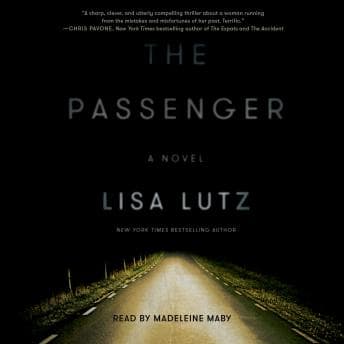
I picked up The Passenger during a stretch of nights where the unit was eerily quiet - the kind of quiet where you don't say the Q-word, you just pop in your earbuds and pray to the trauma gods. Lisa Lutz's premise hooked me immediately: Tanya Dubois finds her husband dead at the bottom of the stairs, and instead of calling 911 like a normal person (as someone who's actually worked a code, I had opinions about this), she dyes her hair, gets a new identity, and runs. Because apparently this isn't her first dead husband. Or her first name.
She's Not Running From What You Think She's Running From
Here's what got me about this book - it's not just a woman-on-the-run thriller. It's a woman who has been running so long she's forgotten what standing still feels like. Every time Tanya-now-Amelia-now-Debra picks up a new identity, she sheds a little more of whoever she actually was. And Lutz does something clever here: she withholds the why for a frustratingly long time. You're following this woman across state lines, watching her forge documents and sleep in cars and make increasingly risky choices, and you're screaming "JUST TELL ME WHAT YOU DID" at your steering wheel.
I was, anyway. Carlos texted me once asking if I was okay because I'd been sitting in the driveway for twenty minutes. I was fine. I was in a bar in Austin with a woman named Blue.
Blue is the wildcard that makes this story work. She's a bartender who takes one look at our protagonist and clocks her as someone running from something ugly. Their alliance is uneasy and codependent and occasionally funny in that dark, dry way Lutz does so well. There's a moment where Blue essentially teaches Debra the art of being invisible in plain sight, and it's the kind of practical, unglamorous survival detail that makes me trust an author. No Hollywood nonsense. Just two women who know that the most dangerous thing about being a fugitive isn't the police - it's the paper trail.
Madeleine Maby and the Accent That Wouldn't Stay Put
Okay. Let's talk about the narration. Madeleine Maby does solid work here for the most part. Her voice for the protagonist has this low, careful quality that fits someone who's trained herself to never give too much away. The emotional beats land - there's a scene toward the end where the truth finally comes out, and Maby's delivery gave me actual chills at a red light on McDowell Road.
But. The accents. I need to talk about the accents. Blue's voice starts out with this distinct drawl - Southern-adjacent, a little rough - and then somewhere around hour five it... shifts. Not dramatically, not enough to lose the character entirely, but enough that my brain went "wait, who's talking?" more than once. It's the narration equivalent of a doctor charting the wrong side - you notice, and once you notice, you can't un-notice.
I also want to flag that Maby's pacing for certain characters - particularly some of the men our protagonist encounters - runs slow. Like, clinical-documentation-at-3-AM slow. I bumped the speed to 1.25x during those stretches and honestly it helped a lot. The story itself moves plenty fast; the narration just needed a nudge in spots.
The Reveal Is Worth the Wait (But Barely)
Lutz makes you work for the truth about who this woman really is and what she actually did. For most of the book, you're operating on fragments and misdirection. Is she a victim? A predator? Something in between? I hit that same wall of moral ambiguity with Below the Belt — another book that keeps you guessing whether you're rooting for the right person right up until the last chapter. The answer, when it finally arrives, is genuinely surprising - not in a cheap twist way, but in the way that makes you mentally replay earlier scenes and go "oh. OH." I won't spoil it, but I will say it's more complicated than "she killed someone" and less simple than "she's innocent."
My one real complaint with the story: some of the middle section drags. There's a stretch where she's in a new city with a new name and a new situation that feels like it's killing time before the plot kicks back in. At nine hours, this book could've been tighter at seven and a half. Lutz's dark humor carries those slower sections - there are genuinely funny observations about the absurdity of reinventing yourself on a budget - but I still felt the bloat.
Who Needs This in Their Ears
If you like psychological thrillers where the mystery is the person telling you the story, this is your book. If you want a female protagonist who is competent and flawed and occasionally terrifying without being a cliché, get in line. If inconsistent accents make you want to throw your phone out the car window, maybe bump the speed and power through.
Perfect for that post-shift decompression. The tension is sustained without being exhausting, the dark humor keeps it from getting too heavy, and the identity-swapping structure means you're always slightly off-balance. Night shift approved - just maybe not for the last hour of a twelve when your brain is already mush.
My mom would love this. She's been on a thriller kick ever since she retired. (She still thinks I should've been a doctor, but at least we can talk about books now.)