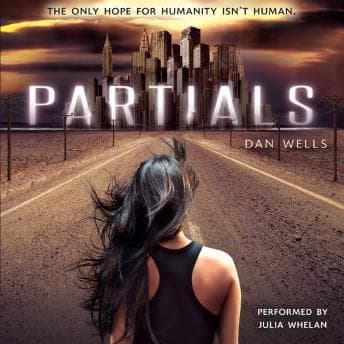

So here's the thing about dystopian YA fiction - it's basically a Rorschach test for how authors think teenagers would handle societal collapse. And honestly? Most of them get it wrong. They write kids who are either impossibly competent or frustratingly passive. Iron Gold falls somewhere in the middle of that spectrum—competent characters, but not always in ways that feel earned. Dan Wells does something different with Kira in Partials, and it took me a few hours to figure out why she felt so psychologically real.
I started this during a long flight delay at Logan - nothing like being trapped in an airport to make post-apocalyptic fiction feel weirdly comforting. Fourteen hours is a commitment, but Julia Whelan's narration made the time disappear in a way that genuinely surprised me.
The Psychology of Survival Guilt
What grabbed me wasn't the action sequences (though they're solid). It was watching Kira process survivor's guilt while simultaneously refusing to accept helplessness. The premise - humanity decimated by a virus, reduced to tens of thousands on Long Island, every baby dying within days of birth - creates this fascinating psychological pressure cooker.
Kira exhibits classic problem-focused coping. She's a medic, so she channels her anxiety into action. But Wells doesn't let her off easy. He forces her to confront the uncomfortable questions: What if the enemy isn't what we think? What if our survival depends on understanding the very beings we've demonized?
The Partials themselves are a brilliant case study in othering. Engineered organic beings, identical to humans but treated as monsters. Research shows that dehumanization follows predictable patterns, and Wells captures this with uncomfortable accuracy. The humans on Long Island have constructed an entire identity around hating Partials, which means any attempt to understand them becomes an existential threat to the community.
(My therapist would have thoughts about this character. Several, probably.)
Why Julia Whelan Works Here
I've listened to a lot of Whelan's work - she's genuinely one of my favorites - and this is an earlier performance that shows why she became the narrator she is now. Her Kira is determined without being grating, curious without being naive. There's this dry wit in her delivery that matches Wells's writing perfectly.
The character differentiation is subtle but effective. She doesn't do wildly different voices, but you always know who's speaking. The pacing adjusts for the political debates and exposition sections - and look, there are some long stretches of world-building that could drag, but Whelan keeps them moving.
There's a moment when Kira starts questioning everything her community believes, and you can hear the cognitive dissonance in Whelan's delivery. It's not overdone. Just... there.
The Slow Burn That Pays Off
I kept asking myself: why does this book work when so many similar ones don't? I think it's because Wells treats his teenage characters like actual people with complex motivations, not chess pieces moving through a plot. Kira makes decisions that feel earned, not convenient.
The world-building is dense - we're talking bio-science, political factions, military strategy. Some listeners have noted the long historical descriptions and debates. Paris Rose has similar density with its historical detail, though in a completely different setting. Honestly, I didn't mind them. They serve the story. But if you're looking for pure action, you might get impatient around hour five or six.
What tracks psychologically is how the different factions respond to existential threat. The Senate wants control. The Voice wants freedom at any cost. The military wants to fight. These aren't just plot devices - they're recognizable patterns of human behavior under stress. Wells clearly did his homework on group dynamics.
Who This Is (and Isn't) For
If you're into The Hunger Games but wished it went deeper into the psychology, this is your book. Best for commutes or long flights - the fourteen hours fly by (pun intended, I'm not sorry). At 1.25x speed, it's even tighter.
Skip this if you need constant action or if philosophical debates about personhood and rights bore you. This book asks uncomfortable questions and doesn't always provide neat answers. That's the point, but it's not for everyone.
The production is clean, professional, no audio issues. Just Whelan and Wells doing good work.
The Diagnosis
I'm genuinely curious where the series goes from here. The ending sets up questions that I need answered. And that's rare - most YA dystopian series lose me by book two. But Wells has built something psychologically interesting enough that I'm in for the long haul.