
How many self-help books does it take before you actually change something? Because I've listened to probably forty of them in the last two years, and I'm starting to think the answer might be "one good one, if you actually do the work." This might be that one. Or it might not. Let me explain.
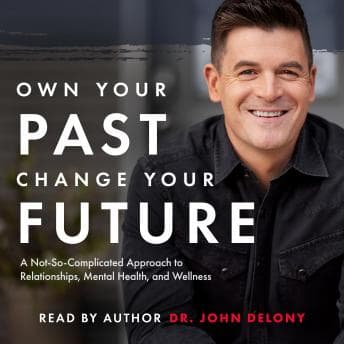
I burned through Own Your Past Change Your Future across two commutes and a chunk of Sunday morning where Kevin was still asleep and I was stress-cleaning the kitchen after a particularly brutal on-call week. That's the context you need: I was tired, I was cranky, and I was half-ready to 1.75x this thing into oblivion like every other self-help book that could've been a blog post.
I didn't. I kept it at 1.5x. That's meaningful, coming from me.
The Guy With Two PhDs Who Talks Like Your Funny Friend
Dr. John Delony narrates his own book, and here's the thing - author-narrated self-help is usually a coin flip between "passionate expert who can actually talk" and "academic reading their dissertation aloud." Delony lands firmly on the first side. He's got this radio-host cadence (makes sense, he has a show) where he'll be walking you through something genuinely heavy - like how your parents' unprocessed grief becomes your anxiety template - and then he'll crack a joke that actually lands. Not performative humor. The kind of dark-but-warm honesty you get from someone who's sat across from people in crisis for twenty years.
He reads it like he's having a conversation with you specifically, which works beautifully on audio. There's a bit early on where he talks about carrying "bricks in a backpack" - each brick being a story someone told you about yourself, or one you made up - and the metaphor is simple enough that my 6AM brain latched onto it immediately. It became the organizing principle I kept returning to. That's good writing for audio. Simple, sticky, repeatable.
The Five Steps Are Actually Useful (But There's a Catch)
The framework: acknowledge your reality, grieve what happened, change your thoughts, change your actions, build connections. Not revolutionary on paper. But Delony doesn't just list these and move on - he actually walks through HOW, with exercises and prompts and specific scenarios.
The "change your actions" piece is the part everyone stalls on, which is exactly the ground Impulse covers - why we know precisely what to do and still don't do it.And that's where the catch comes in. This book has a LOT of practical exercises. Like, "stop and write this down" exercises. "Make a list of the stories you believe about yourself" exercises. On a Caltrain at 6:47 AM surrounded by other half-conscious tech workers, I am not pulling out a journal. I'm barely pulling out consciousness.
So here's my honest take: the audio version gives you maybe 70% of the value. You get the framework, the stories, the motivation, Delony's delivery (which genuinely carries the material). But there's a version of this book that works better as physical + audio combo. I've flagged a few chapters to revisit with a notebook. That's rare for me - I almost never double-dip on formats.
The section on making friends as an adult hit different. He talks about how we've traded depth for breadth - the "1,000 Facebook friends but no one to help you move a couch" line from the description is basically the thesis of that chapter. As someone who moved from Seattle to SF and whose closest friends are now Slack channels and group chats... yeah. That section earned its runtime.
Where It Drags (Because It Does)
At 6 hours 52 minutes, this isn't long. But there are stretches in the middle - particularly around the thought-change chapters - where Delony repeats core concepts a few too many times. I get it: repetition is pedagogy. But on audio, it feels like padding. I bumped to 1.75x for about 30 minutes in chapters 4-5, then dropped back down when he got into the action steps.
Also, if you're already deep into therapy or have read extensively in the trauma-processing space (Bessel van der Kolk, etc.), the foundational concepts here will feel familiar. Delony's contribution is accessibility and warmth, not novelty. He's not breaking new ground - he's making existing ground walkable for people who haven't been on it before.
Who Gets the Most From This
Perfect for: train, gym. Skip for: deep work (you'll want to pause and journal). If you're someone who listens to Delony's podcast and wants a more structured version of his advice, this is exactly that - same voice, same humor, but organized into an actual framework instead of caller-by-caller. If you've never encountered his stuff, this is a solid entry point.
But if you're looking for academic rigor or clinical depth, this isn't it. This is basically Boundaries but for your internal narrative - practical, digestible, occasionally oversimplified.
The ROI Calculation
The ROI on this audiobook is solid but conditional. If you actually stop and do the exercises (buy the physical book too, or at least keep your Notes app handy), it could genuinely shift how you process the backpack of bricks you're hauling around. If you just listen passively like I mostly did? You'll walk away with a useful framework and some motivation, but the real work stays undone.
It's the same lesson Ultimate Sales Machine hammers home from the business side - the plan is worthless until you actually run it.Two commutes. No regrets. But I'm buying the paperback this weekend, and that's the real review.