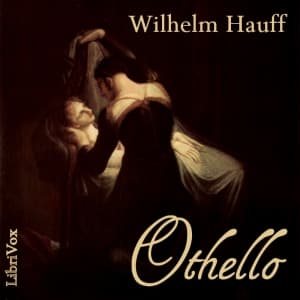

"Ist eine Verkettung unglücklicher Zufälle oder ein Fluch die Ursache der tragischen Ereignisse?" That question — dropped right in the description — is basically the entire vibe of this weird little novella, and honestly? It hit different than I expected at 2 AM when I should've been debugging my procedural dungeon generator.
Let me set the scene. Wilhelm Hauff wrote this in the 1820s. The dude died at 24. Twenty-four. I'm older than that and my biggest accomplishment is a half-finished thesis and an encyclopedic knowledge of Sanderson's Cosmere. Hauff was out here writing novellas that use the opera Othello as a narrative frame for a ghost story wrapped in a murder mystery wrapped in a forbidden love plot. In under two hours. The audacity.
A 19th-Century German Novella Walks Into a D&D Campaign
Okay, hear me out. This thing reads like someone took the bones of a gothic one-shot adventure and dressed it up in Romantic-era German prose. You've got your inciting incident — the opera Othello serving as both literal backdrop and thematic mirror for the real-world tragedy unfolding. There's a murder. There's a ghost. There's love that can't be. And then Hauff does this genuinely clever thing where he presents both a rational explanation AND a supernatural one and just… leaves you there. No resolution. The DM looked you in the eye and said "what do YOU think happened?" and ended the session. Nightfall does something similarly maddening with its ending — different genre entirely, but that same refusal to hand you a clean resolution hit me the same way.
As someone who's run more ambiguous-ending campaigns than I care to admit, I respect the hell out of that move. It's the kind of narrative structure that would make my Thursday night D&D group argue for an hour after the session — and that's the highest compliment I can give a story.
The world-building here isn't Sanderson-level (nothing is, fight me), but for a sub-two-hour listen, Hauff packs in a surprising amount of atmosphere. The opera setting does a lot of heavy lifting — you've got this layered reality where the fictional jealousy and violence of Othello bleeds into the "real" events of the novella. It's meta before meta was cool.
Hokuspokus and the LibriVox Question
So here's where I have to be honest: this is a LibriVox recording. Solo narrator, volunteer production. Hokuspokus reads in clear German, and the pacing is steady enough that I never felt lost even when my German was working overtime (four semesters of college German plus a lot of Rammstein lyrics — don't judge me). But I can't sit here and tell you the character differentiation is on a Steven Pacey level. Steven Pacey walked so other narrators could run, and Hokuspokus is… walking. Competently. In a straight line. Which for a free community recording of a 200-year-old German novella is honestly fine.
There's no music, no sound effects, no production flourishes. Just one person reading a text clearly. If you're coming from polished Audible productions, recalibrate your expectations. But if you've ever listened to a LibriVox recording before, you know exactly what you're getting. The narration serves the text without getting in the way, and for a story this short, that's enough.
Who's Rolling Initiative on This One
This is for a very specific listener. You want this if: you're into gothic/Romantic-era European literature, you're practicing your German listening comprehension, you have a thing for unreliable narratives that refuse to give you a clean answer, or you're just curious what a pre-Victorian German writer did with the Othello premise before it became a cliché. At under two hours, it's basically a long podcast episode. Low commitment, decent payoff.
Skip it if you need hard magic systems, epic scope, or English. (I read this instead of writing my thesis, but I could've also written my thesis in the time it took to listen, which is both a pro and a con.)
The forbidden love angle and the murder-or-curse ambiguity give it a surprisingly modern feel for something written when Andrew Jackson was president. It's not going to change your life. But it might make you think about narrative framing in a way that sticks with you — the opera-within-the-story structure is genuinely smart, and I kept thinking about how I'd adapt it for a campaign setting where the PCs attend a play and the play starts… happening to them.
Roll a Wisdom Save and Decide for Yourself
Hauff died before he could become the writer he was clearly becoming. This novella — short, strange, structurally ambitious — is a snapshot of raw talent. The audiobook is free, it's under two hours, and it asks you a question it refuses to answer. That's worth something. Not a credit, maybe. But definitely your time on a late night when the code won't compile and you need something dark and strange in your ears.