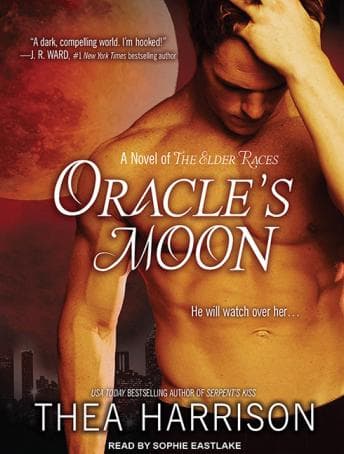

Grace Andreas is broke, limping from a car accident that killed her sister, raising two tiny humans she didn't plan for, and oh yeah — she's now the Oracle of Louisville. That sentence alone had me clutching Diego to my chest like an emotional support pillow.
I came to Oracle's Moon after burning through the first few Elder Races books, and this one hit different. Not because it's the best written or the most dramatic, but because Grace is the most human heroine Thea Harrison has given us. She's not a sentinel or a powerful half-Wyr creature. She's a woman on food stamps who can barely afford groceries, dealing with grief while two toddlers scream in the background. Smoke Bitten is another one where the heroine's ordinary human vulnerabilities hit harder than any supernatural threat — that same anchoring in real-world exhaustion is what makes paranormal romance actually land for me. The romance is secondary to survival for the first few hours, and that grounding — that desperation — made me care about her so much more than I expected.
A Djinn Prince Doing Dishes Is My Love Language
Khalil is not your typical paranormal romance hero. He's Djinn. He's ancient. He's arrogant in that specific immortal-being way where he genuinely doesn't understand why humans need sleep. But the thing that wrecked me? He starts showing up to help with the kids. Not in a sexy, mysterious, "I'll protect you" way. In a "the baby needs changing and Grace hasn't slept in two days" way. He learns domesticity like it's a foreign language, and watching this all-powerful Djinn figure out that love looks like warming bottles and standing guard during nap time — my heart. MY HEART.
The power dynamic is interesting too, because Grace refuses to be impressed by him. She's too tired, too broke, too stubborn. She treats him like an annoying houseguest who happens to be made of wind and fire. And Khalil, who has existed for millennia and could level a building, is absolutely baffled by her refusal to be intimidated. The chemistry is chef's kiss specifically because it's born from friction and mutual bewilderment, not instant attraction.
Sophie Eastlake and I Have a Complicated Relationship
Okay, here's where I get honest. Sophie Eastlake's narration is polarizing in this series, and I land somewhere in the complicated middle. Her emotional delivery during Grace's grief moments — the scenes where Grace is just trying to hold it together for the kids — those are genuinely good. She captures that specific exhaustion-grief cocktail where you're too tired to cry but the tears come anyway. I felt that in my chest.
But her character differentiation is subtle to a fault. Khalil should sound otherworldly. Ancient. Like wind through a canyon or something that makes the hair on your neck stand up. Instead he gets a slightly deeper register and a touch more formality, and that's about it. For a being who's essentially elemental chaos in humanoid form, I wanted more texture. Compare this to what someone like Julia Whelan would do with that kind of character — she'd find some quality in her voice that felt genuinely inhuman, something that would make you shiver. Eastlake plays it safe, and safe doesn't quite capture Khalil's strangeness.
The kids sound fine. The Oracle visions have a nice weight to them. It's a competent performance that occasionally rises to something lovely, but it doesn't elevate the material the way the best narrators do.
The Grief That Snuck Up on Me
I was designing a logo for a mezcal brand — midnight, Frida asleep on my keyboard, deadline in six hours — when Oracle's Moon hit me with the grief stuff. Grace visiting her sister's grave. Grace finding Petra's handwriting on a grocery list. Grace looking at her niece and seeing her dead sister's face. The quiet devastation of that kind of grief — the kind that lives in small ordinary objects — reminded me of something I felt reading Akata Witch, where loss shapes a character's entire sense of belonging without ever being made into spectacle. Thea Harrison doesn't sentimentalize it. She just... drops these moments in between the paranormal politics and the Djinn banter, and suddenly you're not okay.
I ugly-cried around hour seven. Not dramatic, heaving sobs — more like that quiet crying where you realize you're doing it and you don't stop. Because Grace's grief is the kind where you keep going. You make lunches. You answer the door. You deal with the terrifying Oracle power you never wanted. And that quiet endurance reminded me of my abuela after my abuelo passed. She just kept making breakfast every morning. Abuela would have loved this one — the telenovela drama of a Djinn prince falling for a broke single guardian? She would've watched that on Univision in a heartbeat.
Who This Book Is Really For
This is a rainy Sunday book. It's for people who want their paranormal romance served with a side of realistic financial stress and found family. If you need wall-to-wall action or a narrator who does wildly distinct voices, you might bounce off this one. But if you want to feel what it's like to be completely overwhelmed and then slowly, reluctantly, let someone powerful be gentle with you — yeah. Come get your feelings hurt in the best way.
Not Harrison's strongest book in the series, but maybe her most emotionally honest one. And sometimes that's worth more than spectacle.