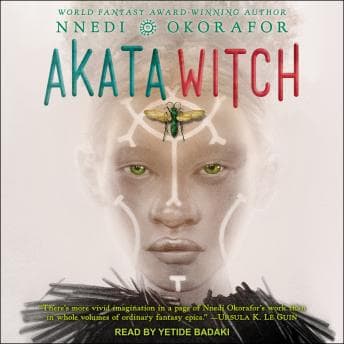

I was making aloo gobi at 10 PM on a Tuesday—one of those nights where I needed something absorbing to keep me from doom-scrolling through academic Twitter—when Sunny Nwazue first appeared in my ears. And I thought: here's a protagonist who actually makes psychological sense.
Twelve years old, albino, American-born but living in Nigeria, a soccer player who can't play in the sun. The research actually shows that identity formation in adolescence is complicated enough without being visibly different in multiple overlapping ways. Sunny isn't just "the outsider." She's navigating what psychologists call intersectional otherness—never fully belonging to any single category. Okofor gets this. Sunny's isolation isn't performative angst. It's the quiet, persistent ache of someone who's learned to expect exclusion. That same ache—the kind that comes from being perpetually on the outside—runs through Bel Canto, though in a completely different context.
A Case Study in Found Family Done Right
What makes this quartet compelling is how they form. Sunny, Orlu, Chichi, Sasha—they're not thrown together by convenience. Each one carries their own version of not-fitting. Orlu's solemn, careful nature (Badaki gives him this weighted, thoughtful voice that immediately signals someone carrying responsibility too early). Chichi's cheekiness reads as a defense mechanism, which—psychologically, this tracks. Sasha's American bravado masking deeper insecurities. These aren't archetypes. They're actual people.
I found myself asking: why does Sunny really accept this magical world so readily? And the answer is there in the text. She's been waiting her whole life for somewhere to belong. The Leopard society isn't just magic school. It's the first place where her differences become assets. I saw a similar transformation in Last Thing He Told Me, where the protagonist also had to reconstruct her understanding of who she was in light of new revelations. Sunny exhibits classic patterns of identity reconstruction—she's not changing who she is, she's finally being seen for it.
Yetide Badaki Understands Code-Switching
Okay, the narration. Badaki does something I rarely hear executed this well: she makes the accent shifts meaningful. Her American voice for Sunny and Sasha versus her Nigerian inflections for other characters—it's not just "different voices for different people." It's class, culture, belonging, all encoded in how someone pronounces their vowels.
This is a fascinating case study in how narration can do cultural work. When Sunny code-switches (and she does, naturally, the way bicultural kids actually do), Badaki shifts with her. It's not jarring. It's true. I've watched my own students do exactly this—one voice for the classroom, another for home, another for friends. Badaki captures that fluidity.
The pacing is brisk, especially in chapter openings, which keeps the world-building from feeling like homework. And there's a lot of world-building. Juju, chittim (the currency that literally falls from the sky when you learn something), the Leopard society's rules. I'm usually skeptical of fantasy systems—my brain wants internal logic—but Okofor's magic feels grounded in something real. Nigerian folklore, yes, but also the universal human desire to believe that knowledge has tangible value.
Where My Therapist Would Have Thoughts
The villain—Black Hat Otokoto, a serial killer using children's body parts for juju—is genuinely disturbing. Content warning: this is marketed as middle grade, but it goes dark. The violence isn't gratuitous, but it's there. My therapist would have thoughts about asking children to catch a murderer, even magically gifted children.
But here's where Okofor does something smart. She doesn't pretend Sunny is ready. The fear is real. The stakes are real. And the quartet's power comes not from being chosen ones but from being desperate, scared kids who happen to have each other. That's psychologically honest in a way most fantasy isn't. Heroism isn't about being unafraid. It's about acting anyway.
Who Will Love This (And Who Should Know What They're Getting)
If you're a fan of magical realism with actual cultural specificity—not generic "exotic" window dressing—this is your book. If you want a protagonist whose psychology actually makes sense given her circumstances, Sunny delivers. Fans of Afrofuturism, obviously. Parents looking for diverse fantasy for their kids, with the caveat that you might want to preview for the darker elements.
Who should skip? If you need constant action, the world-building might feel slow. If you're looking for light bedtime listening, the serial killer subplot will not help you sleep. (I speak from experience. The aloo gobi was excellent. My dreams were not.)
The Diagnosis
Eight hours and fifty minutes. That's a reasonable commitment, and Badaki makes every hour count. I'm already eyeing the sequel—same narrator, which matters. When someone understands a character's voice this well, you don't want to start over with someone new.
Sunny Nwazue is the rare protagonist who feels like a real person rather than a collection of traits designed to be relatable. Okofor writes her with the precision of someone who understands that identity isn't simple, magic isn't a solution, and belonging is earned, not given. The research actually shows that stories like this—stories where outsiders find their people—have measurable psychological benefits for readers who see themselves in them.
I don't know if Nnedi Okofor reads psychology journals. But she writes like she does.