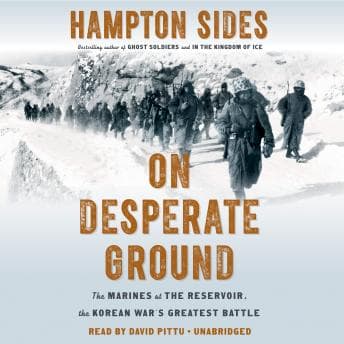

People talk about Hampton Sides like he's the gold standard for narrative military nonfiction. I've been skeptical. Ghost Soldiers was solid, but sometimes these bestselling civilian authors smooth out the ugly parts for a mass audience - lose the grit that makes war history honest. So I came into On Desperate Ground with my guard up.
Started this one at 0430 on a Tuesday. Couldn't sleep. Ranger curled up next to my desk chair while I knocked out threat assessments for a corporate client. By the time Linda came down for coffee at seven, I was genuinely furious at Douglas MacArthur. A man who's been dead since 1964. That's when I knew Sides had me.
MacArthur's Ego vs. 300,000 Chinese Soldiers
Let me cut to the chase - this book does something genuinely hard. It operates on two levels simultaneously: the strategic catastrophe unfolding at the command level, and the frozen, desperate, minute-by-minute reality on the ground with the Marines of the First Division. Sides shifts between MacArthur's delusional confidence on Wake Island - telling Truman the Chinese absolutely won't intervene, October 15, 1950 - and the 300,000 PLA soldiers already streaming across the Manchurian border while he's still talking. The dramatic irony is so thick it's almost unbearable when you know what's coming.
I've seen this scenario play out in real life. Senior leadership so committed to their narrative that ground truth becomes an inconvenience. MacArthur wasn't just wrong. He was catastrophically, arrogantly wrong, and young men paid for it with frostbitten limbs and their lives. Sides doesn't editorialize much. He doesn't need to. He just lays out the timeline and lets the facts do the indicting. The same toxic blend of ego and denial echoes in Presidents Club—a book that made me almost as angry at living presidents.
Twenty Below Zero and Still Fighting
Where this book earns its keep is the ground-level detail. Temperatures plunge to minus twenty degrees Fahrenheit, and Sides makes you feel it - weapons jamming because the lubricant froze solid, morphine syrettes that had to be thawed in a corpsman's mouth before injection, C-rations that were essentially frozen rocks. These aren't details you pick up recycling other history books. This is archival digging, interview work, the kind of primary source research that separates serious military history from Wikipedia summaries.
And here's what I respect most: Sides doesn't turn these Marines into superhuman action figures. He shows them scared, exhausted, making mistakes, losing friends - and still fighting their way through encirclement to the sea. That's harder to write than the Hollywood version, and it's more honest. If you've ever been in a situation where the mission has gone completely sideways and you're operating on adrenaline and training and not much else, this book will hit you somewhere deep. (It got me. Won't say exactly where, but Ranger gave me a look.)
Compared to Martin Russ's "Breakout," which covers the same battle, Sides gives you more of the command-level picture - the intelligence failures, the inter-service politics, the decisions made in warm rooms that determined whether men lived or died in frozen mountains. Russ is more of a pure grunt perspective. Both are worth your time, but Sides gives you the full operational picture. The audiobook format actually helps with the pacing of the back-and-forth between headquarters and the front line - those transitions feel natural in your ears in a way that can be jarring on the page.
David Pittu Behind the Mic
Pittu's narration is professional and emotionally invested without tipping into melodrama - which is the exact right approach for this material. He doesn't do theatrical voices for MacArthur or General O.P. Smith, but there's a clear emotional register shift when he moves between the command scenes and the combat sequences. You can practically feel the temperature drop in his delivery when Sides describes the reservoir. No mispronunciations that I caught, and for a book loaded with Korean place names and military unit designations, that's not nothing. He gets the rank structures right, the terminology right. Small things. They matter to people like me.
At 1.25x, Pittu's pacing was just about perfect across the 12-hour runtime. There were moments during the breakout sequences where I bumped it back to 1x because I didn't want to miss a single detail. That's always a good sign. Funny enough, I recognized his voice from my granddaughter's dog-eared copy of Sword Thief—the man's range is something else.
Who Needs This in Their Ears
If you care about military history - Korean War specifically, or just what happens when strategic arrogance collides with tactical courage - this is your book. If you've served, especially in conditions where the cold was trying to kill you as hard as the enemy, this one's going to land differently than it does for civilians. If you need constant action and can't handle the political and strategic setup in the early hours, stick with it. The payoff is worth the patience.
If military history just isn't your thing, this probably won't convert you. But it might. Sides writes people, not just battles.
Mission Accomplished, Hampton
Worth your time? Here's the debrief: On Desperate Ground is the rare military history that respects both the strategic complexity and the human cost equally. The author clearly did their homework - years of it - and Pittu delivers it with the right balance of gravity and restraint. The Frozen Chosin has been written about plenty of times, but I'm not sure it's been told better than this.
Ranger approved this one. So do I.






![Steve Jobs [unabridged audiobook] audiobook cover](/_next/image?url=https%3A%2F%2Fcovers.audiobooks.com%2Fimages%2Fcovers%2Ffull%2F9788499923406.jpg&w=1920&q=75)