
Everyone told me Ray Porter was wrong for this book. An American narrator voicing an English protagonist? I'd seen the complaints online, and honestly, I went in expecting to be annoyed. I teach kids who can't tell Dickens from Dostoyevsky, but even they'd notice if someone read Oliver Twist in a Texas drawl. So I braced myself.
I was wrong. Not completely wrong - I'll get to that - but wrong enough that I owe Porter an apology.
The Accent in the Room
Let's address it directly. Joseph Bridgeman is English. Ray Porter is not. And yes, for the first twenty minutes or so, my brain kept flagging this mismatch like a spell-check underlining a perfectly good British spelling. But here's what happened: Porter doesn't try to be English. He doesn't attempt some wobbly mid-Atlantic compromise. He just... commits to Joseph as a person, not a nationality. And somewhere around the time Joe gets pulled into the Continuum's orbit and starts dealing with this organization of time travelers from the future, I stopped hearing the accent gap and started hearing the character.
What's interesting - and this is where I think the complaints have a point they don't fully articulate - is that Porter gives Joseph a flatter vocal register than everyone around him. Gabrielle Green, the wisecracking partner who clearly wants nothing to do with Joe? She's got bite. Vinny, Joe's best friend? Warmer, livelier. It's like Porter reserved all his vocal fireworks for the supporting cast and left Joseph as this steady, slightly muted center. I think that's actually a deliberate interpretive choice - Joe is the observer, quite literally - but I can see how it reads as the narrator being less interested in his own protagonist.
1873 Paris Burns Better Than You'd Expect
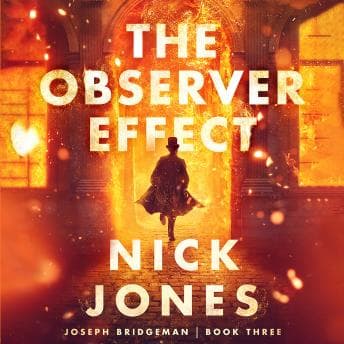
Nick Jones is from Stratford-Upon-Avon, which is about as English literary pedigree as you can get without being Shakespeare's actual ghost. And the man knows how to build a set piece. The nineteenth-century Paris sections are where this book earns its keep. Joe and Gabrielle hunting for a missing operative inside a burning opera house - that sequence had me standing still on the lakefront trail, Denise walking ahead without me, because I genuinely couldn't move and listen at the same time. The prose deserves to be savored there. Jones layers the sensory details - smoke, heat, the crack of timber - and Porter's pacing slows just enough to let the danger breathe.
But here's what really got me: the conceit that the missing traveler disappears the moment anyone observes him. The observer effect. It's right there in the title, and it's not just a clever name. Jones is playing with a genuine quantum physics concept and turning it into a plot mechanic, and it actually works. This reminds me of what Hemingway said about prose being like an iceberg - the dignity of movement comes from the seven-eighths underwater. The science fiction framework here is mostly underwater. Jones doesn't over-explain. He trusts you to keep up.
My students would hate this. I love it.
The Series Problem (And Why I Didn't Mind)
This is book two (or possibly three - the series numbering is a little opaque), and I came in cold. There are moments where the references to Amy's paintings and Joe's previous time-traveling adventures clearly carry weight I'm not fully feeling. Some subplot about a "familiar foe" threatening to trap them in the past felt like it was supposed to land harder than it did for a newcomer. I won't pretend I caught every thread.
But honestly? I've been teaching literature for twenty years. I've watched seventeen-year-olds pick up The Return of the King without reading the first two books and still cry at the ending. Sometimes you don't need every backstory beat. The emotional architecture here - Joe learning to trust Gabrielle, Gabrielle's antagonism slowly revealing itself as something more complicated - that stands on its own.
The narrator understands that pause is punctuation. Porter uses silence well in the quieter moments between Joe and Gabrielle, and those silences carry the weight of two people who don't like each other slowly figuring out they might need to.
Who Should (and Shouldn't) Queue This Up
If you loved 11/22/63 or the quieter episodes of Doctor Who - the ones where it's less about the time travel and more about the people doing it - this is its spiritual successor. Fans of time-travel fiction who want rules and stakes rather than wibbly-wobbly hand-waving will appreciate how the Continuum operates.
Skip it if accent authenticity is a dealbreaker for you. I mean that sincerely, not dismissively. Some readers need that, and Porter doesn't provide it here. Also skip if you need your sci-fi front-loaded with action - this is a slow build with a spectacular payoff, not a constant sprint.
Worth Pausing the Faculty Meeting For
Twelve hours at 1.0x speed. That's roughly six weeks of faculty meetings I could've spent with Joseph Bridgeman instead of pretending to care about the new attendance software. Porter's performance isn't flawless - the female characters occasionally tip into a slightly grating register that I think is interpretive rather than technical, and Joseph could use about fifteen percent more vocal personality. But the story itself? Smart, well-constructed time-travel fiction that trusts its audience. That's rarer than it should be. Another Country gave me that same feeling of being trusted as a reader - different genre entirely, but the same sense that the author isn't going to hold your hand through every plot turn.
I'm going back for book one. Denise says I can listen on our next lakefront walk. She's already heard me explain the observer effect three times this week. She's very patient.