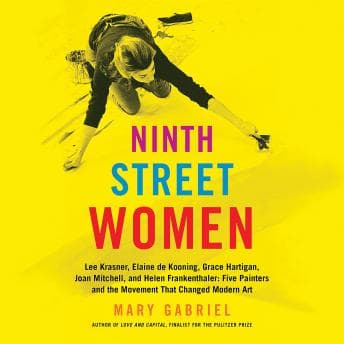

What happens when we finally tell the story of modern art from the perspective of the women who were actually there—not as muses, not as wives, but as painters with paint under their fingernails and ambition in their bones?
I started this nearly 39-hour commitment during a particularly brutal stretch of grading junior essays on The Great Gatsby. (If I read one more paper claiming Gatsby "really loved Daisy," I may lose my mind.) Something about Mary Gabriel's meticulous chronicle of five women fighting for recognition in the 1950s art world felt uncomfortably parallel to watching my female students still hesitate to speak up in class discussions. Some things change slower than we'd like to believe.
The Weight of Being Seen—And Overlooked
Here's what Gabriel does that most art history books don't: she refuses to let these women exist only in relation to their famous husbands or lovers. Lee Krasner isn't just "Mrs. Jackson Pollock"—she's the hell-raiser who was organizing artists before Pollock could even afford canvas. Elaine de Kooning isn't merely Willem's wife but the intellectual engine who could articulate what Abstract Expressionism meant when the artists themselves couldn't find the words.
The research Gabriel conducted is staggering. Lisa Stathoplos handles the dense material—the endless quotes from journals, interviews, critical writings—with steady, thoughtful emphasis. She knows when to let a devastating diary entry breathe. When Joan Mitchell's childhood wounds surface through her fierce, magnificent paintings, Stathoplos doesn't oversell it. She trusts the material.
That said, I understand why some listeners found her delivery occasionally "cutesy." There's a brightness to her tone that sometimes feels at odds with the rawer moments—the drinking, the fights, the genuine tragedy woven through these lives. But honestly? After 39 hours together, I grew to appreciate her consistency. She's not performing drama. She's delivering history.
Five Lives, One Revolution
This reminds me of what Hemingway said about Paris—how the city shaped a generation of writers who would change literature. That sense of place as character shows up differently in Life of Benjamin Franklin, where colonial Philadelphia becomes the backdrop for another kind of American reinvention. Gabriel makes the same case for New York's cold-water lofts and Cedar Tavern booths. These women weren't just painting; they were living a doctrine of liberation before anyone had the vocabulary for it.
Grace Hartigan abandoning her life as a New Jersey housewife and mother to pursue art—in the 1950s!—feels genuinely radical even now. Helen Frankenthaler, at twenty-three, creating work so original it launched an entirely new school of painting. Gabriel gives each woman her due without sanitizing the complications. These were difficult people living difficult lives. They drank too much. They made terrible romantic choices. They were sometimes cruel to each other.
The prose deserves to be savored. Gabriel writes with the authority of someone who spent years in archives and the passion of someone who genuinely loves her subjects. If you loved "Love and Capital" (her Marx biography that was a Pulitzer finalist), this is its spiritual successor—the same exhaustive research married to genuine narrative momentum.
The 39-Hour Question
Let's be honest about what you're signing up for: 39 hours is a commitment. This isn't background listening while you fold laundry. Gabriel's detail-rich approach rewards attention—the connections between personal lives and artistic breakthroughs, the way cultural shifts in postwar America shaped what these women could and couldn't achieve.
I listened during my lakefront walks with Denise, during late-night grading sessions, and yes, during at least two faculty meetings where Principal Martinez definitely noticed I wasn't paying attention. (Worth it.) The length never felt padded, but it does require patience. Gabriel is building something comprehensive, not punchy.
My students would hate this. Too long, too much context, too many names to track. I love it.
Who Should Listen—And Who Should Skip
If you want a quick primer on Abstract Expressionism, this isn't it. If you want to understand how five extraordinary women navigated a world designed to ignore them—and changed that world anyway—Gabriel has written the definitive account.
Art history enthusiasts, obviously. But also anyone interested in how creative women have always had to fight twice as hard for half the recognition. Anyone who's ever wondered what the wives and girlfriends of famous artists were doing while their partners got the retrospectives. (Spoiler: often making better work.)
Skip this if you need action or can't handle extensive historical context. This is a book for readers who believe understanding requires immersion.
Worth Pausing the Faculty Meeting For
Ninth Street Women won the NYU/Axinn Foundation Prize for narrative nonfiction, and it's easy to see why. Gabriel has rescued five essential artists from the footnotes of their husbands' biographies and given them the canvas they deserved all along. Stathoplos delivers nearly 40 hours without ever losing the thread.
Is it a commitment? Absolutely. Is it worth it? If you care about art, about women's history, about the stories we choose to tell and the ones we've ignored—yes. This is why we still read the classics, and why we need new ones that finally get the story right.





![Steve Jobs [unabridged audiobook] audiobook cover](/_next/image?url=https%3A%2F%2Fcovers.audiobooks.com%2Fimages%2Fcovers%2Ffull%2F9788499923406.jpg&w=1920&q=75)