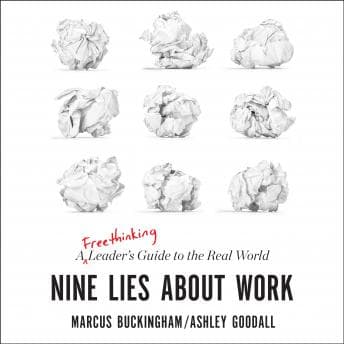

I was elbow-deep in a chicken tikka masala — the real kind, not the jarred stuff — when Buckingham hit me with Lie #1: "People care which company they work for." And I actually stopped stirring. Put the wooden spoon down. Because as someone who studies why people construct the narratives they do about their own lives, that sentence landed like a diagnostic question in a clinical interview. Simple on the surface, devastating underneath.
This is a fascinating case study in what happens when two organizational psychologists decide to burn down the conventional wisdom of corporate America, one sacred cow at a time. Nine lies. Nine chapters. Each one dismantling something your HR department probably has laminated on a poster somewhere.
The Psychology of Corporate Self-Deception
Here's what Buckingham and Goodall are really doing, even if they don't frame it this way: they're exposing the gap between espoused theory and theory-in-use. (Shoutout to Chris Argyris, who would've loved this book.) The lie about feedback is the one that had me practically yelling at my stove. They argue people don't want feedback — they want attention. And the research actually shows this tracks with what we know about positive psychology and strengths-based interventions. When you tell someone what's wrong with them, their brain literally shuts down the learning centers. When you tell them what's working, they lean in.
Compare this to something like Daniel Pink's Drive, which also challenges workplace orthodoxy but stays mostly in the motivation lane. Buckingham and Goodall go wider — culture, planning, goals, competencies, leadership itself. It's more ambitious. Whether it always earns that ambition is another question.
Some of the nine lies feel like genuine revelations. The distinction between a company's culture and a team's local reality? That's sharp. I found myself asking: why does every organization talk about culture as if it's a monolith when anyone who's worked in more than one department knows it's not? The protagonist exhibits classic — okay, there's no protagonist here, but the reader exhibits classic confirmation bias throughout. You'll nod along at the lies you already suspected and resist the ones that challenge your own assumptions. There's something worth sitting with in To Hell with the Hustle about why we cling so hard to the productivity structures we've built our identities around — the same psychological resistance Buckingham and Goodall keep bumping up against in their readers. I caught myself doing it with the goal-setting chapter. I like goals. I have a color-coded planner. Don't come for my planner, Marcus.
But other lies feel like they're overstating the case to make a point. The chapter on strategic planning being a lie, for instance — psychologically, this doesn't quite track for me. The argument that plans are less useful than real-time intelligence is valid, but calling planning itself a "lie" feels like provocation for provocation's sake. There's a difference between "this is overvalued" and "this is false," and the book sometimes blurs that line.
Two Authors, Two Voices — Literally
So here's where the audiobook format gets interesting. Both authors narrate, and the contrast is... noticeable. Buckingham has this lighter, almost musical quality to his voice — there's a lilt that keeps you moving through the business-speak without glazing over. He sounds like someone who's given a thousand keynotes and knows exactly when to pause, when to punch a phrase. Solid. Workmanlike in the best sense.
Goodall, on the other hand, has a deeper, more professorial tone with a nasal quality that — and I say this as someone who listens to a LOT of academic lectures — can drift into that zone where your brain starts composing grocery lists. It's not bad narration. It's just that when you're alternating between two voices across nine chapters, the energy differential becomes obvious. I found myself re-engaging every time Buckingham's sections came back, which tells you something.
My therapist would have thoughts about how I'm essentially rating these two men on vocal charisma while one of them is a Cisco SVP and the other is a bestselling researcher. But the audiobook format makes this a legitimate concern. You're stuck with the voice. There's no skimming.
Who Gets the Most Out of This (And Who Won't)
If you're a mid-career manager who's been quietly suspicious that your company's performance review system is garbage — this book will feel like vindication. If you're someone who's read Buckingham's earlier work (First, Break All the Rules, the StrengthsFinder stuff), this is an evolution of that thinking with a sharper edge.
If you want deeply specific, step-by-step implementation advice? This isn't that book. It's more diagnosis than prescription. Which, as a researcher, I respect — but I know it frustrates people who want the how after the why.
At just under nine hours, it's a solid commute companion. I'd recommend 1.25x speed, especially during Goodall's sections, not because they're bad but because the pacing benefits from a slight push.
My Clinical Notes
The author understands human nature — or at least understands organizational behavior well enough to poke holes in its most cherished assumptions. Not every lie lands with equal force, and the dual-narrator setup creates an uneven listening experience. But the core argument — that we've built our work lives around comfortable fictions instead of observable human behavior — is one worth sitting with. Even if your tikka masala burns a little while you do.