
"Silence is the new rebellion."
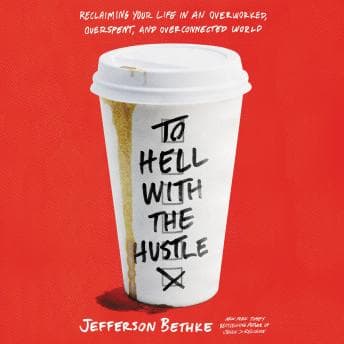
That line hit somewhere around hour two, and I actually paused the audiobook. Which is ironic, right? A book about slowing down, and I'm listening at 1.5x on a packed Caltrain at 6:47 AM, surrounded by other tech zombies checking Slack before we've even had coffee.
Bottom Line: Worth your commute if you're a burned-out knowledge worker who needs permission to stop. Skip if you're not into the Jesus stuff—it's front and center.
The Irony of Listening to This at 1.5x Speed
Look, I get it. Jefferson Bethke wrote a book about rejecting hustle culture, and here I am optimizing my consumption of it. But that's kind of the point he's making—we've so internalized the productivity mindset that even our attempts to escape it become another thing to optimize.
The book is basically Digital Minimalism but for Christians. If you're looking for the secular version of this argument with more actionable frameworks, Atomic Habits covers similar ground about building intentional systems instead of chasing productivity theater. Bethke argues that silence, solitude, obscurity, and vulnerability—the things our LinkedIn-obsessed culture treats as career poison—are actually the things that make life meaningful. He's not wrong. After two years of pandemic-era remote work bleeding into every waking hour, followed by return-to-office chaos, the message landed.
But here's where it gets complicated.
The Narrator Problem (And It's a Big One)
Bethke narrates his own book, which should feel intimate and authentic. And sometimes it does—there are moments where you genuinely feel like he's just talking to you, friend to friend. The personal anecdotes about his own burnout, his marriage, his kids? Those sections work.
The problem? His delivery is... frantic. Which is deeply ironic for a book about slowing down.
I found myself getting anxious listening to him. His pacing rushes through points like he's worried you'll click away to the next podcast. It's the verbal equivalent of those Instagram reels where people speed-talk through recipes. For a breakdown of why delivery matters as much as content, How to be Heard covers exactly that. I kept wanting to tell him: dude, you're literally preaching rest. Maybe demonstrate it?
I tried dropping to 1.25x, which helped somewhat. But the underlying energy is still there—a kind of breathless urgency that undercuts the message. It's like getting a lecture on meditation from someone who just did three espresso shots.
The Jesus Factor
Okay, so this needs to be addressed directly: this is a Christian book. Not "vaguely spiritual" or "mentions God occasionally." Full-on, Bible-quoting, Jesus-is-the-answer Christian.
If that's your thing, great. Bethke's faith perspective is genuine and he's not preachy in an aggressive way—he's more like that youth pastor who actually seems to care. But if you're looking for secular productivity advice, this isn't it. The framework is explicitly religious, and the solutions involve prayer, Sabbath-keeping, and spiritual disciplines.
I'm not particularly religious, but I grew up going to church with my grandmother, so the language didn't throw me. I could extract the practical bits about boundaries and digital detox while mentally translating the theology into secular terms. Your mileage may vary.
What Actually Stuck
The audiobook includes some extra content not in the print version, which is a nice touch. And despite my complaints about the narration, some ideas genuinely lodged in my brain:
- The concept of "productive obscurity"—that not everything needs to be shared, optimized, or monetized
- His point about how we've replaced boredom with constant stimulation, and how boredom is actually where creativity lives
- The practical stuff about setting phone boundaries (though nothing revolutionary if you've read other digital wellness books)
At 4 hours 15 minutes, the ROI is decent. I finished it in three commutes. It's not going to change your life, but it might give you permission to change a few habits.
Who This Is (and Isn't) For
If you're a burned-out professional who's also Christian, this is probably exactly what you need. The religious framework will feel natural, and the anti-hustle message will hit home.
If you're secular but curious, approach with realistic expectations. There's good stuff here, but you'll be doing mental translation work throughout.
Skip it if you're already anxious and the idea of a frantic narrator makes you twitchy—maybe grab the print version instead. Or listen at 1x with noise-canceling headphones in a quiet room. Not on a packed train at 6 AM like an idiot (me).
The Debug Report
This audiobook is like a well-intentioned function with a performance bug. The core logic is sound—hustle culture is destroying us, rest is radical, boundaries matter. But the execution (the frantic narration) creates an ironic mismatch with the message. It's not broken, but it could use some refactoring.
Would I recommend it? Conditionally. If you can tolerate the pacing issues and you're open to (or actively seeking) a Christian perspective on burnout, it's worth your time. If either of those is a dealbreaker, there are better secular alternatives.
Kevin asked me what I was listening to, and when I explained it, he just stared at me. "You're listening to an anti-productivity book... while optimizing your commute... at 1.5x speed."
Yeah. I'm aware of the irony. Maybe that's the whole point.









