
I was sitting in the kitchen at 11:30 PM, halfway through a stack of sophomore essays on "The Cask of Amontillado" — which, by the way, roughly a third of them spelled "Amontiyado" — when Joe Mantegna started reading "Popsy" in my earbuds and I genuinely forgot I was holding a red pen. That's the highest compliment I can pay a short story narration: it made me stop grading.
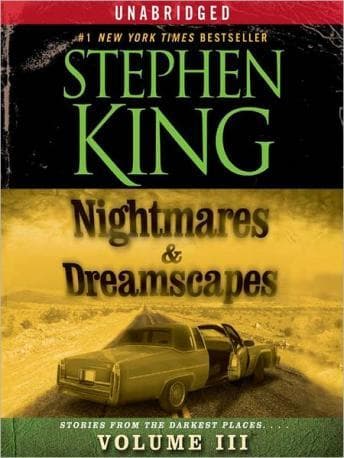
Let's talk about what King is really doing with this collection, because Nightmares & Dreamscapes as a whole is one of those projects where you can feel him cleaning out the workshop. Some of these stories are precision instruments. Others are... well, they're the stuff he found in the back drawer. Volume III gives you both, and the multi-narrator format means each story arrives with its own personality, for better and occasionally for worse.
Mantegna Owns "Popsy" and It's Not Even Close
If you listen to this collection for one reason, make it Joe Mantegna's reading of "Popsy." The man brings this grimy, desperate energy to the kidnapper character — there's a specific weariness in his delivery, like he's narrating from a barstool at 2 AM, confessing to someone he barely knows. When the story pivots from crime thriller to something much darker and stranger, Mantegna doesn't oversell the turn. He just... lets it happen. The narrator understands that pause is punctuation. The gap between the kidnapper's confidence and the reader's growing dread is where the horror lives, and Mantegna parks right in that gap.
Compare that to some of the other readings in this volume, and you start to notice an unevenness. Gary Sinise is a fine actor — nobody's questioning that — but his narration here feels more studied, more careful. It's competent without being electric. Joe Morton, who's won enough AudioFile Earphones Awards to fill a shelf, delivers with professional warmth, but I found myself wanting him to push harder into the uglier corners of King's prose. King's stories aren't polite. The best narrators of his work shouldn't be either.
When King Reads King, You Get the Weird Uncle at Thanksgiving
And then there's Stephen King reading his own work. This is always a polarizing thing. His voice is nasal, his pacing is idiosyncratic, and he sounds exactly like a guy from Maine telling you a story in a hardware store parking lot. Which is — honestly? — kind of perfect for certain stories. There's an authenticity there that trained actors can't replicate. He wrote these sentences. He knows where the stress falls because he put it there. But I won't pretend it's smooth listening. It's like hearing a songwriter perform their own ballad slightly off-key. You believe them more, but you wince a little.
The story selection itself is a mixed bag, and I think that's where the honest conversation needs to happen. "The Night Flier" is peak King — a vampire story filtered through tabloid journalism, sleazy and smart. "You Know They Got a Hell of a Band" takes one of those "too-perfect small town" setups and populates it with dead rock stars, which is the kind of premise my students would love if they ever read anything longer than a TikTok caption. "It Grows on You" is a quieter Castle Rock piece, the kind of story that rewards patience with atmosphere rather than payoff. My students would hate this. I love it.
For a King novel that sustains its momentum from start to finish, 11/22/63 is the one I'd hand to anyone who thinks he can't do long-form.But the back end of the volume drags. I felt it around hour six — that specific kind of listening fatigue where you realize you've been on autopilot for ten minutes and need to rewind. The final stories don't have the same bite. Not bad, exactly, but they feel like the B-sides they are. King's short fiction has always been uneven; the difference between "The Jaunt" and some throwaway in a collection is the difference between lightning and a desk lamp.
Eight Hours, Four Narrators, and the Anthology Problem
Here's the thing about short story audiobooks: they live or die on transitions. You finish one world, get dumped into another, and the narrator changes on you. It's disorienting in a way that novel audiobooks never are. Volume III handles this better than most — the narrators are distinct enough that your brain recalibrates quickly — but it also means your experience depends heavily on which stories grab you. If "Popsy" and "The Night Flier" are A-tier and the closing stories are C-tier, your memory of the whole collection skews based on what you heard last. And what you heard last here is... fine. Just fine.
Worth pausing the faculty meeting for? Parts of it, absolutely. The whole thing? I'd say it's worth your time if you're already a King reader who wants to hear how professionals interpret his voice. If you're new to King's short fiction, start with Volume I — or better yet, go read "The Jaunt" and "Children of the Corn" and then come back.
Who Gets the Assignment
King completists and short fiction fans will find enough here to justify the listen. The Mantegna performance alone is worth the price of admission. But if you're credit-conscious and you haven't listened to the earlier volumes, this isn't where you start. And if horror anthology pacing tends to lose you — if you need a single sustained narrative — this format might test your patience by the end.
Me, I'll keep Mantegna's "Popsy" in rotation. The rest I can let go. Sometimes a collection is really just two or three great stories wearing a trench coat.