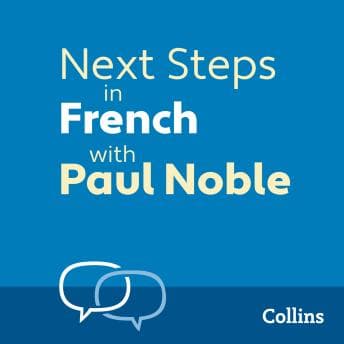

This is not a fantasy audiobook. I know. I know. But hear me out — I've been trying to learn Spanish for two years because half my D&D group switched to playing in Spanish on off-weeks (long story involving a study abroad semester and a betrayal arc), and Paul Noble's beginner course actually got me somewhere. So when I saw the intermediate follow-up, I grabbed it. Listened to the whole thing over a week of doing laundry, grocery runs, and yes, procrastinating on my thesis. Dr. Patel would be proud that I'm at least learning something.
The No-Failure Magic System (It's Basically Progression Fantasy for Language)
Here's the thing — Paul Noble's method reminds me of a well-designed progression system in LitRPG. You start with a few building blocks, he layers on new vocabulary and grammar structures, and suddenly you're constructing sentences you couldn't have imagined at hour one. The progression is satisfying. He'll teach you a pattern like "I would like to" and then spend the next twenty minutes having you combine it with everything you already know until your brain just... does it automatically. No conjugation tables, no "repeat after me" drills that make you feel like a parrot. He explains why Spanish works the way it does, and for someone whose brain is wired to understand systems (thanks, Sanderson), that approach clicks hard.
The structure is basically: Paul introduces a concept in English, explains the logic behind it, gives you the Spanish, then has you build increasingly complex sentences by combining new material with old. It's iterative. It's methodical. And it works — by hour five, I was muttering conditional sentences while sorting my board game shelf by BGG ranking.
Where the Editing Rolls a Nat 1
Okay, so there's a real problem with the review sections at the end. Paul will prompt you to translate a sentence, and the pause he gives you is — I'm not exaggerating — maybe two seconds. Two. For sentences that are sometimes eight or nine words long with verb conjugations you learned forty minutes ago. You basically have to speak at auctioneer speed or just accept that you'll be talking over him when he gives the answer. I found myself smashing the pause button constantly during these sections, which kills the flow. This is clearly an editing issue, not a Paul Noble issue, because the pacing during the teaching portions is perfect — relaxed, unhurried, generous with silence. But whoever cut the review segments together apparently thought we were all speed-running Duolingo.
The repetition is the other thing. And look, I understand why it's there. Spaced repetition is how language sticks. But by the third time Paul asks you to say "I would like to go to the restaurant with you this evening" with minor variations, you start to feel like you're grinding XP in a mid-tier MMO. Some listeners will find this reassuring — the confidence-building aspect is real. Others will want to claw their ears off. Know thyself.
What's Missing From the Character Sheet
The biggest gap: there are no native Spanish speakers in this course. It's just Paul, speaking clearly and slowly in his English accent, giving you Spanish phrases. Which is great for comprehension and confidence-building, but it means you never hear Spanish spoken at native speed, with native rhythm, with the kind of casual contractions and slang people actually use. It's like learning combat mechanics from a rulebook without ever rolling initiative. That gap between knowing the rules and surviving actual contact with the chaos is something Darkstalker captures surprisingly well — all that accumulated power and knowledge, and still completely blindsided when the real world doesn't follow the expected script. You'll know the theory, but the first time a native speaker fires rapid Castilian at you, you're going to feel like a level-1 character walking into a dragon's lair.
I also wanted more everyday conversational scenarios. Paul covers useful stuff — restaurants, travel, expressing opinions — but there's not much about, say, chatting with neighbors, or arguing about fantasy books at a party. (Okay, that last one might be niche.) The scenarios feel a bit textbook-safe.
Who Rolls Advantage, Who Rolls Disadvantage
If you did Paul Noble's beginner course and liked his style, this is the obvious next step and it delivers on what it promises. If you're an auditory learner who wants to practice during commutes or chores, it's genuinely useful — I retained way more from this than from any app. If you want immersive native-speaker dialogue or a course that pushes you into uncomfortable territory, look elsewhere. And if repetition makes you twitchy, maybe pair this with something else so you're not grinding the same phrases for seven hours straight.
Rolling for My Thesis Instead
Paul Noble won't make you fluent. He's very clear about that, to his credit. But he will make you functional and — more importantly — confident enough to actually try speaking. The magic system here is simple, logical, and well-structured. The execution has some rough edges, especially those rushed review pauses. But as someone who'd rather listen to 40 hours of Stormlight than study grammar tables, the fact that I stuck with all seven hours and came out the other side actually speaking better Spanish? That's a win. Now if only someone would make a Paul Noble course for "how to write a thesis on procedural generation." I'd listen to that tomorrow.