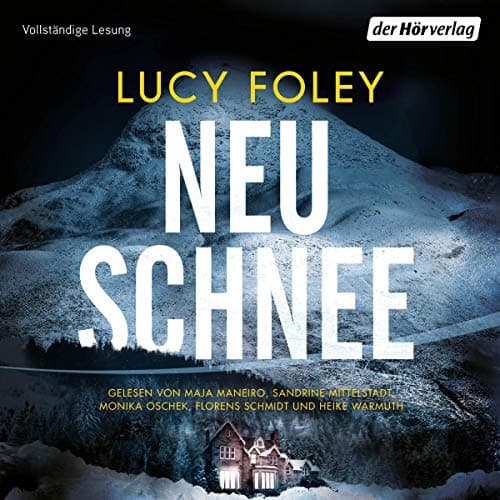

Nine friends, one remote Highland lodge, a blizzard, and a body in the snow. Lucy Foley's Neuschnee is not reinventing the locked-room thriller. It knows that. And honestly? It doesn't need to.
I was on the treadmill at the NYU gym at like 11 PM - the only person in there besides a guy doing deadlifts with headphones so loud I could hear his music over mine - when the first real crack in the friend group started showing. The careful politeness between characters dissolving into something ugly. I bumped the speed down from 1.5x to 1x because I wanted to catch every shift in tone. That's a compliment from me.
Nine Friends, Five Narrators, and the Lies Between Them
The five-narrator setup is doing heavy lifting here. Florens Schmidt, Maja Maneiro, Heike Warmuth, Sandrine Mittelstädt, and Monika Oschek each anchor a different perspective, and the rotation keeps the claustrophobia from going stale. What works - genuinely works - is how each narrator captures a slightly different register of denial. These nine people are lying to each other, but also to themselves, and you can hear it in the vocal performance. One narrator will deliver a memory with warm certainty while another narrator's version of the same event carries this edge of barely-concealed resentment. The German narration is clean and professional; no one is stumbling over the Scottish Highland setting descriptions or the occasional English loan words.
But here's the thing - five narrators for nine characters still means some voices are doing double duty. And the differentiation between supporting characters within a single narrator's chapters can get blurry, especially during the party scenes where everyone's talking over each other. I had a few moments where I genuinely lost track of who was speaking. Not a dealbreaker, but at 1.5x speed on a crowded subway? You'll miss things.
The Blizzard Does the Work Foley's Plotting Doesn't Always Do
Let me be real: the atmosphere in this book is excellent. The Highlands setting - the isolation, the snow cutting them off, the mention of a serial killer possibly roaming outside - all of it builds genuine dread. Foley is good at environmental tension. She understands that being trapped with people you supposedly love is scarier than being trapped with strangers.
What she's less good at is pacing the reveals. The "long-buried secrets" drip out in a pattern that becomes predictable once you're a few hours in. Someone acts weird. A narrator hints at something dark. Another chapter passes. Another hint. By hour five or six, I wanted to grab the characters and say just SAY it. The medical details are sparse - there's a body found in the snow and the cause of death stuff is handled lightly enough that I didn't have anything to yell at my phone about, which is either a mercy or a missed opportunity depending on how you look at it. As someone who's actually run a code, I can tell you that death in fiction often feels too clean. Here it feels... decorative. The body is a plot device more than a person.
The group dynamics are where the book earns its keep. The class tensions, the old university friendships gone sour, the couples hiding cracks beneath Instagram-perfect surfaces. Katabasis does something similarly brutal with a tight group under pressure - the slow erosion of trust hits the same nerve. There's a particular thread about loyalty versus self-preservation that hit me in a way I wasn't expecting - maybe because I've watched people in crisis reveal who they really are at 3 AM in an ER. Foley captures that ugly truth: when survival instincts kick in, friendship is the first thing people sacrifice.
Who Gets Left Out in the Cold
Pick this up if you want a solid atmospheric thriller in German with strong production value. Skip it if you need your mysteries to have genuinely surprising twists - the whodunit element landed with less impact than the character work that built up to it. The translation by Ivana Marinović reads smoothly in audio; nothing felt clunky or forced in the German rendering, which is not always the case with translated thrillers. The Final Gambit is another one where I cared more about the relationships than the reveal - and that's not necessarily a criticism of either book.
At 9 hours and 6 minutes, it's a good length for this kind of story. Not bloated. The multi-narrator format keeps things moving even when the plot stalls.
Between Shifts and Salah - My Honest Take
This kept me going through a rough week of rotations. It's not going to change your life. It's not breaking new ground. But Foley understands group dynamics under pressure, and the five narrators give the audiobook a theatrical quality that the print version probably can't match. I wanted more teeth in the resolution - the ending felt a little too tidy for all that buildup - but the journey through the snow was worth the cold.
My mom would not care about this book at all, but she'd be glad I was listening to something in a language I'm trying to keep up with instead of doomscrolling between prayers. That counts for something.