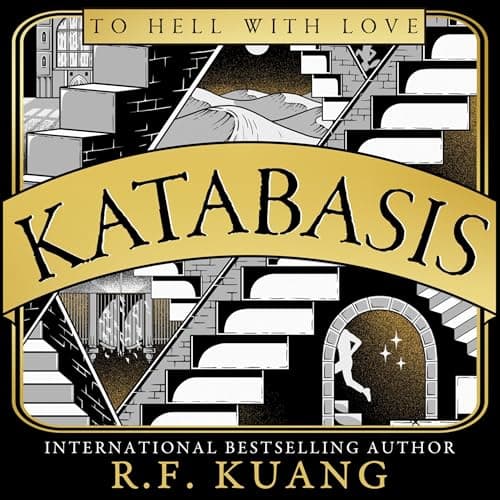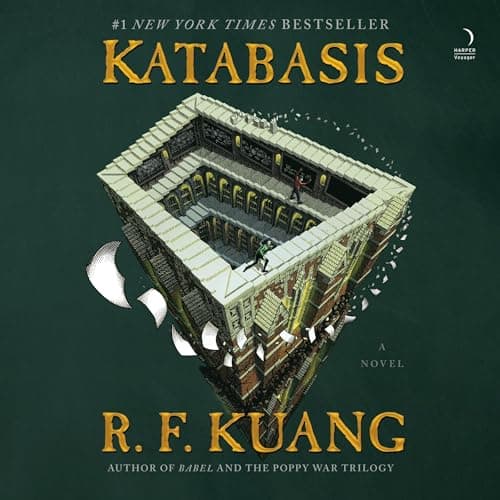

Can we talk about how R. F. Kuang has basically weaponized the PhD experience? Because I spent a good chunk of Katabasis wanting to scream at Alice Law — not because she's poorly written, but because she's so painfully, recognizably the worst version of academic ambition that I've ever encountered in fiction. This woman literally descends into Hell for a recommendation letter. And the thing that made me furious? I understood her completely.
Katabasis takes the ancient Greek concept of the hero's underworld journey and drops it squarely into the corridors of Cambridge, where two graduate students — Alice and Peter — discover that their professor, Jacob Grimes, has died in a magical accident that may or may not be Alice's fault. His soul is in Hell. His recommendation letter is not yet written. So naturally, armed with chalk, spite, and an encyclopedic knowledge of Orpheus and Dante, they go after him.
I listened to this over several late-night sessions, earbuds in, lights off, and I think that was the right call. The atmosphere Kuang builds is extraordinary — her version of Hell isn't fire and brimstone but something more unsettling, more academic, more like the soul-crushing institutional machinery that grinds people down in the real world. It's Hell as metaphor for the systems that consume brilliant people and spit out husks, and it works disturbingly well.
Morag Sims and Will Watt deserve serious credit for what they pull off here. Sims narrates Alice with this cutting blend of sarcasm, vulnerability, and barely-contained dread that had me wincing in recognition. There's a particular quality to how she delivers Alice's internal monologue — studious and sharp on the surface, fraying at the edges underneath — that the text alone might not convey as effectively. Will Watt's Peter is a perfect counterpoint: brittle, simmering with his own brand of desperation, refusing to show weakness even as the literal landscape of damnation closes in around him. The dual narration isn't just a gimmick; it creates genuine emotional contrast and keeps the eighteen-plus hours from ever blurring into monotony.
Now, here's where I have to be honest about some friction. Kuang loves her tangents. She loves her asides, her philosophical detours, her extended riffs on the nature of knowledge and sacrifice and whether academia is worth the psychological damage it inflicts. I happen to find most of this fascinating — the woman has genuine things to say about institutional power, about how we confuse suffering for meaning, about the gap between what we think we're chasing and what we actually need. But I can absolutely see how listeners who want the plot to move might start grinding their teeth around hour ten. There were moments where I thought, "Yes, R. F., I get the metaphor, can we please walk through the next circle now?"
The magic system is genuinely inventive — chalk-drawn pentagrams, incantations rooted in classical scholarship, spells that demand intellectual precision rather than raw power. It fits the setting perfectly and gives the whole enterprise a grounded, almost procedural quality that balances the wilder supernatural elements. When the magic fails or misfires, it feels consequential because you understand the rules.
What kept me locked in, ultimately, was the relationship between Alice and Peter. They're rivals, they're mirrors, they're two people who have sacrificed enormous amounts of themselves to the same altar of academic achievement, and watching them navigate Hell together — forced to cooperate, forced to confront what they've become — is genuinely absorbing. Their dynamic evolves in ways that feel earned rather than formulaic. The audiobook format intensifies this because you're literally hearing two different people, two different voices, slowly converging and diverging and converging again.
Compared to Babel, which hit me like an emotional freight train, Katabasis operates on a different frequency. It's more contained, more inward-looking, perhaps less devastating but more psychologically precise. If Babel was about the violence of empire, Katabasis is about the quiet violence we do to ourselves in pursuit of validation from systems that don't care about us. Both land, but differently.
This is a dense listen. The academic jargon is thick, the philosophical conversations demand actual attention, and it rewards focus rather than casual background listening. If you've ever stayed up too late working on something you're not sure matters anymore, if you've ever sacrificed your wellbeing for someone else's approval, if you've ever wondered whether the entire structure you've built your life around might actually be a very elegant kind of Hell — this book will get under your skin and stay there. Skip it if you need brisk pacing or if philosophical tangents make you restless; this one won't meet you halfway on that front. I kept thinking about how Outlander also uses an impossible journey — physical and psychological both — to strip a character down to what they actually value, though Kuang's version is considerably less romantic and considerably more likely to make you question your career choices.