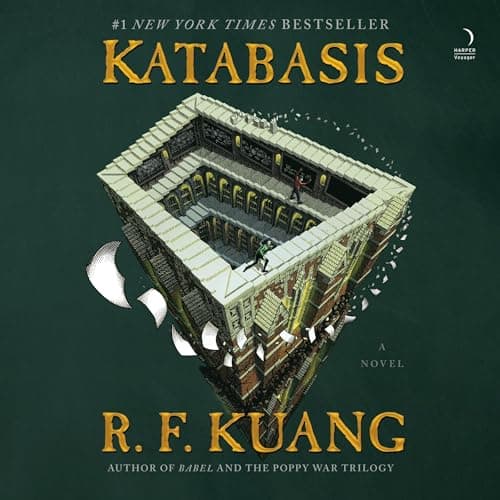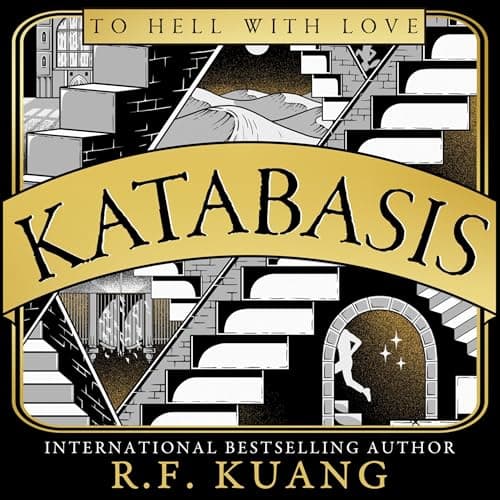

People are calling Katabasis a romp. I listened to big chunks of it while snowshoeing a wind-scoured ridge above my cabin, powder squeaking underfoot, and what I kept thinking was: this is less a romp than a very smart panic attack with infernal paperwork.
That's not a complaint. Not exactly.
R.F. Kuang takes the old descent-into-Hell structure and runs it through grad school ambition, academic abuse, rivalry, and the kind of intellectual self-justification that can make two brilliant people sound like they're both defending dissertations at knifepoint. Alice Law wants to be the brightest mind in analytic magick. Her path there depends on a dead professor now residing in Hell. So she goes after him. With Peter Murdoch. Her rival. Which is already a setup I'm predisposed to like, because desperation and bad company make for good fantasy.
where this book bites
The strongest thing here is the central pressure system: Alice and Peter are not just enemies-to-reluctant-allies in some generic sense, they're trapped in a hierarchy of scholarship, need, and ego. That changes the emotional weather. Every exchange has that brittle edge of people who know exactly how to wound each other because they speak the same language - not just English, but academia. Status. Citation-brain. Obsession.
And Kuang knows that world from the inside. You can hear it in the philosophical tangents, the academic jargon, the way ambition is treated as both engine and poison. For some listeners, that density is going to be the whole appeal. For others, it's where the book starts feeling like it's circling its own arguments. I get both reactions. There were stretches where I was fully locked in, especially when Hell's upside-down rules started pressing against Alice's need to make everything legible and rational. And there were stretches where the asides piled up and I wanted somebody - anybody - to stop theorizing and move.
Still, the premise holds. A dead mentor in Hell. A rival you may need more than you hate. A descent shaped as much by intellectual vanity as by dark magic. Specific enough to feel like its own creature.
voices in the underworld
Morag Sims is the reason I'd point people toward the audio edition instead of just the print. Her Alice has briskness without turning glib, and she catches three key frequencies at once: sarcasm, dread, and that humiliating little thread of hope you hear when a hyper-competent person realizes competence may not save them. That balance matters. If Alice were played as pure sharpness, she'd get exhausting fast. Sims lets the vulnerability leak through at the right moments.
Will Watt as Peter is more divisive, and I get why. His voice for Peter has that brittle, simmering, slightly slick quality that some listeners are absolutely going to call slimy. I don't think it's a failure, exactly. It fits a character who seems built to provoke eye-rolls and defensive posture. But it is a choice, and if that vocal texture hits your ear wrong, you'll feel it for 18 and a half hours. Nature doesn't forgive mistakes. Neither do I. And while this isn't a mistake, it is a gamble.
The two-narrator setup does help sharpen the rivalry. You feel the contrast between Alice's studious urgency and Peter's more abrasive edge. No gimmicky production, no music, no sound effects trying to sell you Hell. Just clean audio and performance. Honestly, good call. This book needs clarity more than drama pasted on top.
when the book argues with itself
What surprised me is that Katabasis worked better for me as an audiobook when I gave it full attention, and worse when I tried to let it run in the background while splitting kindling or doing stove maintenance. This is not casual listening. Miss one philosophical turn or one piece of infernal logic and you can still follow the plot, sure, but you lose the thing the book is actually doing.
That's the trade. You get a fantasy built on ideas - academic ambition, power, mentorship, the way institutions warp love and loyalty - but you give up propulsion. Some listeners wanted more emotional devastation, especially compared with Kuang's previous work. I felt that too. Climate grief hit different in this one, weirdly not because the book is about climate at all, but because it understands a related sickness: building your whole self around systems that are consuming you and still asking for your best work. That part landed.
What didn't always land was momentum. Hell should feel unstable and dangerous, and sometimes it does - spectral chills, dark magic, the sense that the rules are wrong in a way that could kill you. But sometimes the narrative heat drops while the conversation keeps elaborating. If you like fiction that thinks out loud, you may be thrilled. If you need the underworld to keep swinging a club at your head, you may get impatient.
who should listen (and who should skip)
You should pick this up if you want fantasy that treats scholarship as blood sport, if you enjoy rivals forced into cooperation, and if you don't mind stopping your hike to rewind a paragraph because the argument mattered. I literally did that on a drifted switchback - pulled off a glove, backed it up thirty seconds, listened again.
Skip it if you need clean forward momentum, if academic jargon makes your eyes glaze over even in audio form, or if a narrator voice that reads as intentionally off-putting is a dealbreaker. I had a similar reckoning with Cold Paradise, where the pacing asked more patience than the payoff fully earned. Also skip if you want Kuang at maximum emotional wreckage. This one is more cerebral than shattering.
my trailhead take
Katabasis is ambitious, heady, and more prickly than pleasurable. I admired it more than I loved it - but I did admire it, genuinely. Morag Sims gives Alice the right kind of steel, Will Watt will either work for you or absolutely not, and the book's best idea is that Hell is only half the problem. The other half is academia.
I'd say borrow it or catch it on sale unless that premise already has claws in you. Then sure, descend.