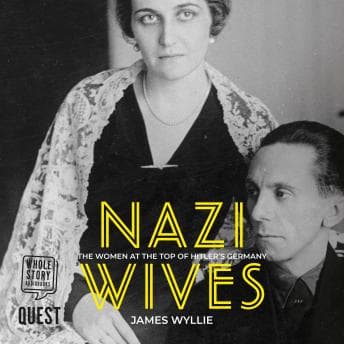

"She poisoned them one by one." Magda Goebbels, six children, cyanide capsules crushed between their teeth. I was sitting in my home office around 2300, Ranger asleep at my feet, and that section hit me like a breaching charge. Not because it was new information - I knew the broad strokes - but because Wyllie builds to it with such methodical detail about Magda's motherhood, her public image, her absolute devotion to the regime, that when you finally arrive at that bunker scene, you understand the twisted logic that got her there. And that understanding is what makes your skin crawl.
Let me cut to the chase: this is a solid, well-researched history that uses an underexplored angle - the wives - to illuminate the Third Reich's power dynamics in ways I genuinely hadn't considered before.
Seven Women, Seven Windows Into the Machine
Wyllie structures this around the wives of Goering, Goebbels, Himmler, Heydrich, Bormann, and Hess - plus Eva Braun hovering over everything like an awkward dinner guest nobody quite knows how to seat. What surprised me was how different these women were from each other. Lina Heydrich comes across as a true believer, arguably more ideologically committed than her husband in the early years, pushing him toward the SS when his naval career collapsed. Margaret Himmler, by contrast, reads as a dowdy, bitter woman who got left behind as her husband rose - their marriage basically dead by the mid-1930s while Heinrich was off orchestrating genocide and carrying on with his secretary.
The social jockeying is where the book really finds its footing. These women competed for Hitler's attention and approval with the pettiness of a military spouse hierarchy on steroids - and yes, I've seen that scenario play out in real life, though obviously with dramatically lower stakes. Emmy Goering throwing lavish parties while Magda Goebbels positioned herself as the regime's ideal mother. Gerda Bormann writing letters to her husband essentially encouraging his affairs because it aligned with Nazi breeding ideology. That last detail - Gerda actively promoting polygamy for ideological reasons - was something I'd never encountered, and it stopped me cold.
Where the Formation Gets Loose
Here's where it lost me at times: Wyllie is tracking seven women across roughly twenty-five years, and the narrative can feel like a patrol with too many waypoints. You'll be deep into Magda's complicated relationship with her stepfather, then suddenly you're with Carin Goering's health decline, then jumping to Ilse Hess's isolation. The chronological approach means you're constantly context-switching. Around the middle third - maybe hours four through six - I found my attention drifting, which doesn't happen often at 1.25x.
The book could've used more depth in fewer places rather than trying to give equal time to everyone. Lina Heydrich and Magda Goebbels are by far the most interesting subjects here. Lina because she survived the war and spent decades afterward essentially defending her husband's legacy with zero remorse - she ran a restaurant on property the Czech government kept trying to reclaim, defiant to the end. Magda because her story is genuinely tragic in the classical sense: a woman of real intelligence who chose evil and followed it all the way to murdering her own children. The others - particularly Ilse Hess and Margaret Himmler - feel thinner, more like sketches than portraits.
What the author clearly did his homework on is the post-war period. The Nuremberg section and the aftermath - Emmy Goering's denazification trial, the various levels of denial these women maintained for decades - is probably the strongest part of the book. It's easy to write about the rise and fall. It's harder and more valuable to document the delusion that followed.
Dalya Raphael Behind the Mic
Raphael does clean, professional work here. Her pacing matches the material well - measured but not plodding. She handles the German names and terminology without stumbling, which matters more than you'd think in a book where you're hearing "Reichsführer" and "Obersalzberg" every few minutes. No dramatic vocal shifts for different characters, but this isn't that kind of book. It's history, and she treats it that way. Solid B+ performance - nothing that pulled me out of the narrative, nothing that made me rewind to catch something she'd mangled.
No sound effects, no music, just a single narrator doing her job well. Clean production throughout.
Who Needs This in Their Rotation
If you're a WWII history reader who's already consumed the major works on the Reich's leadership and wants a genuinely different perspective, this delivers. It's not a deep dive on any single figure - think of it more as a reconnaissance sweep across unfamiliar terrain. You'll come away with a much better understanding of the domestic ecosystem that surrounded these men.
If you're looking for a tight, propulsive narrative, you'll get frustrated by the structural sprawl. And if you need your history books to be emotionally distant and clinical - this one isn't that. The Magda Goebbels sections in particular are devastating.
Worth your time? Here's the debrief: at nine and a half hours, it's a reasonable commitment for what you get. Not every section earns its real estate, but the best parts - Lina Heydrich's cold-blooded pragmatism, Magda's final hours, the post-war denial - those hit hard. Ranger slept through most of it, but he perked up when I said "what the hell" out loud during the Gerda Bormann letters. Fair enough, buddy. Fair enough. Mobituaries scratched a similar itch for me - that same instinct to look at history sideways, through the people who don't usually anchor the headline.







![Steve Jobs [unabridged audiobook] audiobook cover](/_next/image?url=https%3A%2F%2Fcovers.audiobooks.com%2Fimages%2Fcovers%2Ffull%2F9788499923406.jpg&w=1920&q=75)