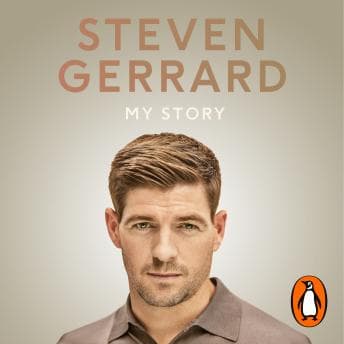

Okay, I need to get something off my chest: I am not a football person. Like, at all. The closest I get to sports is yelling at the TV during the World Cup because my tía insists we all gather and I'm mostly there for the food. So when my client - a diehard Liverpool fan building a sports podcast brand - asked me to listen to this so I could "get the vibe" for his visual identity, I rolled my eyes so hard Frida knocked a pen off my desk in solidarity.
And then Istanbul happened.
The Night That Wrecked Me at 2 AM
Let me set the scene: it's stupid-late, I'm adjusting kerning on a logo that refuses to cooperate, and Michael Ryan is narrating Steven Gerrard's account of the 2005 Champions League final. Liverpool down 3-0 at halftime against AC Milan. And the way Ryan delivers this section - the desperation, the refusal to quit, the raw disbelief when the comeback actually materializes - I stopped working. Just stopped. Hands off the keyboard, staring at my second monitor like it was a confessional.
I ugly-cried. At a football memoir. Me. The woman whose sports knowledge peaks at knowing Messi is short.
Because here's the thing: you don't need to care about football to feel a man describing the moment he refused to let his city down. Gerrard doesn't write about tactics in that section (well, he does, but the emotion bulldozes right through it). He writes about looking at the Liverpool fans who'd traveled to Istanbul, fans who were crying in the stands at halftime, and deciding he couldn't let their journey be for nothing. MY HEART. My abuela would have understood that - she didn't know a thing about football either, but she knew everything about fighting when everyone's already counted you out.
Michael Ryan's Liverpool Accent Is a Whole Mood (With Caveats)
So the narrator situation is... complicated. Michael Ryan commits fully to Gerrard's Scouse accent, and when it works, it really works. The narration genuinely feels like Gerrard is sitting across from you in a pub, pint in hand, telling you about his life. That authenticity is the audiobook's greatest weapon - you forget you're listening to someone else's voice.
But - and this is a real but - there were stretches where I had to rewind because I genuinely could not parse what was being said. Certain words got swallowed by the accent, especially during faster passages where Ryan picks up momentum. I'd be locked in, emotionally invested, and then suddenly: audio blur. It happened maybe five or six times across thirteen hours, which isn't catastrophic, but each time it yanked me out of the moment like someone pulling the headphone cord. If English isn't your first language or you're not used to Liverpool accents, this could be a bigger problem than it was for me.
The emotional delivery, though? When Gerrard talks about the slip against Chelsea - that moment that cost Liverpool the league title - Ryan's voice gets quieter, tighter, like he's physically holding something back. You can hear the shame and the grief compressed into how carefully each sentence lands. That's not just reading. That's performing someone else's worst memory with respect.
When a Football Book Becomes a Book About Loyalty
What surprised me most is that this isn't really a sports book. I mean, it IS - there's plenty of match analysis and tactical stuff that went over my head like a free kick over a wall (see, I know one football thing). But underneath all of that, this is a book about what it means to stay. Gerrard spent his entire career at Liverpool when he could have gone to Chelsea, to bigger money, to shinier trophies. And he's honest about how close he came to leaving. He doesn't pretend it was easy or simple or noble.
That tension - between loyalty and ambition, between what you owe the place that made you and what you owe yourself - that's universal. Shonda Rhimes wrestles with a different version of this in Year of Yes - what you owe yourself versus what fear tells you to protect. That's my mom choosing to stay in San Antonio near Abuela instead of taking a better job in Dallas. That's me choosing freelance chaos over a stable agency gig because Austin is home and my cats would stage a coup if I moved them.
The book drags in places, I won't lie. There are stretches in the middle - around hours 6 through 8 - where the match-by-match recounting feels like reading someone's very detailed diary entries about work. Important to Gerrard, sure, but I zoned out and started actually focusing on my design work instead of being pulled into the story. At thirteen hours and thirty-nine minutes, this could've been tighter.
But every time I started to drift, Gerrard would hit me with something personal - his relationship with his family, his fear of failure, the weight of being captain - and I'd be right back.
Who Gets a Ticket and Who Stays Home
If you're a Liverpool fan, you probably already own this. Go listen, it's your story too. If you're a general football fan, it's absolutely worth your time - Gerrard's honesty about other players and managers is genuinely surprising.
But if you're like me - a non-sports person wondering if this is worth thirteen hours of your life - the answer is a cautious yes, IF you care about stories of loyalty, identity, and what it costs to be the person everyone depends on. Skip through the tactical deep-dives if they bore you. The human stuff will find you.
Just maybe don't listen at 2 AM when you're already emotionally compromised by a stubborn logo. Frida gave me the most judgmental look when she caught me crying over a footballer.
Diego didn't even wake up. Typical.