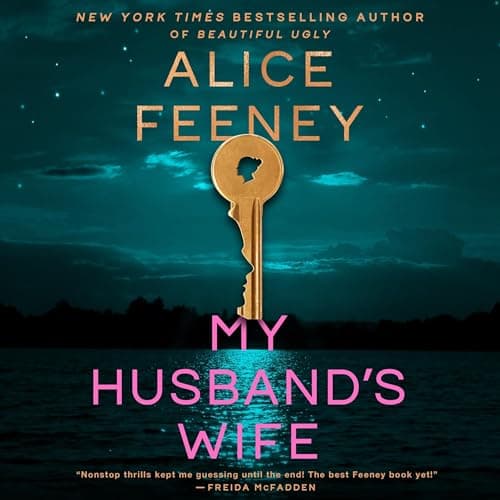

The rain had just started tapping the tin edge of my porch roof when Eden came home from her run, slid her key into the lock, and found that it no longer belonged to her own front door. I had my sweet tea sweating beside me, dogwoods darkening in the dusk, and I actually sat up straight. Because that is the kind of opening that makes the body listen. Then the woman on the other side of the door - eerily similar, not quite mirror and not quite stranger - says, in effect, this is my house. And the husband backs her. Lord.
My late husband would have loved this setup. Not because it is clever for cleverness's sake, but because Alice Feeney knows how to turn domestic space into a moral trap. A lock. A house name. A marriage. Tiny things that should anchor reality, suddenly treacherous.
The house keeps changing shape
Spyglass is one of those houses that enters the book as architecture and leaves it as psychology. Hope Falls, with its seaside hush and local unease, gives the story a salt-cold edge that suits Feeney's favorite subject: the instability of identity. Who gets believed? Who gets named? Who gets erased? This prose deserves to be savored slowly - not because Feeney writes purple sentences, but because the story keeps asking you to notice what sounded ordinary a minute ago. Weyward stirred something similar in me - that slow, unsettling recognition that the ordinary details of a woman's life have been quietly weaponized against her all along.
The Birdy thread worked especially well for me. A reclusive woman, a life-altering diagnosis, an inheritance from a grandmother she barely knew, and then that deeply unsettling London clinic claiming it can predict the date of your death. The countdown device in audio form is creepy in exactly the right way. Not loud. Not cartoonish. Just intrusive enough to make your shoulders tighten. Some stories need time to breathe, and this one also needs silence around it, because the minute you get distracted you may miss the breadcrumb that later becomes the whole loaf.
There are interview segments presented like recordings - running audio, footsteps, that sense of someone being listened to as much as heard. I admired the ambition of that. I didn't love every second of it. A few of the audio-drama touches nudged right up against being too much for me; once or twice the background sounds announced themselves when I wanted the language to stay in charge. Still, most of the design is used with intelligence: howling wind, crashing waves, labored breathing on a hill. You feel the weather pressing on the people. You feel the walls closing in.
And yes, the twists. Feeney is Feeney. The book keeps sliding the floorboards out from under your feet. I enjoyed that, mostly. But let me be plain: there were moments when I had to rewind because the plot grows busy, and a couple of turns ask you for more surrender than I usually like to give. If you need every reveal to feel tidy and inevitable, the last stretch may test your patience. The ending landed for me emotionally more than mechanically. I was less interested in whether every screw was tightened than in the uglier questions about love, possession, revenge, and gaslighting.
Three voices inside the same locked room
Bel Powley is the reason this audiobook works as well as it does. Her Eden begins with a controlled, almost careful brightness, then frays by degrees. When panic enters, she doesn't simply get louder; her voice thins, tightens, hesitates. You can hear a woman trying to stay reasonable while reality peels away from her. That takes craft. She understands the weight of every pause.
Richard Armitage, meanwhile, brings exactly what Harrison needs: steadiness with a shadow underneath it. Gravitas, yes, but also ambiguity. He knows how to let one line reading suggest two motives at once. That's a skill thriller narration depends on, and he has it in abundance. Henry Rowley, as Carter, gives the policing scenes some welcome texture - protective instinct, a bit of banter, and then increasing urgency as matters turn darker. The three performances don't fight one another; they braid together.
Because this is multicast with sound design, I wouldn't rush it. Over-speeding a production built around breath, atmosphere, and tonal contrast feels like cutting corners on a good meal. Even in a twisty thriller, pacing matters. Let the unease gather.
Who gets this book - and who should walk past Spyglass
If you loved the marriage-madness machinery of Rock Paper Scissors and wanted something with more overt audio staging, this is a strong bet. If you enjoy multiple viewpoints, unreliable perception, and the sensation that the book is slightly ahead of you at all times, you'll have a very good evening here. Perfect for porch time with sweet tea - or a long, focused car ride where you can stay inside its spell.
But if you mostly listen while answering emails, folding laundry, or drifting in and out, I would not start here. You will lose the thread. And if sound effects in fiction audiobooks annoy you on principle, sample this first. I found the production more effective than irritating, but I understand the listeners who felt jarred by certain choices. Fair is fair.
My parting word
This isn't Feeney at her most elegant; it is Feeney at her most mischievous. The pleasure is in being manipulated by someone who knows exactly where your assumptions live. The full-cast performance gives the deception extra voltage, and Bel Powley in particular carries the emotional strain beautifully. I finished it with that rare thriller feeling - not simple shock, but a little bruise of unease. And sometimes that is exactly what you want from a house called Spyglass.