
"There was a large… wardrobe alongside the… door… to the kitchen."
That's not a direct quote from the audiobook, but it might as well be. I was chopping onions for a dal that would take two hours to simmer—plenty of time for a cozy mystery, right?—when I first noticed my brain doing something strange. It kept anticipating pauses that shouldn't exist. Like my neural pathways were being retrained to expect… commas… everywhere.
This is a fascinating case study in how narration can fundamentally alter your experience of a perfectly serviceable mystery.
The Solanki Setup: When Your Baker-Detective Actually Makes Sense
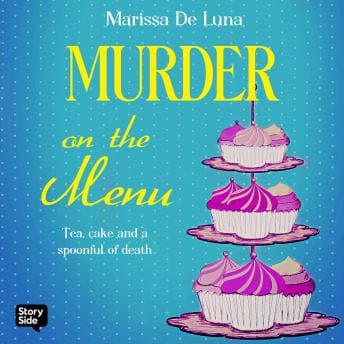
Let me give credit where it's due. Marissa De Luna has created something I rarely encounter in cozy mysteries: a protagonist whose amateur sleuthing doesn't make me want to throw things. Shilpa Solanki is a baker in the Devon village of Otter's Reach, and when tycoon Roy Arden dies at his eightieth birthday party—one she catered—his daughter Caroline asks her to investigate.
Psychologically, this tracks. Caroline doesn't trust the police, she's grieving, and she's latched onto the one person who was there but isn't family. The human mind under stress seeks allies in strange places. I found myself asking: why does Caroline really want Shilpa involved? The answer, when it comes, is more layered than I expected.
The Arden family dysfunction provides plenty of suspects, and De Luna clearly understands that family money creates specific pathologies. Dead Men's Money explores similar territory—how inheritance and greed warp family bonds beyond recognition. The much-younger second wife. The gardener-turned-son-in-law Roy never approved of. The brother with the strained relationship. These aren't just Clue characters—they're recognizable types. I've read enough case studies to know that inheritance disputes bring out humanity's worst impulses.
Then Caroline turns up dead too. Which—okay, I didn't see that coming. And I've read approximately eight thousand mysteries.
The Pause Problem: A Psychological Toll
Here's where things get complicated. Rachel Petladwala has a lovely British RP voice. Clear, pleasant, professional. But her pacing includes these micro-pauses that accumulate into something genuinely distracting.
My therapist would have thoughts about this. She'd probably say something about how our brains crave rhythmic predictability, and how disruption of expected patterns creates low-level cognitive stress. She'd be right. By hour three, I was so focused on the pauses that I'd miss actual plot points and have to rewind.
It's not quite as extreme as that listener quote suggests—we're not talking word-by-word pauses—but it's enough that I started speeding up the narration to 1.25x just to smooth things out. That helped. Considerably, actually. The story flowed better, the pauses became less noticeable, and I could finally focus on whether the gardener-son-in-law was as suspicious as he seemed. (He was. But not in the way I expected.)
Cozy Mystery as Comfort Food—With a Side of Genuine Cleverness
The research actually shows that cozy mysteries serve a specific psychological function: they provide the thrill of danger within a contained, ultimately safe environment. Murder happens, but it happens in a quaint village where the baker solves crimes and everyone knows everyone.
De Luna leans into this. Otter's Reach is charming without being cloying. Shilpa's baking business provides natural opportunities for her to interact with suspects—people order cakes, they chat, they reveal things they shouldn't. It's organic in a way that many cozy setups aren't.
What makes Shilpa compelling is her outsider-insider status. She's settled in the village but she's not from there originally. This gives her perspective that the locals lack, but also means she has to work harder to earn trust. She exhibits classic boundary-crossing behavior—inserting herself into a murder investigation—but De Luna gives her enough self-awareness that it doesn't feel absurd.
The mystery itself is solid. Not groundbreaking, but the clues are fairly planted, and when the solution comes, you can trace the logic backward. Golden Lion takes a different approach to plotting—more sprawling, more ambitious—but both books respect the reader's intelligence. That's harder to pull off than it sounds.
Who Should Listen (And Who Should Run)
If you love British cozy mysteries with food elements and don't mind adjusting your playback speed, this is a pleasant seven hours. The writing is competent, the setting is appealing, and Shilpa is likable without being saccharine.
But if audio pacing issues drive you up the wall? If you're the type who notices every vocal quirk and can't un-notice it? Grab the ebook instead. I'm not saying the narration is bad—it's not. It's just got this rhythmic hiccup that will either not bother you at all or bother you intensely. There's no middle ground.
The Diagnosis
Look, I finished the dal. I finished the audiobook. Both turned out fine—good, even. But I kept thinking about how the narration experience could have been different. The bones of this mystery are strong. The family dynamics are psychologically credible. The solution is satisfying.
At 1.25x speed, this becomes a genuinely enjoyable listen. At normal speed, it's an exercise in patience. Adjust accordingly, and you might find yourself charmed by Shilpa Solanki and her very sensible approach to amateur detection.