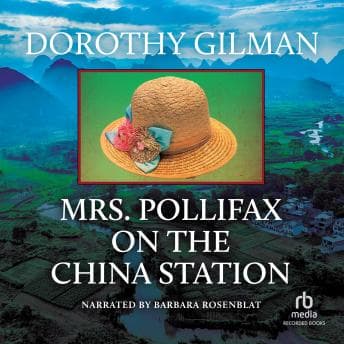

I was making chana masala at 10 PM on a Tuesday — the kind of elaborate cooking project that exists purely because my brain wouldn't stop spinning after a long day of reviewing survey data. The apartment smelled like cumin and toasted coriander, and Barbara Rosenblat was in my ears giving me Emily Pollifax, a sixty-something retired grandmother who the CIA apparently thinks is the ideal candidate for covert operations in Communist China. And honestly? The more I listened, the more I thought: yeah, actually, she kind of is.
Why a Grandmother Makes the Perfect Spy (And Why Gilman Knows It)
The protagonist exhibits classic underestimation bias — and Dorothy Gilman builds the entire premise around it. Mrs. Pollifax isn't Jason Bourne. She's not even George Smiley. She's a garden club lady from New Brunswick, New Jersey (a detail that hit close to home for this Jersey girl), and her superpower is that absolutely nobody takes her seriously. The research actually shows that people consistently underestimate older women in threat-assessment scenarios, and Gilman understood this decades before any psychologist published on it.
What makes this character compelling is that she's not faking incompetence. She genuinely is a sweet retired lady who happens to have steel underneath. When she dresses as a Chinese peasant to move through the countryside, it's absurd and she knows it's absurd, but she does it anyway because the mission matters more than her dignity. I found myself asking: why does Emily really keep saying yes to these CIA assignments? It's not the thrill-seeking you'd expect from spy fiction. It's closer to what I'd call a late-life identity reconstruction — she found purpose after retirement, and now she can't let it go. My therapist would have thoughts about this character, and most of them would be approving.
The tour group dynamics are a fascinating case study in forced proximity and suspicion. You've got a handful of Western tourists in 1980s China, and any one of them could be the contact — or the threat. Gilman handles the slow-reveal paranoia well, though I'll say the political tensions feel somewhat surface-level. The Communist China setting provides atmosphere but not much depth. Gilman is more interested in her characters than in geopolitics, which is fair. This is a cozy spy novel, not le Carré.
Psychologically, there's one thing that doesn't quite track for me: the Chinese official character that everyone apparently loves. He's charming, sure, and Rosenblat gives him a great voice, but his motivations feel a little too convenient — too quickly aligned with Emily's needs. Real people in positions of authority within authoritarian systems don't pivot that easily. But I recognize I'm applying clinical rigor to what is essentially comfort food fiction, and comfort food doesn't need to be nutritionally perfect.
Barbara Rosenblat Is Doing Something Sneaky With Her Voice
Six-time Audie Award winner, and you can hear why. But here's what impressed me most: Rosenblat doesn't just voice characters, she psychologically differentiates them. Her Mrs. Pollifax has this sweet, slightly breathy quality — the kind of voice that makes you think "oh, what a nice lady" — and then there are these moments where the sweetness drops half a register and you realize Emily is calculating. It's subtle. It's the vocal equivalent of watching someone's eyes go sharp while their smile stays in place.
Her American characters each carry their own regional flavor, and the Chinese characters — look, this is where it gets complicated. The book was written in 1983, and some of the cultural disguise scenes carry the baggage of their era. Rosenblat handles it with more care than the source material probably deserves, but if you're sensitive to Western authors writing Asian characters through a dated lens, be aware. It's not malicious, but it's not invisible either.
The performance is warm and funny in the right places, genuinely tense in others. She doesn't oversell the suspense — she trusts the quiet moments, which is exactly right for a protagonist whose danger comes wrapped in politeness.
Who Gets the Most Out of This
If you want a mystery protagonist who isn't a tortured detective or a brilliant sociopath — if you want someone whose psychological complexity comes from being deeply, defiantly ordinary — Mrs. Pollifax is your person. This is great for fans of cozy mysteries who want just a little more geopolitical spice. White Cargo scratches a similar itch — that blend of coziness and stakes where you're somehow relaxed and anxious at the same time. At 7 hours and change, it's the right length: doesn't overstay, doesn't rush.
If you need gritty realism or deep cultural analysis of Cold War-era China, this isn't it. If unreliable narrators and dark psychological twists are your thing, you'll find this too sunny. And if dated cultural representations are a dealbreaker, proceed with caution.
The Case File on Mrs. Pollifax
I finished the chana masala. I finished the book. Both were comforting in ways I didn't expect to need on a Tuesday night. Gilman wrote a character who proves that identity isn't fixed — that a grandmother can be a spy, that retirement can be a beginning — and Rosenblat voices her like she believes every word of it. It's not going to change your understanding of human nature, but it might remind you that the most interesting people are the ones you'd never suspect.