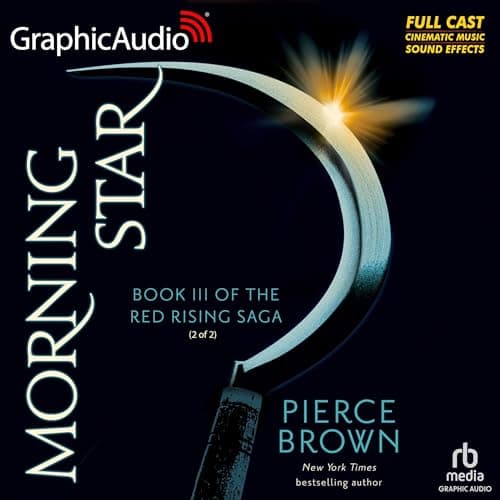
I started this one before dawn, breaking trail through two feet of new snow while the spruce boughs kept dumping powder down my collar. Cold enough that every breath sounded metallic. And that turned out to be exactly the right weather for Morning Star (2 of 2) in this dramatized format, because this adaptation lives on pressure - war pressure, class pressure, grief pressure - and it wants your full attention. Not half. Not while you're folding laundry and checking your phone. I listened while snowshoeing at 8,000 feet, and even then I had to stop a couple times just to let a scene land.
This is the back half of a story already in motion, so I'm not going to pretend it's newcomer-friendly. It isn't. You come in here for payoff - for Darrow's war against the Gold hierarchy, for old loyalties going rotten, for the revolution finally pushing past rhetoric into blood cost. And because this is a GraphicAudio-style dramatized adaptation, the whole thing feels less like "someone reading you a novel" and more like being dropped into a war room, a prison cell, or the middle of a shipboard confrontation with steel groaning around you.
What the cast gets right about power
Stewart Crank's Darrow carries exactly the weight this role needs. Not just anger - lots of actors can do anger. He gives you exhaustion, command, and that dangerous edge where hope and vengeance start sounding a little too similar. That's hard to pull off without flattening the character into pure heroic thunder. He doesn't. You hear a man trying to hold a revolution together with scar tissue.
Jon Vertullo as Sevro is the other standout for me. Listener sentiment wasn't wrong there. His performance has bite to it - feral, fast, a little cracked around the edges in the best way. Every time Sevro enters, the audio gains this unstable voltage. He's not comic relief, not exactly. More like the human embodiment of what war does when it stops being theoretical.
And the casting choices around them help define the social order fast. Jenna Sharpe gives Mustang a steadier, more measured presence than the chaos around her. John Kielty's Cassius has that sharpened, aristocratic confidence that fits a Gold raised inside power. Julie-Ann Elliott as Octavia Au Lune sounds cold in a way that made my shoulders tighten - controlled, elevated, lethal. Kay Eluvian's Roque also lands because you can hear refinement turned brittle. Those distinctions matter in Red Rising. The class divide isn't wallpaper; it's the engine.
The ecology here is spot-on - not literal landscape ecology, obviously, but social ecology. Predator hierarchy. Resource capture. Ornamental excess built on extraction. Pierce Brown understands systems, and this cast understands how those systems sound when individual people are trapped inside them.
When the production goes full ironstorm
The big selling point here is the production, and yes, it earns that pitch. The immersive sound effects and cinematic music do real work. Doors slam with consequence. Engines rumble under dialogue. Battle sequences have motion and texture instead of turning into shapeless noise. This is how the mountains actually sound - by which I mean, real environments have layers, and this production mostly understands layering. It doesn't just blast effects at you. It builds atmosphere and then lets voices cut through it.
That said - and this is the trade-off - dramatized adaptations always compress your imaginative space a bit. You gain immediacy, lose some solitude. If you're the kind of listener who wants every line delivered clean in a neutral studio, you may find the music and effects a little forceful. I didn't. But I was listening in deep winter silence, where every little shift in sound matters, so maybe I was primed for it.
At 10 hours 29 minutes, this also moves with a kind of ruthless efficiency. That's shorter than a standard unabridged epic would be, and you can feel the adaptation shaping momentum. Pretty much no lingering. Scenes hit, pivot, escalate. For this story, that works more often than it hurts, because Morning Star is built on reversals, confrontations, and emotional detonations. But if your favorite thing about the Red Rising books is long tactical setup or extended interior reflection, you'll notice the streamlining.
Still. For listeners who want immersion? This version absolutely knows its job.
Who gets fed here - and who gets left in the cold
You should pick this up if you want sci-fi rebellion with teeth and you like hearing class conflict embodied through performance, not just described on the page. Birthmarked scratches a similar itch — dystopian hierarchy pressed into individual bodies, the cost of resistance made personal rather than rhetorical. You should also pick it up if Sevro is your guy, because Vertullo really does make him feel volatile and alive in a way that changes the room whenever he speaks.
Skip it if you mostly listen distracted. I mean that. Full-cast productions can punish inattention because key emotional beats are carried by timing, overlap, and tonal contrast. Miss thirty seconds and you're suddenly catching up by context clues. Also skip if you need the spaciousness of an unabridged single narrator; this adaptation is designed for impact first.
One more thing I respected: even without a lot of granular production complaints floating around, this cast never gave me that common dramatized-audio problem where everyone sounds like they're acting in different genres. They belong to the same brutal universe. That's rarer than it should be.
My only real caution is structural, not quality-based: because this is "2 of 2," it is payoff-heavy by design. If your memory of the earlier material is fuzzy, refresh yourself first. Otherwise you're bringing a dull knife into thick country.
Leaving the fire on low
This landed for me. Hard. Not because it's "epic" in some empty marketing sense, but because the performances understand that revolutions are built from injury, loyalty, vanity, and fear - very human materials. The land itself is the main character is something I say a lot about nature writing; here, the equivalent is the system itself. Society hangs over every conversation like weather.
So yes, for this format, this is close to ideal: sharp casting, muscular pacing, and production that knows when to hit the gas. Nature doesn't forgive mistakes. Neither do I. This one makes very few.









