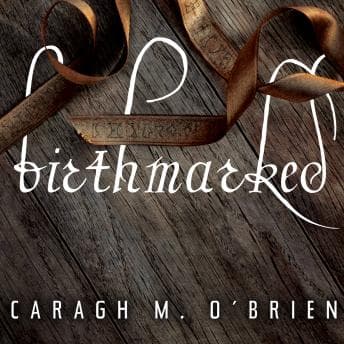

Look, I need to rant about something before we get into this. Why does every YA dystopia insist on making the protagonist's parents the inciting incident? Mom and Dad get arrested, kidnapped, or mysteriously vanish, and suddenly our teenage hero has to single-handedly dismantle an authoritarian regime. It's like the Hero's Journey, but make it family trauma.
That said? Birthmarked actually does something interesting with this trope. And I'm annoyed about how much I liked it.
A Midwife With a Moral Crisis? Sign Me Up
I was three hours deep into my thesis procrastination—staring at my procedural generation notes like they personally offended me—when Gaia Stone started questioning everything she'd been taught about the Enclave. And honestly? Same energy. Gaia's a sixteen-year-old midwife (already more accomplished than me, cool, cool) who's been dutifully handing over babies to the walled city her whole life. The quota system is just... how things work. Until it isn't.
What grabbed me is that O'Brien doesn't rush the moral awakening. Gaia doesn't immediately become a revolutionary badass. She's confused, scared, and making decisions based on incomplete information—like an actual teenager would. The world-building here is patient. You piece together the Enclave's eugenics program alongside Gaia, and by the time you understand what's really happening with those quota babies, it hits different.
The magic system is—okay, there's no magic system, this is dystopian sci-fi, but the GENETICS SYSTEM is chef's kiss. O'Brien was a high school teacher, and you can tell she actually thought through the science of what happens when you restrict a gene pool. The Enclave's desperation makes sense. Their methods are monstrous, but the logic tracks. That's Sanderson-level world-building, honestly.
Carla Mercer-Meyer and the Art of Quiet Devastation
Here's the thing about narrating YA dystopia: you can go big and dramatic, or you can trust the material. Mercer-Meyer trusts the material. Her voice has this warm, honest quality that fits Gaia perfectly—she sounds like someone who genuinely believes she's doing the right thing, which makes the gradual horror of realization land harder.
The research I found called her "precise and careful," and yeah, that's accurate but undersells it. There's a scene—Gaia's in prison, everything's gone wrong, and someone slips her an orange. Just a small kindness in this bleak concrete nightmare. Mercer-Meyer's delivery of that moment is so understated it almost broke me. No dramatic pause, no quivering voice. Just... warmth, in a place where warmth shouldn't exist.
I will say the character differentiation isn't as distinct as I'd like. Leon (the love interest, because of course there's a love interest) and some of the Enclave officials could use more vocal distinction. It's not confusing, but I've been spoiled by Steven Pacey, and everyone else has to live in that shadow. Steven Pacey walked so other narrators could run, and Mercer-Meyer is at least jogging comfortably.
The Pacing Problem (That Isn't Really a Problem)
At nearly 13 hours, this isn't a quick listen. The first third is slow—world-building, establishing Gaia's normal before it all falls apart. If you don't like info-dumps, this isn't for you (but you're wrong). My D&D group would love this setup because O'Brien is essentially giving you a campaign setting. The Enclave, the wall, the Unlake, the social hierarchy—it's all there, waiting to be explored. Warded Man has that same methodical world-building approach—Brett takes his time establishing the ward magic system before the demons show up.
But if you're coming in expecting non-stop action, adjust expectations. The progression is satisfying, but it's a slow burn. I listened over about a week, mostly during late-night coding sessions when I should've been working on my thesis. (Dr. Patel, if you're reading this, I was multitasking. Productively. Probably.)
Who's Going to Love This (And Who Should Skip)
This is for the Hunger Games crowd who wanted more world-building and less love triangle drama. It's for readers who appreciate when dystopia has internal logic instead of just vibes. If you're into stories about complicity—how ordinary people enable terrible systems because they've never questioned them—Gaia's journey will hit hard.
Skip it if you need fast pacing, distinct character voices, or if you've hit your quota (pun intended) on YA dystopia. Also skip if you're not prepared for a trilogy setup—this ends with resolution but clearly has more story to tell.
Shelving This Next to My Sanderson Collection
Yes, it's 12+ hours. Yes, it's worth it. Birthmarked isn't revolutionary, but it's solid, thoughtful YA sci-fi with a narrator who understands the assignment. Gaia Stone isn't the Chosen One—she's just a girl who finally asked "why" and couldn't live with the answer. That's more compelling than any prophecy.
Now if you'll excuse me, I have a thesis to not write and a sequel to add to my queue.