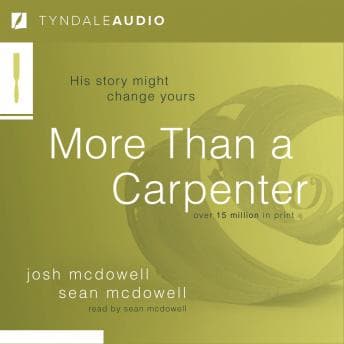

So here's where I'll be honest with you: I wasn't expecting to have much to say about a book I can finish in less time than it takes me to grade one class period's worth of persuasive essays. Eighty minutes. That's it. I started More Than a Carpenter while Denise and I were waiting for our Thai food order - the place on Devon that always takes forever - and I finished it before we'd cleared the dishes.
And yet I've been thinking about it for three days.
The Skeptic's Syllabus
Let me give you the context first, because context is everything. Josh McDowell wrote the original in 1977 - the same year Star Wars came out, if you want a cultural timestamp. He was a former skeptic, a guy who set out to disprove Christianity intellectually and ended up... well, writing this. Fifteen million copies later, his son Sean has updated the material and narrates this edition, adding a chapter addressing the New Atheist writers - Dawkins, Hitchens, that crowd.
What struck me is the structure. This isn't a sermon. It's built like a legal brief. McDowell treats the question of Jesus's identity the way a prosecutor might build a case: here's the claim, here's the historical documentation, here are the alternative explanations, here's why those alternatives don't hold up. The "Lord, Liar, or Lunatic" trilemma - that's the spine of the argument, and if you've taken any philosophy of religion course, you've encountered it. McDowell didn't invent it (that's C.S. Lewis), but he packages it for a popular audience in a way Lewis never quite managed.
Now - and this is where my teacher brain kicks in - the book does what a solid five-paragraph essay does. It states a thesis, supports it with evidence, and anticipates counterarguments. My students would recognize the formula instantly. Whether the evidence is sufficient is a different question, one the book doesn't always wrestle with deeply enough. The chapter addressing modern atheist objections feels more like a rebuttal outline than a sustained engagement. If you're coming from Bart Ehrman or even a serious reading of Hitchens's God Is Not Great, you'll find McDowell's responses a bit... tidy. Too clean. Real intellectual doubt is messy, and this book prefers neat categories.
But I don't think that's entirely a flaw. I think it's an honest acknowledgment of scope. This is eighty minutes, not eight hundred.
Sean McDowell Reads Like a Teacher, Not a Preacher
Here's where the audiobook earns its particular value. Sean McDowell narrates with the cadence of someone who's spent years in classrooms and on debate stages - I recognize the rhythm because it's my rhythm. He emphasizes key logical transitions the way you do when you're trying to make sure the kid in the back row tracks the argument. There's energy without theatrics. He doesn't drop into that breathy, reverent tone that so many religious audiobooks default to, the one that makes you feel like you're being prayed at rather than talked to.
What he doesn't do is disappear into the text. You're always aware this is Josh McDowell's son reading Josh McDowell's book, and there's a warmth to that - a filial pride - that colors the delivery. Whether that's a feature or a bug depends on what you're looking for. I found it genuine. A little earnest, sure. But I'll take earnest over slick any day of the week.
The production is clean, no weird audio artifacts, no awkward editing cuts. At 1.0x - and yes, I listened at 1.0x, because even apologetics prose deserves its natural cadence - it's a brisk, focused listen.
Who Gets the Most Out of This
If you're a committed atheist looking for a worthy sparring partner, this probably isn't it. The arguments are introductory, not exhaustive. If you're a believer looking for ammunition, you'll find the basics here but you'll want to graduate to McDowell's heavier work, Evidence That Demands a Verdict, pretty quickly.
Where this book actually shines? The genuinely curious person who hasn't thought much about the historical claims of Christianity and wants a starting point that doesn't require a seminary education. This reminds me of what Hemingway said about prose - the dignity of an iceberg is that only one-eighth of it is above water. McDowell gives you the visible eighth and trusts you to go deeper if you want to.
My students would probably call this a TikTok-length argument for faith. They're not entirely wrong. But sometimes the short version is exactly what someone needs to decide whether the long version is worth their time.
Worth the Eighty Minutes, Not the Credit
Here's my honest math: at under ninety minutes, this is closer to a long podcast episode than a traditional audiobook. The content is solid for what it is - accessible, clearly argued, genuinely rooted in a personal conversion story that gives it emotional weight. But I can't tell you to spend a full Audible credit on something shorter than my average faculty meeting. (And I know exactly how long those meetings are because I've timed them. Against Middlemarch. Middlemarch wins.) Stream it, borrow it from the library app, listen to it on a short drive. It earns that much of your attention easily. The Christian fiction shelf has been on my mind lately anyway - I reviewed Brush of Wings recently, and while it takes a very different approach to questions of faith, it's another case where the genre asks more of the reader than it sometimes gets credit for.