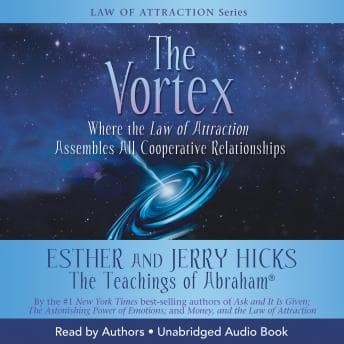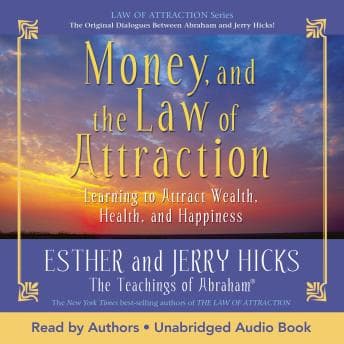

Seven and a half hours. That's how long Esther and Jerry Hicks need to tell you that thinking positive thoughts attracts positive outcomes. Seven. And. A. Half. Hours.
I was reorganizing my home office at 10 PM on a Tuesday - Jenny had finally convinced me to sort through the graveyard of Post-it notes and dead Moleskines on my desk - and I figured I'd give this a fair shot. A client's founder swears by Abraham-Hicks. She meditates before board meetings. Her Series B closed oversubscribed. Correlation isn't causation, but I was curious.
My Parents Didn't "Vibrate" Their Way to Solvency
Look, I'll say the quiet part loud: the central premise here - that your financial and physical well-being are primarily controlled by your vibrational alignment with the universe - is a hard sell for anyone who watched their parents press shirts for 14 hours a day to make rent in Koreatown. The book is structured in five essays covering pivoting your thoughts, attracting money, physical health, weight and mind, and careers. And each essay essentially delivers the same message with slightly different packaging: focus on what you want, not what you don't have, and the universe will match your frequency.
The health and career sections in Parts III through V are genuinely the strongest material. There's practical-adjacent advice about not catastrophizing your physical symptoms and reframing your career as a source of joy rather than obligation. I can actually see utility there - I've coached founders who spiral so hard on burn rate that they manifest (pun intended) the exact death spiral they feared. The psychology of focus and attention bias is real science. But this book doesn't want to be science. Cialdini's Influence, New and Expanded actually does the hard work of grounding these same psychological mechanisms in evidence - which makes the contrast with what Hicks is selling here even sharper. It wants to be channeled wisdom from a "Non-Physical consciousness" named Abraham, and that's where it loses me.
The 2.0x Problem
Here's the thing about this audiobook specifically: my 2.0x speed couldn't save this one. Esther narrates with this deliberate, almost hypnotic cadence that's clearly intentional - it's designed to lull you into a receptive state. At normal speed, it's meditative. At 2x, it sounds like a yoga instructor who's had three espressos. And Jerry's portions, while briefer, feel like the warm-up act that doesn't know when to leave the stage.
The repetition is the real killer. I lost count of how many times the phrase "vibrational escrow" appeared. The core concepts get restated, rephrased, re-illustrated, and restated again across all five sections. If you distilled the unique insights down to their essence, you're looking at maybe 90 minutes of actual content. The rest is affirmation and reinforcement, which - fine, if that's what you need. But for someone who processes information at consulting-deck speed, it felt like sitting through a 200-slide presentation where 180 slides say the same thing in different fonts.
The live workshop excerpt included as a bonus is actually the most interesting part. There's an energy to Esther channeling Abraham in front of a live audience that's missing from the studio-recorded essays. Whether you buy the premise or not, the Q&A format forces more specificity than the essays ever achieve.
Where "Ask and It Is Given" Already Did This Better
Fans consistently rank this as a close second to Ask and It Is Given, and I think that comparison tells you everything. If you're already in the Abraham-Hicks ecosystem, this is supplementary material focused on money and health. If you're new to it, you're starting with the B-side. The financial advice never gets more tactical than "align your vibration with abundance" - no budgeting frameworks, no investment principles, no actual money mechanics. Compare that to, say, Ramit Sethi giving you specific scripts for negotiating your salary, and you see the gap between vibes and value.
I've seen this fail at three different companies - founders who confused optimism with strategy, who thought manifesting product-market fit was a substitute for customer interviews. Mindset matters, absolutely. But mindset without execution is just daydreaming with better branding.
Jenny would say I'm being harsh. Jenny is right. There are people who genuinely benefit from permission to stop catastrophizing about money, and this book grants that permission generously. If anxiety about finances has you paralyzed, the reframing exercises here could unlock some mental bandwidth. That's not nothing.
The ROI Calculation
Bottom line: this is a 90-minute idea in a 7.5-hour package, narrated at a pace that fights your fast-forward button. The health and career essays earn their keep. The money sections stay frustratingly abstract. If you're an Abraham-Hicks believer, you already own this. If you're skeptical but curious, start with Ask and It Is Given instead. And if you're a founder thinking this replaces a financial model - please, I'm begging you, call me first.