
Look, I need to get something off my chest: I just spent 14 and a half hours listening to a woman channel a non-physical entity named Abraham, and I did it at 2.0x speed, which means I still gave this thing over seven hours of my life. Seven hours. I could've prepped two client decks. I could've called my mom. My 2.0x speed couldn't save this one.
I was reorganizing my home office at midnight - Jenny's asleep, I'm labeling storage bins like a psychopath - and I figured I'd give this a fair shake. A client of mine, founder of a Series A wellness app, swears by Abraham-Hicks. She talks about "vibrational alignment" the way I talk about unit economics. So fine. Let's see what we're working with.
22 Processes and Zero P&L Statements
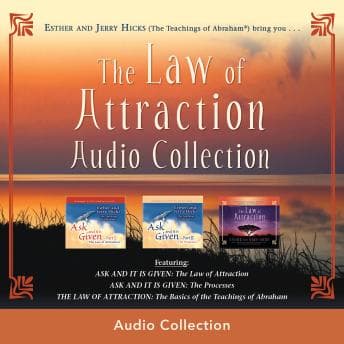
This collection bundles three Esther Hicks programs: Ask and It Is Given: The Law of Attraction, Ask and It Is Given: The Processes, and The Law of Attraction: The Basics of the Teachings of Abraham. The core premise is straightforward - your thoughts attract matching experiences, positive thoughts attract positive outcomes, negative thoughts attract negative outcomes. If you've consumed any self-help content in the last 20 years, you've encountered this framework. It's the operating system behind The Secret, behind vision boards in WeWork conference rooms, behind every Instagram motivational quote overlaid on a sunset.
The 22 Processes section is where the practical rubber is supposed to meet the road. You get techniques like the "Emotional Guidance Scale" (ranking your feelings from joy down to despair) and the "Rampage of Appreciation" (which is exactly what it sounds like). Some of these are genuinely useful as cognitive reframing exercises. The gratitude stuff isn't revolutionary, but it works - I've seen founders pull themselves out of death spirals by shifting focus from what's broken to what's functional. That's not woo-woo, that's just good mental hygiene. The clinical side of that same reframing work gets a much more grounded treatment in Anxiety Solution: A Quieter Mind, A Calmer You — less Abraham, more actual cognitive tools you can stress-test.
But here's where I start grinding my teeth: there's no mechanism for accountability. No system for when positive thinking runs headfirst into a supply chain collapse or a term sheet that falls apart. My parents didn't manifest their dry cleaning business into survival through vibrational frequency. They did it through 14-hour days, brutal cost control, and the kind of relentless adaptability that no amount of "allowing" teaches you.
The Seminar Tape Problem
Production-wise, this collection has an identity crisis. Parts of it feel like a proper audiobook narration - Esther reading prepared material with clear delivery, pleasant pacing. She's got a warm, conversational quality that makes the repetitive concepts go down easier than they should. But then you hit sections that are clearly recordings from live seminars, and suddenly you're listening to audience Q&A with variable audio quality and Jerry Hicks facilitating questions that meander. One listener nailed it when they said it feels like "a low effort podcast from some boomers more than a book." That's harsh. Jenny would say I'm being harsh. Jenny is right. But it's also... not entirely wrong.
The seminar portions do have a certain raw energy - there's something interesting about hearing Esther shift into "Abraham mode" in real time, the cadence of her voice changing, becoming more declarative and rhythmic. If you're already bought into the premise, those live sections probably feel electric. If you're not, they feel like you accidentally wandered into someone else's church service.
Who Gets ROI Here (And Who Doesn't)
If you're already in the Abraham-Hicks ecosystem - if you listen to Bashar, if Joe Dispenza is in your rotation, if you have a meditation practice and want a philosophical framework around intentionality - this collection is a solid library piece. 14+ hours gives you the full download (pun intended) and the live seminar material at the end adds texture you won't get from the books alone.
If you're a skeptic looking for evidence-based self-improvement, skip this entirely. If you're a founder looking for practical business strategy wrapped in spiritual language, go read Think and Grow Rich instead - it's the same DNA but with more applicable structure.
And if you're somewhere in the middle - curious, open, but allergic to anything that can't survive contact with reality - cherry-pick the Processes section. Skip to the emotional scale and appreciation exercises. There's maybe 90 minutes of genuinely useful cognitive tools buried in here. The other 13 hours? That's a lot of repetition about vibrations.
Bottom Line on the Billing Rate
I can't rate this the way I rate a business book because it's not really a business book. It's a spiritual framework wearing self-help clothing. Esther Hicks is a pleasant narrator with clear delivery, and fans will get exactly what they came for. But at 14.5 hours, the signal-to-noise ratio is brutal. This is what my parents did instinctively - staying optimistic, focusing forward, refusing to dwell - now it has a TED talk. Several, actually. And a channeled entity. And way too many hours of runtime for the core insight.
The key takeaway is worth the listen. The other 13 hours? Not so much.