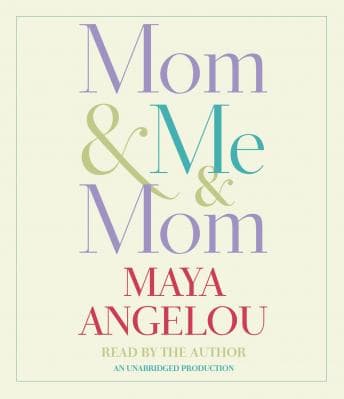

"Lady, you are so beautiful." There's a moment early on where Maya says this about her mother, Vivian Baxter, and the way her voice cracks on the word "beautiful" — it's barely perceptible, just the tiniest fracture — I had to pause my work and put my stylus down. Frida jumped into my lap like she knew.
I wasn't ready for this book. I thought I was. Four hours, a Sunday afternoon, rain tapping against my apartment windows in Austin. Perfect memoir weather. But this isn't just a memoir. This is a woman in her eighties sitting across from you, telling you the hardest truth she's ever had to tell: that she loved someone who left her, and then she chose — chose — to love that person again.
The Voice That Carries Everything
Here's what wrecked me about this audiobook: Maya Angelou narrates it herself. And at this point in her life, her voice has this specific quality — Southern drawl still warm and round, but with a softness underneath that sounds almost childlike when she's recalling being three years old and put on a train to Arkansas. She's not performing the child. She's not doing a "little girl voice." But somehow her cadence shifts, gets smaller, and you feel the bewilderment of a toddler who doesn't understand why Mommy isn't there anymore.
And then — and then — when she talks about Vivian Baxter the woman, the pistol-carrying, business-owning, take-no-nonsense force of nature, her voice gets this almost conspiratorial brightness. Like she still can't quite believe her mother was real. The way she says "My mother" versus "Lady" — two completely different emotional registers. "My mother" is reverent. "Lady" is intimate, a little wild, the way you'd talk about your most glamorous friend who also terrifies you.
There's no music. No sound effects. Just Maya Angelou's voice in your ears for four hours. And honestly? Nothing else is needed. Nothing else would even be appropriate.
When Abandonment Becomes the Origin Story
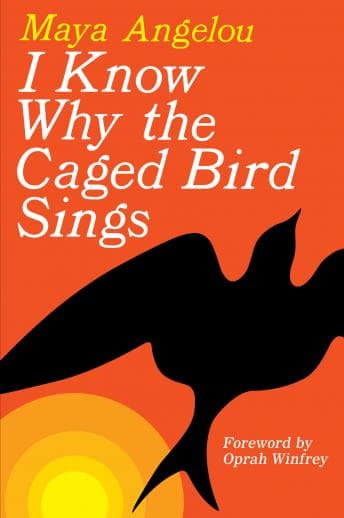
So here's what I didn't expect: this book is SHORT. Four hours. And it covers decades — from Maya being sent away at three, through her traumatic childhood (and yes, she references the rape from I Know Why the Caged Bird Sings, briefly but directly — content warning there), through teenage motherhood, through her mother showing up and slowly, persistently, almost stubbornly earning her way back in.
Because of the length, it moves fast. Almost too fast sometimes. There are entire years compressed into a paragraph. Her marriages get a sentence or two. And at first I was frustrated — I wanted to sit longer in certain moments, especially the early reunion when teenage Maya arrives in San Francisco and meets this small, impossibly stylish woman who is technically her mother but feels like a stranger.
But then I realized the pacing IS the point. This isn't a detailed autobiography. It's a love letter. And love letters don't cover everything. They cover what matters. The time Vivian showed up with a .45 when someone threatened Maya. The phone call where Vivian said "baby, I think you're the greatest woman I've ever met" and Maya went silent because she didn't know how to hold that much tenderness from the person who'd once been the source of her deepest wound.
I ugly-cried at that phone call scene. Full mascara situation. Diego looked at me from his perch on my bookshelf like I was embarrassing him.
Abuela Would Have Loved This One
I keep thinking about my grandmother. How she raised me while my parents worked. How that love — the grandmother love, the one that fills in the gaps — is both the most stable thing in the world and also proof that something else was missing. Maya's grandmother Annie Henderson in Stamps, Arkansas, gave her everything. Structure, faith, survival. But she couldn't give her Vivian.
And Vivian couldn't be Vivian and also be a mother to small children. She says as much. She was too wild, too young, too full of her own unresolved everything. And the miracle of this book is that Maya doesn't forgive her in a neat, packaged way. That slow, unglamorous work of choosing connection anyway — Wholeness circles this same territory, though it couldn't move me the way Maya's own voice does. She just... keeps choosing to move toward her. Over and over. Phone calls and visits and awkward silences and eventually, eventually, the kind of closeness that only people who've survived real distance can build.
Abuela used to say "la sangre llama" — blood calls to blood. She would have been clutching that rosary through this whole book and then quietly saying, "Mija, that mother loved her. She just didn't know how at first."
Who Needs This in Their Ears
If you have a complicated relationship with your mother — the kind where love and hurt are so tangled you can't find where one starts and the other ends — this book is going to hit like a freight train. If you love memoir that's more feeling than chronology, more poetry than plot, you'll be fine with the short runtime and the gaps.
If you need detailed, linear autobiography with all the context filled in, start with I Know Why the Caged Bird Sings first. This is the capstone, not the foundation. It assumes you already know Maya Angelou's story, or at least the broad strokes, and it's filling in the one piece she'd never shared publicly.
And listen at 1.0x. Please. Maya Angelou's pauses are doing half the work.
The Last Thing I'll Say About This
This book felt like sitting in a kitchen with someone who's lived nine lives, drinking coffee that's gone cold because neither of you noticed the time passing. Four hours. I didn't move from my desk the entire time. The rain stopped at some point and I didn't notice that either.
My heart. MY HEART.