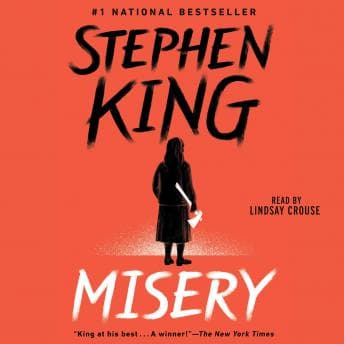

So here's the thing about Annie Wilkes: she's the reason I got into psychology in the first place. Not literally, obviously—I was twelve when I first read Misery and my career aspirations at that point were limited to "veterinarian" and "Bollywood actress." But something about King's portrayal of obsessive fandom twisted into something monstrous stuck with me. The way he understood that love and violence aren't opposites—they're neighbors.
Listening to this audiobook twenty years later, with an actual degree in behavioral psychology, I found myself doing something I couldn't have done as a kid: diagnosing Annie in real-time. And honestly? King got it right. The erotomania, the splitting, the way her moods shift on a dime from maternal warmth to cold fury. This is a case study in how devotion curdles.
Lindsay Crouse and the Kathy Bates Problem
Let's address the elephant in the room. If you've seen the 1990 film—and statistically, you probably have—you're going to hear Kathy Bates in your head. That's just reality. Lindsay Crouse makes an interesting choice here: she doesn't fight it. Her Annie has that same folksy sweetness masking something deeply wrong, that same "aw shucks" cadence that makes the violence hit harder.
Some listeners found this redundant. I get it. But here's what I noticed: Crouse finds the tender moments in a way the film couldn't quite capture. There's a scene where Annie talks about her childhood, and Crouse's voice goes soft in a way that made me genuinely uncomfortable—because for a second, I felt sorry for her. That's the mark of a narrator who understands character psychology. She's not playing a monster. She's playing a woman who became one.
Her Paul Sheldon works too. Weaker, more desperate, increasingly unhinged in his own way. The protagonist exhibits classic trauma responses—hypervigilance, dissociation, the desperate cognitive reframing of his captor as someone he can reason with. Crouse captures that spiral.
The Misery Within Misery (And Why It Drags)
Okay, I need to be honest about something. The sections from Paul's novel-within-the-novel? They're rough. King includes long passages from the Misery Chastain romance Paul is forced to write, and while I understand the thematic purpose—we're watching Paul create under duress, his art becoming survival—it still dragged. King's later work If It Bleeds shows he eventually learned to trust his readers more—less is more when it comes to nested narratives.
I was jogging through Cambridge when one of these passages hit, and I genuinely considered skipping ahead. (I didn't. My therapist would have thoughts about my inability to abandon things.) But if you're listening at 1x speed, consider bumping to 1.25x during these sections. The story won't suffer.
The pacing issues some listeners mention are real, but they're more about King's structure than Crouse's delivery. She does what she can with the material.
The Psychology of a Villain Who Makes Sense
The research actually shows that we're drawn to fictional villains who reflect distorted versions of normal human drives. I saw this same psychological realism in Terminal List, where the antagonists aren't cartoonish—they're operating from their own warped but internally consistent logic. Annie doesn't want anything unusual—she wants connection, recognition, control over her environment. She wants to matter to someone. The horror is in how she pursues these completely understandable needs.
King understood something that a lot of thriller writers miss: the scariest antagonists aren't the ones who are incomprehensible. They're the ones who make a terrible kind of sense. When Annie explains why she's doing what she's doing, you follow the logic. You shouldn't, but you do.
Crouse's narration leans into this. She never plays Annie as cartoonishly evil. Even in the most violent moments—and there are moments that made me flinch while crossing the Charles River—there's something almost plaintive underneath. She believes she's the hero of this story.
The Claustrophobia That Works
The audiobook format actually enhances something I didn't expect: the claustrophobia. When you're reading, you can put the book down, look around, remember you're safe. But with earbuds in, Crouse's voice becomes the only reality. Paul's prison becomes yours. There's nowhere to look away.
I listened to most of this during evening cooking sessions—elaborate dishes I ate alone, as usual—and found myself burning things because I couldn't pull my attention away. That's not a complaint. That's the audiobook working.
The production is clean, though I've seen some listeners mention background music. I didn't notice it, but my tolerance for ambient sound is probably higher than average. The lack of chapter announcements is annoying if you're trying to navigate, but honestly, this is a book that rewards straight-through listening.
My Clinical Recommendation
For fans of psychological suspense, this is essential. King at his most focused, his most intimate. No supernatural elements to hide behind—just two people and the terrible things humans do to each other in the name of love.
For my students studying obsessive attachment patterns? Honestly, yes. (Don't tell my department chair I'm assigning horror novels as supplementary reading.)
Skip this if you need your villains to be clearly monstrous, if you want distance from the darkness. Annie Wilkes will get under your skin in ways you might not want. She's too human. That's the whole point.
Crouse delivers a performance that honors the source material without being overshadowed by the film. She finds her own Annie. And that Annie will haunt you.