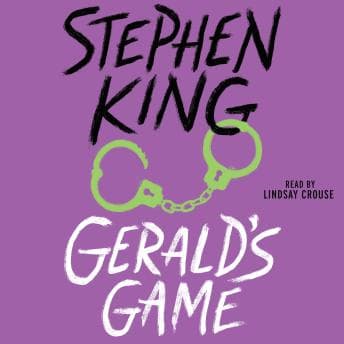

What happens when you strip away every external threat and leave a person alone with nothing but their own mind? Stephen King answered that question with Gerald's Game, and the result is one of the most uncomfortable reading experiences I've ever had—in the best possible way.
The setup is almost cruelly simple. Jessie Burlingame finds herself handcuffed to a bed in an isolated cabin after her husband Gerald dies mid-assault. No phone. No neighbors. No cavalry coming. Just Jessie, the handcuffs, and roughly thirteen hours of her mind fragmenting under pressure. It's essentially a case study in dissociation as survival mechanism, and King nails the psychology with an accuracy that made me genuinely squirm.
Lindsay Crouse Goes Full Theater Kid (And It Works)
Lindsay Crouse's narration is theatrical. Let me be direct about that, because it's going to determine whether this audiobook works for you. She doesn't just read Jessie's internal voices—she performs them, each fractured persona getting its own distinct treatment. The practical Goodwife Burlingame. The angry, defiant Ruth. The terrified child. Crouse commits to these shifts with full conviction, and I found myself genuinely unsettled by how real these internal arguments felt. There's something about hearing a person debate themselves out loud that hits differently than reading it on the page.
Did the theatricality occasionally tip into too much? Honestly, yes. A few moments felt like I was listening to a stage production rather than an intimate psychological horror story. But here's the thing—Jessie's situation is theatrical in a strange way. She's performing for herself, creating these voices to stay sane, putting on a show of competence while her mind cracks at the seams. Crouse's approach mirrors that internal drama, and once I stopped resisting it, the style clicked.
The Slow Spiral of a Mind Under Siege
The pacing will test your patience. This isn't The Shining with its escalating supernatural dread or Misery with its cat-and-mouse tension. Gerald's Game is slower, more circular, deliberately repetitive in the way trauma actually works. Jessie's mind keeps returning to the same memories, the same fears, the same desperate calculations about whether she can slip her hand through the cuff if she's willing to sacrifice enough skin. Some listeners find this maddening—I've seen reviews calling Jessie's internal monologue "constant yammering." But repetitive thought patterns aren't a bug here; they're the entire point. This is what a mind under extreme stress actually does.
The childhood trauma subplot is where King's psychological insight really lands. Without spoiling specifics, there's a reason Jessie ended up in those handcuffs, a reason she's spent her adult life submitting to situations that make her uncomfortable. The flashback sequences are genuinely difficult to listen to, and Crouse delivers them with an emotional weight that made me pause the audiobook more than once. These aren't gratuitous—they're the key to understanding who Jessie is and what she's really fighting against.
Then there's the figure in the corner. The "space cowboy." Is he real? Imagined? Something in between? King keeps you guessing, and Crouse's reading of these scenes adds an eerie quality that made late-night listening genuinely inadvisable. I made that mistake exactly once.
A Few Technical Notes
The production is clean overall, though I noticed a couple of audio edits that pulled me out of the story momentarily. Nothing catastrophic, but worth mentioning for listeners who are sensitive to that sort of thing. The runtime of thirteen and a half hours is substantial for what is essentially a single-location psychological thriller, but the story earns its length.
Who Should (and Shouldn't) Get Handcuffed to This One
If you want action, external conflict, or a protagonist who makes consistently smart decisions, look elsewhere. If you're sensitive to themes of abuse, assault, and psychological trauma, this one will be rough—King doesn't soften these elements, and neither does Crouse. But if you're fascinated by how minds break and rebuild under pressure, if you appreciate horror that's more about internal demons than external monsters, Gerald's Game delivers something genuinely rare.
Case Closed
I listened to most of this during a long drive, which turned out to be the perfect context. Trapped in a car, nothing to do but listen, forced to sit with Jessie's escalating desperation—it created an uncomfortable parallel that I suspect King would appreciate. By the time I reached the ending, I needed to sit in silence for a while.
Crouse's performance isn't for everyone, but it's absolutely for this story. She understood the assignment: make us feel as trapped and fractured as Jessie does. Mission accomplished.