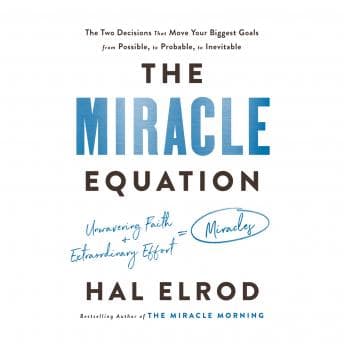

What if the formula for achieving your goals was actually... simple? Like, embarrassingly simple? That's the question I kept turning over during my morning jogs through Cambridge while Hal Elrod laid out his Miracle Equation in my earbuds.
Look, I'll be honest. I approached this one with my researcher brain fully activated. Self-help books make fascinating case studies in how we construct narratives about human potential, and I was curious whether Elrod would give me something psychologically substantive or just motivational cotton candy.
The answer? Somewhere in between. And that's not necessarily a bad thing.
The Psychology Behind the Formula
Elrod's equation—Unwavering Faith + Extraordinary Effort = Miracles—is deceptively simple. My therapist would have thoughts about the word "unwavering" (because honestly, who among us is unwavering about anything?). But here's what makes this work from a psychological standpoint: Elrod is essentially describing a combination of self-efficacy beliefs and behavioral commitment. The research actually shows that this pairing matters. People who believe they can achieve something AND consistently take action toward it do tend to outperform those missing either component. That same pairing of belief and action shows up in Witch of Blackbird Pond, where Kit's unwavering conviction in her own principles drives every choice she makes.
What I found myself asking: why does this framing land when it's basically repackaging established psychology? I think it's because Elrod strips away the academic jargon. He's not citing Bandura's self-efficacy theory or discussing implementation intentions. He's telling you to believe in yourself and work hard. Revolutionary? No. Accessible? Absolutely.
The personal stories he weaves in—surviving a near-fatal car accident, overcoming cancer, financial struggles—these aren't just inspirational fluff. They function as case studies in resilience. The protagonist of his own narrative exhibits classic post-traumatic growth patterns. He's living proof of his own thesis, which adds credibility that pure theory can't match.
Hearing It From the Source
Here's the thing about author-narrated audiobooks: they're a gamble. Some authors should never be allowed near a microphone (don't @ me, I've suffered through enough monotone readings to have opinions). Elrod falls into the category of "not a professional narrator, but it works."
His delivery is warm and clear. You can hear that he genuinely believes what he's saying, which matters for this kind of content. There's an authenticity that a hired voice actor might not capture. When he talks about his health struggles, there's a weight to it that feels earned.
That said—and I'm being real here—the pacing can feel a bit... even. Some listeners might find themselves wanting more dynamic variation, especially during the more instructional sections. I found myself bumping up to 1.25x speed during my runs, which helped maintain momentum. Not a dealbreaker, but worth knowing.
Who Should Listen (And Who Should Skip)
The Miracle Equation works best for people who already have goals but struggle with either the belief or the follow-through component. If you're someone who starts strong and fades (hi, every January gym resolution), the framework here might actually stick because it's so stripped down. There's nowhere to hide.
The 30-Day Challenge at the end is genuinely useful. It's structured without being overwhelming, which—from a behavior change perspective—is exactly right. Small, consistent actions beat ambitious but unsustainable plans every time.
But let's be clear about who should skip this. If you're looking for deep psychological analysis of WHY you self-sabotage, this isn't it. If you want evidence-based strategies with citations and nuance, look elsewhere. Elrod is not doing psychology; he's doing motivation. Both have their place, but they're different tools.
I also noticed he doesn't really address systemic barriers to success. The implicit assumption is that unwavering faith and extraordinary effort will overcome anything, which... my academic brain has concerns about that framing. Life is more complicated than any equation, miracle or otherwise.
A Researcher's Reluctant Recommendation
Did this audiobook change my life? No. (My dissertation committee would be concerned if it had.) Did it give me a useful mental framework I've actually found myself returning to? Surprisingly, yes.
The simplicity that initially made me skeptical is actually the strength here. When I'm staring at a research paper that won't write itself, "unwavering faith plus extraordinary effort" is a more actionable mantra than any complex psychological model I could cite.
At just under seven hours, it's a reasonable time investment. The production is clean, Elrod's narration is engaging enough, and the content delivers on its promise without excessive padding. For anyone in a motivation slump who needs a reset, this is a solid listen. Just don't expect it to replace actual therapy or address the deeper stuff.
(And yes, I'm aware of the irony of a psychology researcher recommending a self-help book. We contain multitudes.)