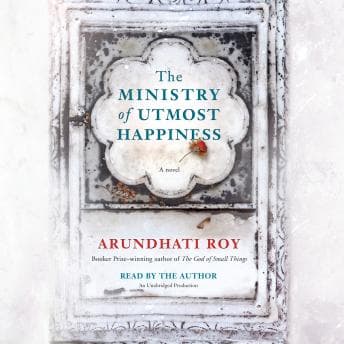

How long do you wait for a writer to come back before you stop calling it a follow-up and start calling it a resurrection?
Twenty years. That's how long Arundhati Roy took between The God of Small Things and this novel. Twenty years in which she became one of India's most prominent political voices, writing nonfiction about dams and nuclear policy and the machinery of state violence. And then she returned to fiction with a book that carries all of that political weight inside it - sometimes gracefully, sometimes like a suitcase packed past the point of closing.
I finished this one on a Sunday morning, lakefront walk with Denise, late autumn wind off Lake Michigan making my ears ache. And I remember standing still at one point, just stopped mid-stride, because Roy was reading a passage about Anjum - born Aftab, a hijra living in a graveyard in Old Delhi - and the way Roy's voice dropped to almost nothing, this whispered declaration about choosing to live among the dead because the living had no room. That moment earned every second of its silence.
A Graveyard Guest House and the People Nobody Wants
Let's talk about what the author is really saying. This is a novel about the discarded - hijras, Kashmiris, Maoists, babies left on sidewalks, people who exist in the margins of the world's largest democracy. Anjum builds her guest house among tombstones and gathers broken people the way some of us collect stray thoughts. Tilo, an architect loved by three different men, drifts through the narrative like smoke - Roy's own simile from the opening, and it's earned.
But here's where I have to be honest with my 47 podcast listeners and anyone else reading this: the plot is not really a plot. It's a constellation. Characters appear, vanish, reappear decades later. The narrative jumps from Old Delhi to Kashmir to a forest insurgency and back again without much warning. Nothing here is hiding under the surface - the surface itself is on fire, and somehow it's still beautiful. She's not interested in conventional structure. She's interested in bearing witness.
It shouldn't hold together. Mostly it does.
Roy Reading Roy - When the Author IS the Narrator
Here's the thing about author-narrated audiobooks: they're either the definitive version or a well-intentioned disaster. Roy lands somewhere fascinating in between. Her clipped Indian accent gives the Hindi and Urdu phrases their actual music - you hear the Delhi streets in her cadence, the way certain consonants land differently than any hired narrator would deliver them. When she reads the sections set in Kashmir, there's an anger in her voice that feels personal, not performed. Roy uses silence the way a drummer uses rests.
But - and this is a real but - she can be difficult to follow. Not always, but enough. Some passages come out in a melodious rush where words blend together, and at 1.0x (yes, I listened at my sacred 1.0x, fight me), I found myself rewinding more than I'd like to admit. Denise asked me twice why I kept jabbing at my phone. I told her I was checking the weather. I was rewinding for the third time through a passage about intelligence documents in Kashmir.
This is not background listening. This is not a faculty-meeting audiobook. (Sorry, Principal Martinez - you're safe from this one.) At 16 hours and 39 minutes, it demands the kind of attention you give to something you know is important even when it's frustrating you.
The Anger That Makes It Necessary
What separates this from a purely aesthetic literary exercise is Roy's fury. She is angry about Kashmir. She is angry about what India does to its minorities, its poor, its gender-nonconforming people. And she doesn't hide that anger behind metaphor - she sometimes drops entire government documents and news reports into the fiction, raw and undigested. Some readers will call this pretentious. Some will call it brave. I called it both, sometimes in the same chapter.
If you loved The God of Small Things, this is not its spiritual successor - it's its politically radicalized older sibling. The lyricism is still there, absolutely. Roy can still write sentences that make you want to underline things you can't underline because they're in your ears. But the scope is wider, messier, angrier. Small Things was a family tragedy. This is a national one.
We need writers who refuse to write comfortably. That refusal to play it safe with politically charged material is something I also wrestled with in When She Woke, which takes a different angle on state control over marginalized bodies but carries a similar undercurrent of righteous anger.
Who Gets an A, Who Should Drop the Class
Listen to this if: you want fiction that treats India's political wounds as personal ones, you appreciate prose that moves at its own tempo, and you want to hear an author read her own work with genuine emotional stakes.
Skip this if: you need clear plot momentum, if accented narration genuinely frustrates you (no shame - accessibility matters), or if you're looking for something to half-listen to while grading 87 essays on The Great Gatsby.
Is it worth the time? Honestly, yes. But clear your schedule first.