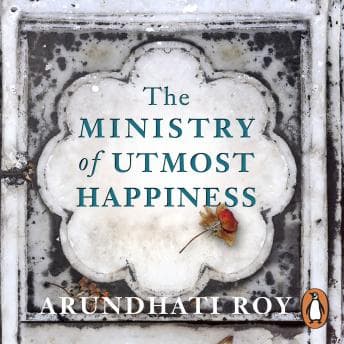

"How to tell a shattered story? By slowly becoming everybody. No. By slowly becoming everything."
That line hit me somewhere around hour three, and I had to set my stylus down and just sit with it. I was working on a rebrand for a local mezcalería — trying to get the color palette right, warm ambers and deep greens — and Roy's voice was doing this thing where it felt less like narration and more like someone praying in the next room. Not to God, necessarily. To the dead. To the broken. To Delhi itself.
A Graveyard That Feels More Alive Than Most Love Stories
So here's the thing about this book: it doesn't behave. It doesn't follow the rules of what a novel is supposed to do. Anjum — born Aftab, a hijra who eventually makes her home in a graveyard in Old Delhi — is our entry point, but she's not the center. Nobody is the center. Or everybody is. Roy builds this sprawling, breathing world where a trans woman's journey and the Kashmir conflict and a baby abandoned on a sidewalk and a group of men orbiting one woman named Tilo all exist in the same sentence, the same breath. And somehow it works. Mostly.
I say mostly because — and I want to be honest here — there were stretches, especially in the Kashmir sections around hours seven through ten, where I lost the thread. Not emotionally. Emotionally I was wrecked. But narratively, I'd realize I wasn't sure whose perspective I was in, or when we were, or how we got from a funeral to a houseboat to an intelligence briefing. Roy writes like she's channeling, not constructing. Which is beautiful and maddening in equal measure.
But God, the beauty. Anjum spreading her threadbare carpet over graves and building a guest house for the living among the dead? That image hasn't left me in days. It felt like — okay, this is going to sound specific, but it felt like visiting my abuela's house after she passed, when my tía had already rearranged everything but you could still smell her perfume in the curtains. A place that belongs to someone gone, made new by someone staying. Abuela would have loved Anjum. She would have been confused and fascinated and ultimately would have said "pobrecita" and meant it with her whole chest.
Roy Reading Roy Is an Act of Devotion (With a Learning Curve)
Here's what nobody tells you about author-narrated books: sometimes the person who wrote the words is the only one who knows exactly how they should sound. And sometimes that exactness makes it harder for you to follow.
Roy's voice is melodic. Like genuinely musical — her clipped Indian accent gives the prose this rhythmic quality, almost percussive, and when she hits an emotional passage she drops into something quieter and more intimate that made me hold my breath. There's a section where she's describing the violence in Kashmir, and her delivery is so controlled, so deliberately steady, that the horror lands harder BECAUSE she's not performing it. She's just... saying it. Like reporting the weather if the weather killed your family.
But. And this is a real but. There were moments — especially during dialogue between characters, or when the narrative shifts abruptly between storylines — where I had to rewind. Sometimes twice. Her reading style doesn't differentiate much between voices, so when Tilo speaks versus when Musa speaks versus when the narrative voice is commenting on both of them, it can blur. I was working on vector illustrations during those sections and I'd look up from my screen realizing I'd missed a transition entirely. Diego (my orange tabby, not the painter, though he's just as dramatic) knocked my headphones off the desk during one rewind and honestly, fair.
At 1.0x speed this is over sixteen hours. And it earns most of those hours. But I won't pretend all of them are easy.
This Book Is a Mosaic, Not a Movie
The comparison that keeps coming to me — and this is the designer in me talking — is that this book is a mosaic. Up close, the individual pieces are sharp-edged, sometimes ugly, sometimes blindingly colorful. The writing about Anjum's body, about the Khwabgah where the hijras live, about the way bureaucracy swallows people whole in India — those pieces cut. But you have to step back to see the full picture, and not everyone has the patience for that.
I ugly-cried twice. Once during the first Miss Jebeen's story (I won't spoil it but if you know, you KNOW, and I had to pause the audio and go splash water on my face like I was in a telenovela). And once near the end, when the graveyard guest house becomes something I didn't expect — a place of radical tenderness in a world that has none.
This is not a rainy Sunday book. It shares that layered, fragment-loving spirit of My Name Is Red — another novel where form refuses to behave — but Roy turns it inward, toward tenderness instead of murder. This is a book for the nights you can't sleep because the world feels too heavy and you need someone to say "yes, it IS too heavy, and people survive it anyway, and here's how."
Who Gets to Live Here
Listen to this if: you love language more than plot, if you've ever felt like you don't fit the shape the world made for you, if you want a book that treats political violence and personal love as the same wound. If you read The God of Small Things and wanted more but also different.
I went back to my notes on The God of Small Things right after finishing this one, and the through-line in Roy's obsessions — forbidden love, grief that becomes architecture — is unmistakable, even when the structures are wildly different.Skip if: you need a clear narrative arc, if author-narrated books with accent-heavy delivery frustrate you, or if you're looking for something you can half-listen to while grocery shopping. This demands your whole brain.
The Carpet Unrolled in the Graveyard
My heart. MY HEART. This book is imperfect and sprawling and sometimes loses its own thread, and I loved it for all of that. Roy wrote a novel that feels like a country — too big to hold, too alive to ignore, full of people the world wants to forget. And then she read it to me in her own voice, which is maybe the bravest thing an author can do with a story this raw.
Frida sat on my chest for the last hour. She knows.