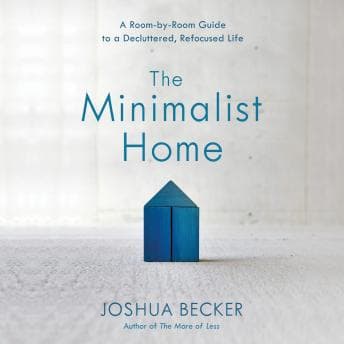

Look, I have a complicated relationship with self-help books that tell me my physical environment is the reason I'm not living my best life. Because — and my therapist would have thoughts about this — the research actually shows that environmental cues do shape behavior and cognition in measurable ways. So when Joshua Becker walks you room by room through your house explaining why you have too much stuff, part of my brain is nodding along while the other part is side-eyeing the oversimplification.
I was chopping onions for a chana masala I had no business attempting on a Tuesday night when I started this one. Eight hours and six minutes of a man calmly explaining why I don't need three sets of sheets. And honestly? By the time I was stirring in the garam masala, I'd already mentally donated half my bookshelf. (Don't worry, Maa. I didn't actually do it.)
The Psychology Beneath the Pile of Stuff
What makes this book more interesting than your average "throw things away" manual is that Becker occasionally — occasionally — touches on the underlying psychological mechanisms behind accumulation. Why do we hold onto objects we haven't used in years? Sunk cost fallacy, identity attachment, anxiety about future scarcity. He doesn't use those terms, because he's writing for a general audience, not publishing in the Journal of Consumer Psychology, but the instincts are there. The room-by-room structure (living room, bedroom, closet, bathroom, kitchen, garage, and so on) works as a kind of behavioral scaffolding — it breaks an overwhelming task into discrete, manageable units, which is pretty much Cognitive Behavioral Therapy 101 applied to your junk drawer.
But here's where I found myself asking: why does Becker really think minimalism solves the deeper problem? He frames decluttering as a launching pad for purpose and fulfillment, and while I buy that a less chaotic environment reduces cognitive load (the research on decision fatigue supports this), the book sometimes slides into motivational territory where correlation gets dressed up as causation. Fewer possessions didn't make anyone more purposeful. Purposeful people might just naturally accumulate less. That distinction matters, and Becker doesn't quite interrogate it. This is the same gap I kept bumping into in Battlefield of the Mind — the assumption that shifting your outer circumstances (or inner thought patterns) automatically rewires the deeper behavioral loops, when really the causality tends to run the other direction.
The content itself is solid, practical, and genuinely useful if you're standing in your garage wondering where to start. He gives specific guidelines — not just "get rid of things" but frameworks for deciding what stays and what goes in each space. The chapter on sentimental items is the strongest, because that's where the real psychological resistance lives and he seems to understand that.
When the Author Reads His Own Book Like a Sunday Sermon
Now. The narration situation. Becker narrates his own book, which I generally appreciate in non-fiction because you get the author's intended emphasis and emotional investment. And his enthusiasm for minimalism is genuine — you can hear it. The man believes in what he's selling, and that conviction carries weight.
But — and this is a real but — he reads slowly. Like, noticeably slowly. I'm someone who processes information while jogging through Cambridge at a decent clip, and this pacing had me wanting to shake my phone. There are inconsistent pauses too: sometimes a beat lands perfectly for emphasis, other times there's a gap that feels like he lost his place on the page. It's not terrible. It's just... distracting enough that you notice. Multiple listeners have flagged this, and the consensus recommendation is 1.25x speed. I bumped it up around hour two and didn't look back. At that speed, it flows the way it should've been recorded.
The style also veers into pep-talk territory. Which, if you're someone who needs encouragement to let go of your college textbooks from 2006, might be exactly what you want. But if you're looking for the measured delivery of a professional narrator, this isn't that. This is a passionate blogger reading his bestseller with the energy of someone giving a weekend workshop. Not bad. Just calibrated for a specific audience.
Who Gets the Most Out of This (And Who Doesn't)
If you're genuinely drowning in stuff and need someone to hold your hand through the process with warmth and structure, this book delivers. The room-by-room approach is smart, actionable, and low-pressure. If you're already a minimalist looking for deeper philosophical engagement with why humans form attachments to objects, you'll find this surface-level. And if you have any training in psychology, you'll wish he'd pushed harder on the why instead of defaulting to inspirational anecdotes.
Best listened to while actually cleaning or organizing — it functions almost like a companion guide. Put it on while you tackle the hall closet. Practical context for practical advice.
My Diagnosis: Useful Prescription, Mild Side Effects
This is a fascinating case study in how self-help books succeed: not by being intellectually rigorous, but by being present at the right moment for the right person. Becker understands human nature well enough to know that most people don't need a theory of minimalism — they need permission and a plan. The audiobook gives you both, if you can get past the pacing. Speed it up, grab a trash bag, and let the man talk you into a calmer living room. Just don't expect him to explain the attachment theory underneath it all.