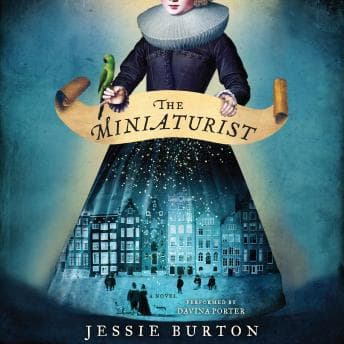

Look, I have a complaint. Jessie Burton wrote a book set in 1686 Amsterdam about a woman trapped in a house with hostile in-laws, a distant husband, and a mysterious artist sending increasingly creepy miniature furniture — and she had the audacity to make it so atmospheric that I nearly missed my turn on the lakefront path three separate times. Denise had to grab my elbow at Montrose Harbor because I was just... gone. Standing there like a fool while Davina Porter whispered about sugar loaves and silver-plated cabinets.
Here's what gets me about this novel: it's not really about the miniaturist. Not in the way you'd expect.
The House That Silence Built
The Brandt household on the Herengracht canal is one of those literary spaces that functions as a character — and I don't say that lightly, because my students write that in every essay and I usually cross it out. But Burton earns it. The house is cavernous and cold, full of locked doors and withheld information. Nella arrives as a bride and immediately discovers she's more like a boarder nobody wanted. Johannes disappears to his warehouse. Marin, his sister, runs the domestic world with the precision and warmth of a Calvinist accountant. And then there's Otto, the Black manservant whose very existence in this Dutch Reformed world carries enormous weight that Burton handles with real care rather than exploitation.
The miniature cabinet — Johannes' wedding gift to Nella — is where the book finds its strange, unsettling heartbeat. Nella orders furnishings from a miniaturist whose workshop she can never quite locate, and what arrives are objects that predict or mirror real events in the household. A tiny cradle. A figure with a dog. Items that shouldn't mean anything but absolutely do. Burton never fully explains the mechanism here, and that restraint is going to frustrate readers who want clean resolution. I'll get to that.
Davina Porter Knows What Silence Sounds Like
Porter is one of those narrators — and there are maybe a dozen working right now — who understands that a pause between sentences isn't dead air. It's punctuation. The narrator understands that pause is punctuation. Her Marin is clipped and commanding, each word bitten off like she's rationing syllables. Her Johannes carries a kind of weary gentleness, the voice of a man who's spent decades performing a version of himself for a society that would destroy the real one. And Nella — Porter gives her this gradual transformation from breathy naiveté to something harder and more certain that tracks so naturally you don't notice it happening until suddenly you do.
One listener said Porter "ruined other books" for them, and I understand the sentiment even if I wouldn't go that far. She's not flashy. She doesn't do vocal gymnastics. What she does is inhabit the psychological register of each character so completely that by the time the plot's stakes become life-and-death — and they do, brutally — you feel the terror in the modulation of her voice rather than in any histrionics. This reminds me of what Hemingway said about prose being an iceberg: Porter delivers what's above the waterline and trusts you to feel what's underneath.
When Amsterdam Feels Like a Trap
Burton's 17th-century Amsterdam is gorgeous and suffocating in equal measure. The city is drowning in money — tulip speculation, sugar trade, spice routes — but its Calvinist moral infrastructure means every guilder comes with guilt and every pleasure is policed. Johannes Brandt's secret, which I won't spoil but which becomes the engine of the novel's second half, is the kind of thing that would barely register in our world but carries a death sentence in his. The trial scenes — when they come — are genuinely harrowing. Not because of violence but because of bureaucratic cruelty dressed in piety. (My students would hate this. I love it.)
If you loved Sarah Waters' Fingersmith or Emma Donoghue's The Wonder, this is their spiritual successor — that same claustrophobic historical feminism, women navigating systems designed to erase them. I got a similar trapped-in-someone-else's-story feeling from Family Upstairs: A Novel, which has that same quality of secrets metastasizing quietly inside a house until the walls can't hold them anymore.
Now. The ending. The miniaturist herself remains essentially unexplained. You will not get a tidy reveal about who she is or how she knows what she knows. Burton seems more interested in the idea that some forces resist our understanding, and that Nella's growth comes not from solving the mystery but from learning to act without certainty. I respect this intellectually. Emotionally, at 11 PM with papers still ungraded, I wanted just a little more. Not everything — just a crumb.
Who Gets the Cabinet Key
This is for readers who like their historical fiction quiet and sharp rather than epic. If you need battle scenes or sweeping romance, skip it. If you want a novel about how a young woman learns to see the world as it actually is — messy, dangerous, full of people performing roles they didn't choose — and you want it delivered by a narrator who treats every sentence like it matters, this is worth thirteen hours of your life.
The prose deserves to be savored. Keep it at 1.0x. Let Porter do her work.
Worth pausing the faculty meeting for? Absolutely. Though I'll admit — I finished it during Martinez's curriculum alignment presentation, and nobody noticed a thing.