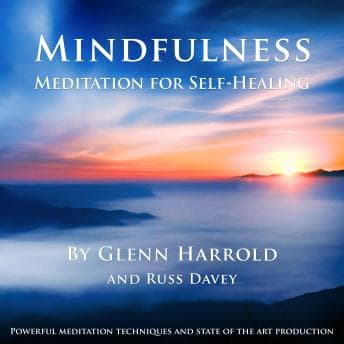

Jenny's been on me about my blood pressure. Not in the nagging way - in the quiet, concerned way where she leaves articles on the kitchen counter and doesn't say anything. So when she texted me a link to Glenn Harrold's Mindfulness Meditation for Self-Healing with just a heart emoji, I figured 46 minutes was a small price for marital peace. I downloaded it on a Thursday night, dimmed the lights in my home office after a brutal client call, and hit play.
At 1.0x speed. First time in months.
The ROI on 46 Minutes of Sitting Still
Bottom line: This isn't a book. It's a tool. And that distinction matters. You're not buying insight or argument or framework - you're buying a guided experience designed to make you stop thinking for half an hour. For a guy who bills by the hour and listens to everything at 2x, that's either revolutionary or terrifying. Honestly? It was a little of both.
Harrold's British accent does the heavy lifting here. It's not dramatic or performative - it's the vocal equivalent of a weighted blanket. Measured, unhurried, clinical in the way a good therapist is clinical. He walks you through a body scan, then into a "healing white light" visualization, then parks you at the base of a mountain for what I can only describe as enforced stillness. The structure is simple: notice your body, notice your pain, stop fighting it, breathe.
This is what my parents did instinctively - except they didn't have language for it. My mom would sit in the back of the dry cleaning shop for ten minutes between loads, eyes closed, hands on her knees. No app, no British guy in her ears. Just survival-grade decompression. Harrold's just productized that.
The 36-minute main track is the real session. There's also a 10-minute version that's basically the espresso shot - stripped down, still effective, meant for lunch breaks. I've actually used the short one twice since that first listen. Between Zoom calls. Don't tell my clients.
Russ Davey's Soundscape Does More Than You'd Expect
The music here isn't filler. Russ Davey layers piano, guitar, what sounds like Tibetan chanting, and these atmospheric choral textures that drift in and out. It's not new age cheese - it's actually well-produced ambient work that supports Harrold's voice without competing with it. The chimes hit at just the right moments to pull you back when your mind starts drafting emails (which mine did, repeatedly, for the first ten minutes).
Here's the catch though, and it's a real one: the Audible version apparently strips out the stereo panning effects from the original release. The background affirmations that are supposed to move across left and right channels? Flattened to mono. For a recording that's specifically designed around hypnotic audio techniques, that's not a minor issue. It's like buying a 4K movie and getting the DVD transfer. It still works, but you're missing part of the engineering that makes it work work.
If you're serious about this, you might want to grab the original from Harrold's site instead of Audible. That's unusual advice for me - I'm basically an Audible shareholder at this point - but the stereo version is the intended product.
Who This Is Actually For (And Who Should Keep Scrolling)
This is the sixth title in Harrold's mindfulness series, so there's a progression assumed. You don't need the first five, but know that this one leans into what he calls "shamanic" energy work and clearing blocks in your energy field. If that language makes you reflexively close the browser tab, I get it. I had the same instinct. But here's the thing - if you ignore the vocabulary and just follow the instructions, the breathing and body awareness techniques are grounded and practical.
This is for the person who knows they need to slow down but can't bring themselves to sit in silence. The person who needs a voice telling them what to do with their attention for 36 minutes because their default mode is planning tomorrow's to-do list. That's me. That might be you.
It's NOT a business book. It's not going to teach you anything you can put in a deck. You can't 2x this (I mean, you can, but then Harrold sounds like an auctioneer and the whole point implodes). And at 46 minutes total runtime, the value-per-credit math is rough unless you're relistening regularly - which is actually the intended use case. Harrold recommends daily listens.
Jenny Was Right. Again.
I'm not going to sit here and tell you this changed my life. That's not how I operate and that's not what 46 minutes does. But I slept better that Thursday. And I've gone back to the 10-minute track three times now. For someone who treats stillness like a productivity leak, that's something.
Glenn Harrold has sold over 10 million of these recordings, and after listening, I understand why. He's not selling enlightenment - he's selling a reliable, well-engineered off switch for your brain. The production quality is genuinely good, the voice is the right kind of boring (that's a compliment), and the mountain visualization stuck with me longer than most business frameworks I've consumed this quarter.
Jenny would say I'm being harsh rating this against regular audiobooks. Jenny is right. My Montessori Baby review hit the same snag - tools and experiences don't grade on the same curve as books with actual arguments to make. But at 46 minutes for a full credit? Grab it on sale or stream it. Use it as intended - repeatedly, before bed, at 1.0x - and it earns its keep.