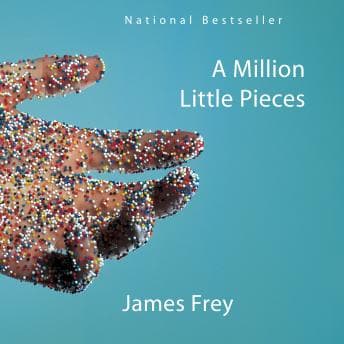

Seventeen hours. Seventeen hours of listening to a man describe his own destruction in excruciating detail, and I'm still not sure how I feel about it. That's either a sign of a complex work or a sign I need to bill myself for therapy.
Let me get the elephant out of the room first: Yes, this is the book Oprah famously eviscerated on live television after discovering Frey fabricated significant portions of his "memoir." The controversy is old news now, but it hangs over every listening experience like cigarette smoke in a 1990s bar. You can't escape it. And honestly? It affected how I processed the whole thing.
The Dental Scene Changed Me (And Not in a Good Way)
There's a scene—you'll know it when you hit it—where Frey describes undergoing root canal surgery without anesthesia because his body is too ravaged by drugs to handle it. L.J. Ganser reads this passage with such measured intensity that I had to pause my dishwasher mid-cycle because I couldn't focus on anything else. Just stood there, sponge in hand, jaw clenched in sympathy pain.
This is the book's power and its problem. Frey writes in this repetitive, almost incantatory style—no quotation marks, minimal punctuation, thoughts bleeding into each other like watercolors. On the page, I imagine it's hypnotic. In audio form at 17 hours, it's... a lot. Ganser commits fully to the approach, which means long stretches of monotone delivery that some listeners will find meditative and others will find maddening.
I landed somewhere in between. Jenny would say I'm being harsh. Jenny is right.
The Cast of Broken People
What actually works here—what kept me coming back during a particularly brutal week of client meetings—is the treatment facility itself. Frey populates it with characters that feel pulled from a Scorsese film: Leonard the mobster who becomes a father figure, Lilly the fragile prostitute, a former world-champion boxer whose name I've already forgotten but whose presence I haven't.
The small kindnesses and pettinesses of institutional life ring true. I've seen enough organizational dysfunction to recognize the rhythms—the way people form alliances, the territorial behavior over common spaces, the counselors who mean well but speak in pre-packaged wisdom. Frey's skepticism of the twelve-step dogma reads as genuine, even if other details don't.
This is what my parents did instinctively—they survived through sheer will, not programs. Now it has a TED talk. Frey's insistence on personal accountability over victimhood would've hit home with my dad, who spent 30 years taking ownership of a business that never gave him a break.
Ganser's Performance: A 17-Hour Endurance Test
Ganser's voice carries weight. Real weight. When Frey describes the physical sensation of withdrawal, Ganser makes you feel the tremors in his delivery. When the therapy sessions happen, there's a weariness that feels earned.
But here's the thing: at 17 hours, even earned weariness becomes exhausting. I bumped to 1.5x speed around hour six and never looked back. Some listeners called Ganser "phenomenal" and "impactful." Others said "monotone" and "boring." Both camps are correct—it just depends on your tolerance for sustained intensity without variation.
My usual 2.0x speed couldn't save this one. Even at 1.5x, there were stretches where I drifted, came back, and hadn't missed anything essential. That's not entirely Ganser's fault—Frey's style demands this kind of delivery. But it does mean this audiobook requires your full attention or it becomes wallpaper.
Who Gets Value Here (And Who Doesn't)
If you're fascinated by addiction narratives and don't mind a slow burn, this delivers. If you need plot momentum or varied pacing, you'll bail by hour four. Skip entirely if you're looking for a recovery roadmap—the fabrication issues make that a liability.
The ROI on 17 Hours of Wreckage
Here's what I kept coming back to: Does it matter that Frey exaggerated? If you're treating this as a recovery manual, absolutely yes. The man claimed he white-knuckled his way through addiction without AA, and that's a dangerous message if it's built on fabrication.
But as a piece of writing—as an audiobook experience—there's something here. The emotional truth of addiction, even if the factual truth is compromised. That tension between emotional weight and literal accuracy shows up differently in Grimm's Fairy Tales—stories that never pretended to be factual but still carved out psychological truths that stick with you. The therapy sessions feel real. The small cruelties and unexpected kindnesses of the facility feel observed, not invented.
I've seen this fail at three different companies—leaders who embellish their origin stories until the embellishments become the story. Frey did that. It cost him his credibility. But the book remains, and the audiobook remains, and 17 hours later I'm still thinking about a dental surgery scene that may or may not have happened.
The facility scenes are worth the listen. The other 16 hours? That depends entirely on how much patience you have for a man excavating his own wreckage, one unpunctuated sentence at a time.
Skip to the facility scenes. Thank me later.