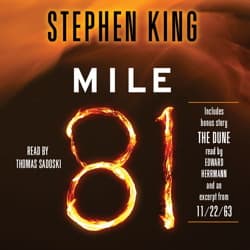

Everyone compares this to Christine meets Stand by Me, and I get it — King himself invites the comparison. But here's the thing: those stories earned their emotional gravity through character development that had room to breathe. Mile 81 doesn't have that luxury, and it knows it, and it doesn't always handle that knowledge gracefully.
I was chopping onions for a chana masala at like 9 PM on a Tuesday when I queued this up. Two and a half hours — perfect for cooking and eating. And honestly? That's about the right container for what this is.
A Ten-Year-Old Boy, a Bottle of Vodka, and a Very Hungry Car
Let me talk about Pete Simmons for a second, because this is where my brain goes. A ten-year-old kid finds a discarded bottle of vodka in a boarded-up rest stop and drinks enough to pass out. The protagonist exhibits classic risk-taking behavior that King writes with uncomfortable accuracy — that particular cocktail of bravado and stupidity that defines preadolescent boys who are trying to prove something to absolutely nobody. King gets this. He's always gotten this. The fear and the swagger existing simultaneously in the same small body.
What makes this character work — and Thomas Sadoski's narration really leans into this — is that Pete isn't written as precociously wise or conveniently brave. He's a dumb kid who did a dumb thing and woke up in a nightmare. Sadoski plays it matter-of-fact, almost flat, which is psychologically the exact right choice. When a child encounters something genuinely terrifying, there's this cognitive flattening that happens. The brain can't process it through normal emotional channels, so everything goes weirdly neutral. Sadoski captures that.
But the car itself — the mud-covered station wagon that opens its door and nobody gets out — I found myself asking: why does King give us a monster with so little interiority? Christine worked because the car had a personality, a jealousy, a possessiveness that mirrored human pathology. The wagon at Mile 81 is just... hungry. It's a Venus flytrap on wheels. And for a short story, maybe that's fine. But the comparison King invites works against him here because it reminds you of a richer version of the same idea.
Two Narrators, Two Entirely Different Frequencies
So here's where this audiobook earns its keep. Thomas Sadoski and Edward Herrmann are narrating two completely different stories, and they sound like they're narrating two completely different genres. Which — they kind of are.
Sadoski does Mile 81 with this smooth, unadorned delivery. He doesn't attempt child voices or female voices with any kind of transformation — instead he shifts intonation, changes the energy. It works better than it should. There's something unnerving about horror delivered in a voice that sounds like someone telling you about their commute. The gap between the mundane tone and the monstrous content creates its own tension.
Edward Herrmann on "The Dune" is a completely different animal. That soft, craggy voice — not quite Southern, more like sun-baked Florida gentleman — carrying a retired judge's monologue about a mysterious sand dune where names appear in the sand before people die. Herrmann's pacing is exquisite. He pauses in places that make your stomach drop. The twist at the end of "The Dune" hit me while I was washing dishes, and I literally stopped with my hands in the water.
Here's my honest assessment: "The Dune" is the better story, and Herrmann is the better narrator, and together they make the back third of this audiobook the part you'll actually remember. This is a fascinating case study in how a short piece — probably twenty minutes of audio — can outperform the title story by operating on pure psychological dread instead of monster-movie mechanics.
The Research Actually Shows That Endings Matter
The abrupt ending of Mile 81 is the main complaint I've seen, and I share it. King sets up this wonderful escalation — the rest stop slowly filling with abandoned cars, the growing wrongness of the scene Pete wakes up to — and then resolves it in a way that feels like he needed to catch a flight. Psychologically, this doesn't track with the buildup. When you spend that much narrative energy establishing dread, the resolution needs to match the investment. It doesn't.
But at two and a half hours total, the stakes for your time are low. You're getting a decent King horror snack and a genuinely chilling little dessert in "The Dune."
Who Gets the Most Out of This
King completists, obviously. But also: if you've got a short drive or a quick errand and you want something that'll make you glance at parked cars a little differently afterward — this is that. If you need deep character psychology or a satisfying narrative arc, this will frustrate you. If you're here for atmosphere and two very good narrators doing very different things well, you'll be fine.
Skip if you're expecting novel-weight King. Come for the creepy car, stay for the sand dune.
My Therapist Would Have Thoughts About That Judge
I keep thinking about Harvey Beecher. A man who discovers he can predict death — or maybe cause it — and turns it into a daily ritual for decades. The psychology of that compulsion, the way power and guilt and addiction braid together in one person's routine. That's the real horror in this collection. Blood Lines does something similar with that same braiding — the way ordinary people construct rituals around things they know they shouldn't touch. Not the hungry wagon. The human being who keeps going back to the island.