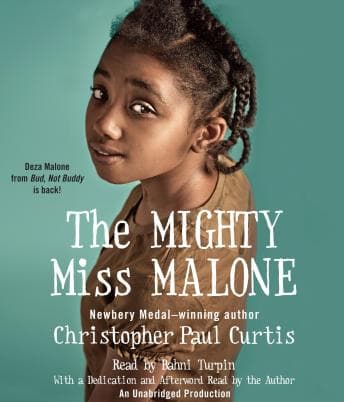

Jenny picked this one. Let me be upfront about that. We were at her parents' place last weekend - one of those Sunday dinners that stretches into Monday - and her niece left this playing on the kitchen speaker while we cleaned up. I caught maybe twenty minutes of Deza Malone narrating her family's life in Gary, Indiana during the Depression, and something about it wouldn't let go. So I downloaded the full audiobook Monday morning, which is not my usual move for a kids' book filed under "Self-Help" for reasons I still don't understand.
I finished it by Tuesday night. At 1.5x, not my usual 2.0x. That should tell you something.
My Parents Ran a Dry Cleaner, Deza's Father Worked the Steel Mills
Here's why this book hit different for me. Deza Malone's family motto - "We are a family on a journey to a place called wonderful" - sounds like the kind of thing you'd find on a motivational poster at a failing WeWork. But Christopher Paul Curtis earns it. He earns it because the Malones aren't naive. They're strategic. When Deza's father Roscoe loses his job at the steel mill and heads out alone to find work, it's not abandonment - it's resource allocation. When Mother drags the kids from Gary to a Hooverville outside Flint, Michigan, she's not wandering. She's executing a search plan with limited information.
This is what my parents did instinctively. Now it has a TED talk. Except Curtis wrote it for twelve-year-olds, which means he stripped out all the jargon and left the truth: poor families don't have the luxury of despair. They operate. They make decisions under constraints that would paralyze any MBA class I've sat in.
Deza herself is the smartest kid in her class and she knows it - not in an arrogant way, but in the way that smart kids from struggling families know their brain is the one asset nobody can repossess. She keeps a vocabulary journal. She corrects her brother Jimmie's grammar mid-argument. She's twelve and already running her own personal development program. I've coached startup founders with less self-awareness.
Bahni Turpin Doesn't Do a Kid Voice - She Becomes One
Okay, the narration. Bahni Turpin is polarizing and I get why. Her voice has a specific texture - warm but not sweet, a little rough around the edges - that some listeners bounce off of immediately. I've heard her do The Help and she was excellent there. Here she's doing something harder: she's playing a child who's smarter than most adults around her, and she has to make that believable without making Deza sound precocious or annoying.
She nails it. The moment where Deza describes Jimmie's singing voice - this scene where his talent just stops the room - Turpin shifts into something almost reverent. She doesn't oversell it. She lets the writing do the heavy lifting and just... holds the space. That's a narrator who trusts the material.
Where she's less convincing: some of the male adult voices blur together. Roscoe and a few of the Hooverville men sound similar enough that I occasionally lost track of who was speaking. Minor issue in a book that's 80% Deza's interior monologue, but worth noting.
The pacing is deliberate - this isn't a thriller, it's a family moving through crisis in real time. At 1.5x it felt right. At 2.0x I was missing emotional beats. At 1.0x it might drag in the early chapters before the family leaves Gary. Find your sweet spot.
What a 12-Year-Old Girl Taught Me About Operational Resilience
I'm going to say something that might sound ridiculous coming from a management consultant: this children's book contains a better framework for operating under uncertainty than half the business books in my Audible library. The Malones lose income, lose housing, lose family cohesion - and at every stage they make the next rational decision with whatever they have. They don't catastrophize. They don't pivot to some fantasy alternative. They move forward.
Curtis also threads real African-American history through the story without making it feel like a textbook. The Hooverville scenes are specific - the social hierarchies, the unwritten rules, the way families carved out dignity in cardboard shelters. It's Depression-era America rendered with the kind of granular detail that makes you realize how sanitized most historical fiction really is.
Jenny would say I'm being harsh. Jenny is right - because I should mention this book also made me tear up on a Tuesday night over a fictional twelve-year-old's vocabulary journal. That happened.
Who Gets the ROI
Parents looking for a road trip audiobook that won't insult anyone's intelligence - this is your pick. Adults who loved Bud, Not Buddy and want the companion story from Deza's side. Anyone who thinks children's literature can't carry real weight. And honestly? Any founder who needs a reminder that resilience isn't a buzzword, it's a daily practice performed by people who never had the privilege of calling it a "mindset."
Skip if you need plot-driven action. This is character-driven, slow-building, and earns its emotional moments the hard way. Protector scratches that action itch if you need something with more forward momentum — though I'd argue it doesn't leave you with nearly as much to sit with afterward.
Bottom Line on the Spreadsheet
Bottom line: Christopher Paul Curtis wrote a kids' book that a 38-year-old consultant couldn't put down. Bahni Turpin's performance is the right kind of understated - she disappears into Deza and lets you forget you're listening to an adult. At just under 8 hours, it respects your time. The key takeaway is worth the listen. And the other 7 hours? Actually worth it too. That almost never happens.