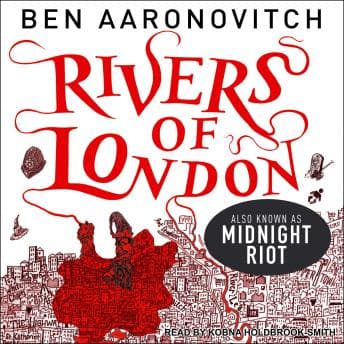

Everyone kept telling me this was basically Dresden Files but British. They were wrong. Well—not entirely wrong, but wrong enough that I almost skipped it based on that comparison alone. I bounced off Dresden hard (sorry, not sorry), but Midnight Riot? I finished it in exactly four commutes and immediately bought book two.
Here's the thing: I started this at 5:47 AM on a Tuesday, wedged between a guy manspreading into my personal space and someone's overly aggressive perfume. Not ideal conditions for picking up British police jargon and magical theory. But by Redwood City, I was so locked in that I missed my stop. Actually missed my stop. That hasn't happened since the first Bobiverse book. Big Little Lies had that same pull—couldn't stop listening even when I should've been paying attention to my surroundings.
The Narrator Is Doing Something Sneaky
Kobna Holdbrook-Smith doesn't do that thing where British narrators default to posh BBC English. Peter Grant sounds like actual London—street-level, mixed heritage, the kind of accent that shifts depending on who he's talking to. And here's what got me: the way he voices Nightingale versus the river goddesses versus the random PCs at the station. It's not just "different voices"—it's class signaling through vowels. Nightingale's clipped, old-money precision against Peter's more relaxed South London cadence creates this mentor-student dynamic before a single word of dialogue establishes it.
Fair warning for my fellow Americans: there's a learning curve. First hour, I was Googling "what is a probationary constable" and "Met Police hierarchy" during my walk from the train to the office. By hour three, I'd absorbed enough through context that it stopped mattering. Your brain adapts. Trust the process.
One quirk that bugged me—and I'm being nitpicky here because the performance is genuinely excellent—Holdbrook-Smith occasionally sounds slightly out of breath at the end of longer sentences. It's subtle. You probably won't notice unless you're listening at 1.5x like a normal person. But once I heard it, I couldn't unhear it.
Urban Fantasy That Actually Understands Cities
Okay, so I work in distributed systems. I think about how complex networks interact, how legacy systems create weird dependencies, how you can't just rip out old infrastructure without understanding what's downstream. Midnight Riot gets this. The magic system isn't just "wizard does cool thing." It's embedded in London's infrastructure—literally. Blue Cross plays with similar ideas about place and power, though in a completely different setting. The rivers have goddesses. The geography matters. There's a reason Peter needs to learn Latin and Newtonian physics alongside actual spellwork.
Ben Aaronovitch wrote for Doctor Who back in the day, and you can feel that influence in how he builds his world. It's not info-dumpy. It's accumulated. By hour six, you understand the rules not because someone explained them but because you've been living in them.
The police procedural elements are legit too. Peter's not some maverick detective—he's a probationary constable who dreams of making detective and instead gets shunted toward paperwork. The mundane bureaucracy of actual policing runs parallel to the supernatural investigation in a way that feels earned rather than gimmicky.
What Almost Lost Me
Peter thinks about sex a lot. Like, a lot a lot. Every woman who enters a scene gets assessed. It's not explicit or graphic—more like a running background commentary that I found mildly tiresome by the halfway point. It's realistic for a twenty-something guy, sure. But realistic isn't always what I want at 6 AM surrounded by strangers.
Also: the pacing in the middle section gets a little meandering. There's a stretch where Peter's learning magic and doing routine police work and meeting various supernatural entities, and while each scene is individually interesting, the main murder investigation kind of... drifts. I bumped up to 1.75x for about an hour there before things tightened up again.
Who Gets a Ticket, Who Should Stay Home
Perfect for: Commuters who want something engaging but followable. Anglophiles. Anyone who liked the concept of Dresden but wanted less noir machismo and more actual police work. Fantasy readers who appreciate when magic has rules.
Skip if: You need American cultural references to stay oriented. You want pure action—this is more investigation than combat. You're deeply bothered by protagonists who notice attractive people exist.
The ROI Calculation
Ten hours. Four commutes. One missed stop. Zero regrets.
The audiobook does something the print version apparently can't—Holdbrook-Smith's performance adds a layer of authenticity to Peter's voice that makes the first-person narration feel like you're actually in his head rather than reading his diary. Multiple reviewers who read the physical book first said the audio version was significantly better. I believe them.
This is the start of a long series (nine books and counting), and normally that makes me hesitant. But the first book works as a complete story while clearly setting up a larger world. No cliffhanger. No "buy book two to find out what happens." Just a satisfying mystery with supernatural elements and a narrator good enough that I'm genuinely looking forward to spending another forty-plus hours with him.
Kevin's going to be jealous. He recommended this months ago and I ignored him. Don't be like me. Don't make Kevin right about things. Just listen to the book.