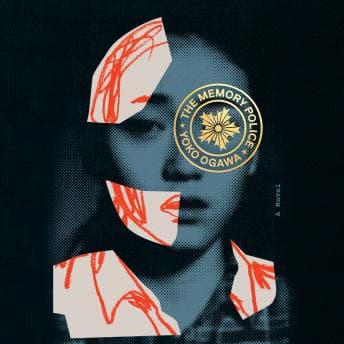

I'd heard people compare Yoko Ogawa to Kafka and Murakami, and I'll be honest - I went in expecting something dense, maybe a bit showy. What I got instead was something far quieter and far more unsettling. I started this one on a Saturday morning walk along the lakefront with Denise, and by the time we looped back to the car, neither of us had said a word in forty minutes. She wasn't even listening. She just felt the silence radiating off me.
This is a book about forgetting. Not the dramatic, sci-fi kind where memories get zapped out of your skull with a laser. The slow kind. The kind where one morning you wake up and roses don't mean anything anymore, and you gather them in a pile and burn them, and nobody questions it. That's the part that crawled under my skin - not the disappearances themselves, but how willingly everyone participates. The unnamed narrator watches birds vanish from the island, then the concept of birds, then even the word for them. And life just... continues. People adjust. They don't fight. They forget they should fight.
What Orwell Got Loud, Ogawa Gets Whispered
I teach 1984 every year to juniors who are mostly checked out until the rats show up. And every year I try to explain that the scariest part isn't Room 101 - it's the slow erosion of language, Newspeak shrinking the boundaries of what you can even think. Most of them don't buy it. They want the horror to be dramatic.
Ogawa would frustrate them. And I mean that as the highest compliment.
The Memory Police aren't jackbooted thugs screaming in your face. They're bureaucrats. They show up, they search, they remove. The terror is administrative. There's a scene where calendars disappear from the island, and a mother can't figure out when her daughter's birthday is anymore - not because she's confused, but because the concept of tracking dates has simply dissolved. I had to pause and sit with that one. Twenty years of teaching dystopian fiction and that scene did something to me that most of the genre hasn't managed.
The novel-within-a-novel - excerpts from the book the narrator is writing about a typist who loses her voice - mirrors the outer story's erosion so precisely that by the midpoint, you can't tell which world is losing more. It's a structural choice that works beautifully in audio because you experience both narratives in the same voice, the same breath. The boundaries blur the way Ogawa intends them to.
Traci Kato-Kiriyama and the Art of Restraint
Here's where I break with some of the criticism I've seen. Some listeners found Kato-Kiriyama's voice too high-pitched, too childlike. I get it. If you're expecting gravitas - a deep, commanding voice to match the weight of the subject matter - you'll be thrown.
But I think the choice is deliberate, and it works. The narrator of this novel is herself diminishing. She's losing pieces of her world, her identity, her capacity to hold onto meaning. Kato-Kiriyama reads her with a kind of fragile steadiness that mirrors that erosion. There's an emotional flatness that isn't disengagement - it's the sound of someone who's already begun to disappear and doesn't fully realize it yet. The prose deserves to be savored, and Kato-Kiriyama lets you do that. She doesn't dramatize. She trusts the quiet.
That said - and this matters - if you need vocal variety between characters, you won't find it here. The editor hidden beneath the floorboards sounds much like the narrator, which sounds much like her old man neighbor. This is a performance built on tone and atmosphere, not character differentiation. For this particular novel, I think that's the right call. The uniformity reinforces the theme: individuality is being erased.
The Pacing Problem (That Isn't Really a Problem)
Yes, it's slow. Nine hours and nine minutes of slow. Things don't accelerate toward a climactic confrontation. The island doesn't rise up. The narrator doesn't become a revolutionary.
And that's the entire point.
If you come to this expecting plot momentum, you'll feel like you're slogging through fog. But if you let yourself sink into Ogawa's rhythm, the slowness becomes dread. Each chapter strips something else away, and the accumulation is devastating. By the final hours, when the disappearances become truly physical - when the narrator's own body begins to lose its capacity - I was grading a stack of sophomore essays at 11 PM and I just stopped. Put the red pen down. Sat there.
My students would hate this. I love it.
Who This Is For (and Who Should Walk Away)
This is for the person who reads Kazuo Ishiguro and thinks, "I wish he'd go darker." It's for anyone who's ever taught Fahrenheit 451 and wished there was something that captured the same anxiety without the action-movie energy. If you loved The Housekeeper and the Professor, this is its spiritual successor - same quiet precision, but aimed at your chest instead of your head.
Skip it if you need answers. Ogawa never explains why things disappear or what the Memory Police ultimately want. I reviewed To Tame a Land a while back, and that one earns its ambiguity too - though in a completely different register, more frontier grit than existential fog, which tells you something about how many ways a story can trust its reader to fill in the gaps. That ambiguity is the engine of the book, but I understand why it drives some listeners up a wall. Also skip it if you're listening while driving or doing anything that competes for attention. This one requires focus. Worth pausing the faculty meeting for - but not worth half-listening to.
The Lesson Plan I'll Never Assign
I'll probably never teach this to my juniors. It's too slow, too interior, too trusting of its reader to sit in discomfort without the payoff of a rebellion scene. But I've thought about it every day since I finished. The image of a woman carefully lowering food through a trapdoor to her hidden editor, both of them knowing the world above is thinning, that things are being subtracted from reality one category at a time - that's going to stay.
This reminds me of what Hemingway said about writing: the dignity of movement of an iceberg is due to only one-eighth of it being above water. Ogawa wrote the one-eighth. Kato-Kiriyama narrates it. And the seven-eighths beneath? That's yours to carry.









