
Here's my complaint: if a student turned in a short story where an enslaved woman disguises herself as a disabled white gentleman — arm in a sling so she won't have to sign hotel registers she can't write in, face bandaged to hide her smooth skin, tinted spectacles to avoid eye contact — and then rides first-class on steamboats and trains through the Deep South with her husband posing as her servant, I'd scrawl "implausible" in red ink and hand it back.
Twenty years of teaching American literature. And I'm still getting schooled by the Crafts.
The Performance Within the Performance
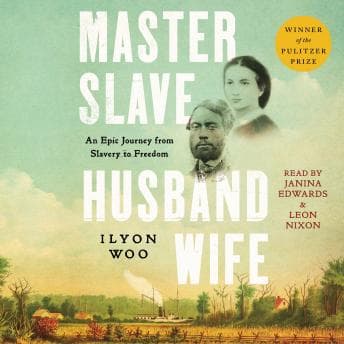
Ilyon Woo structures Ellen and William Craft's 1848 escape like the thriller it actually was, and the dual narration by Janina Edwards and Leon Nixon does something quietly brilliant here. Edwards handles Ellen's perspective with this controlled, low-burning intensity — measured, careful, the way someone would speak if one wrong word could get them killed. Nixon brings warmth and a grounded directness to William's sections. Together they mirror the fundamental split the Crafts had to perform every second of their journey: two people who love each other pretending to be strangers separated by the most violent hierarchy in American history.
There's a stretch early on — Ellen wrapping her arm, putting on the spectacles, becoming this fictional invalid planter — and Edwards narrates it with quiet dread that got under my skin. Not theatrical. Just the weight of what this woman is about to attempt. The narrator understands that pause is punctuation. I was walking the lakefront alone on a gray Saturday morning, and I physically stopped moving. Just stood there on the path like an idiot while joggers went around me.
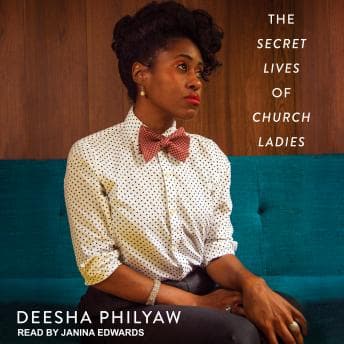
Edwards has that effect on me. I experienced something similar with her narration of Secret Lives of Church Ladies—the stories hit with the same quiet force, and I found myself forgetting I was even listening to a book.This reminds me of what Hemingway said about courage being grace under pressure. Except Hemingway never had to perform grace under pressure while pretending to be his own oppressor. What the Crafts did was performance art at its most dangerous — one slip, one flicker of recognition from a stranger on a steamboat, and it's over. Woo makes you feel every single one of those moments.
I've felt that same sustained tension in Report from Ground Zero, another true story where every second feels like a held breath.When the Lens Pulls Back Too Wide
Now. I need to be honest, because this is where the audiobook experience gets complicated. Once the Crafts reach the North, Woo widens the scope considerably — the abolitionist circuit, Frederick Douglass, William Wells Brown, the political machinery grinding toward the Fugitive Slave Act of 1850. This is important history. I teach it. I believe in it. But after spending hours inside the claustrophobic, minute-by-minute terror of their escape, the shift to secondary figures and legislative context felt like someone changed the channel from a film to a seminar.
Some listeners have called the second half dry, and I understand why. I wouldn't go that far — the third act, when slave hunters actually come north and the Crafts have to flee again, reignites the urgency. But that middle stretch tested my patience, and I'm a man who voluntarily listens to thirteen-hour Faulkner analyses. My students would hate this section. I didn't love it either.
The narrator switches also tripped me up once or twice. Edwards and Nixon have distinct enough voices, but the transitions between their sections aren't always clearly signaled, and in a book this dense with historical figures, I occasionally had to rewind to figure out whose perspective I was in. Minor issue. But worth noting.
Who Needs to Hear This
If you loved Colson Whitehead's The Underground Railroad in any format, this is its spiritual successor — except it's true, which makes it both more astonishing and more painful. Anyone teaching American history or literature needs this in their ear. I'm already figuring out how to excerpt sections for my juniors. If you need constant forward momentum, the second-half pacing might lose you, but stick with it. The final act earns your patience.
This is not a background listen. Don't put this on while cooking or scrolling your phone. The prose deserves to be savored, and Woo's research is too precise to half-hear. Dedicated listening. Full attention. 1.0x speed. The author chose those words. The narrators chose those pauses.
The Assignment I'm Giving Myself
A Pulitzer Prize doesn't automatically mean a great audiobook — I've suffered through award-winners with flat narration that made me miss reading on the page. But Edwards and Nixon honor this material. They don't sensationalize it. They don't sentimentalize it. They let the Crafts' own audacity do the work, which is exactly right.
Worth pausing the faculty meeting for. Worth standing still on a cold lakefront path and letting the story hold you there.








![Steve Jobs [unabridged audiobook] audiobook cover](/_next/image?url=https%3A%2F%2Fcovers.audiobooks.com%2Fimages%2Fcovers%2Ffull%2F9788499923406.jpg&w=1920&q=75)