
"The assassin is on the stage." Somewhere around the forty-minute mark, Richard Thomas delivers this line - this simple, devastating fact - and I realized I'd stopped breathing. I was sitting at the kitchen table at 11:30 PM, a stack of sophomore essays on The Great Gatsby growing cold beside me, and I was completely, stupidly riveted by a story whose ending I already knew.
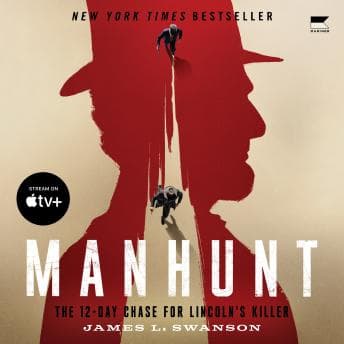
That's the trick of Manhunt, and it's a good one. You know Booth dies. You know Lincoln doesn't make it. Every American with a fifth-grade education knows the broad strokes. But James L. Swanson writes this thing like a procedural thriller, hour by hour, hiding spot by hiding spot, and somehow you're sitting there thinking maybe he gets away this time. That's craft.
The Actor Who Narrates an Actor
Let's talk about the Richard Thomas question, because it's the thing that divides listeners on this audiobook and I understand both sides. Thomas - yes, John-Boy from The Waltons, for those of us old enough to remember - narrates Swanson's history with the instincts of a stage performer. He drops his voice to near-whisper when Booth is dragging his broken leg through the Maryland swamps. He raises the tempo during the cavalry pursuit sequences until you feel like you're the one on horseback. It works. Mostly.
Here's where I part company with some folks: there are moments - particularly in Booth's journal entries and his more grandiose speeches about Southern honor - where Thomas pushes into melodrama. And look, Booth was melodramatic. The man was a Shakespearean actor who literally leapt onto a stage after shooting the president and shouted Latin. He was performing his own assassination. So is Thomas being too dramatic, or is he being exactly as dramatic as Booth himself was? I've gone back and forth on this, and I've landed on: Thomas understands that Booth saw himself as a tragic hero in his own play. The narration mirrors that delusion. It's an interpretive choice, and I think it's the right one, even when it occasionally makes you wince.
The narrator understands that pause is punctuation. Thomas's silences - the beat after the gunshot at Ford's Theatre, the long breath before Booth realizes he's cornered in the Garrett barn - those do more work than any vocal fireworks.
History Written Like a Manhunt (Because It Was One)
Swanson's real achievement is structural. He doesn't write this like a historian surveying events from above. He writes it from the ground, from inside Booth's fevered thinking, from the perspective of the cavalry soldiers who kept arriving at farmhouses twelve hours too late. The twelve-day timeline becomes a ticking clock, and Swanson respects the reader enough to let the suspense build naturally rather than constantly reminding you how dramatic everything is.
This reminds me of what Hemingway said about the iceberg theory - show the surface, trust the reader to feel what's underneath. Swanson doesn't editorialize about Booth's evil or Lincoln's sainthood. He just puts you in the room. In the swamp. In the burning barn. And you draw your own conclusions, which are honestly more devastating than any authorial commentary could be.
What surprised me most was how much time Swanson spends with Booth's co-conspirators and the network of Confederate sympathizers who helped him - or didn't. The moral cowardice of people who half-helped and then pretended they hadn't, the quiet courage of a few who refused to assist. It reads like - and I mean this as a compliment - it reads like the best kind of character study. You understand, without ever sympathizing, how Booth's world enabled him. I got a similar sense of mythmaking-meets-reality from Under the Black Flag, which does for piracy what Swanson does for assassination - strips away the legend to show the messy human machinery underneath.
If you loved Erik Larson's Devil in the White City - that same trick of turning history into a page-turner without cheapening it - this is its spiritual successor. Swanson's scope is narrower, just twelve days instead of years, but the intensity is higher.
Who Gets This Assignment
Civil War buffs, obviously. But honestly? Hand this to anyone who thinks history is boring. Hand it to the person who watches true crime documentaries. This is a true crime story - the original American one, really. My students would probably hate that I'm comparing it to a podcast about a cold case, but the structure is the same. (They wouldn't hate the book itself, though. It's genuinely propulsive at nine hours.)
Skip this if you want deep historiography or political analysis of Reconstruction. Swanson stays laser-focused on the chase, which is both the book's greatest strength and its only real limitation. You won't learn much about why Lincoln's death reshaped America. You'll just feel the twelve days when it happened.
Worth Pausing the Faculty Meeting For
I finished Manhunt during a Saturday morning walk along the lakefront with Denise. She asked me why I was so quiet, and I realized I'd been holding my breath again during the Garrett barn sequence. A history book made me forget to talk to my wife. That's either a recommendation or a warning, depending on how you look at it.
The prose deserves to be savored. Keep it at 1.0x. Thomas's pacing is the whole performance.