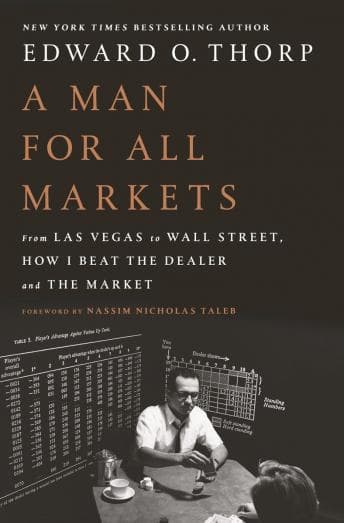

Edward Thorp is basically the original quant, and this audiobook is him telling you exactly how he did it.
I started this on a Monday morning commute, half-asleep as usual, expecting another "I'm so smart" finance memoir. What I got instead was a mathematician casually explaining how he invented card counting, built the world's first wearable computer with Claude Shannon (yes, THAT Claude Shannon), and then applied the same systematic thinking to Wall Street before anyone knew what a quant was. The ROI on this audiobook is absurd.
The Professor Reads His Own Paper
Here's the thing about author-narrated books: they're a gamble. Thorp narrates this himself, and his delivery is... professorial. That's the most accurate word. Some listeners find it lacking enthusiasm, and honestly? They're not wrong. This is not Ray Porter territory. Thorp reads like he's giving a lecture to particularly bright graduate students—measured, unhurried, occasionally a bit flat.
But here's where I disagree with the critics: that tone actually works for this content. When he's walking you through the probability calculations behind card counting, or explaining how he detected the Madoff scheme years before anyone else, you don't want performative excitement. You want clarity. His relaxed pronunciation caused me some trouble in the first hour (I had to rewind a few times), but once my brain adjusted, it clicked.
At 16.5 hours, this is a commitment. I finished it over about 8 commutes plus a few gym sessions. The pacing requires patience—Thorp doesn't rush through anything, and some sections on specific trading strategies get deep into the weeds. Perfect for: train, gym when you're doing steady-state cardio. Skip for: HIIT, anything requiring split attention.
When Math Becomes a Superpower
What kept me hooked wasn't the gambling stories (though those are great)—it was watching Thorp's brain work. He approaches every problem the same way: identify the edge, quantify it, exploit it systematically. Casinos, roulette wheels, options markets, Bernie Madoff—same framework, different applications.
The Warren Buffett bridge games, the young Rudy Giuliani confrontation, the casinos literally banning him and threatening his safety—these aren't just name-drops. They're case studies in what happens when you prove the conventional wisdom wrong and have the receipts to back it up. One listener review nailed it: this gave them "inspiration to get ahead in life regardless of hardships." That sounds cheesy, but Thorp's life genuinely demonstrates that rigorous thinking beats credentials and connections.
The book includes PDF appendices with the actual math, which I appreciated even though I only skimmed them. For the quant-curious, they're gold.
Who Should Queue This Up (And Who Should Skip)
This is a crash course in systematic thinking disguised as a memoir. If you're into probability, statistics, or just want to understand how the first generation of quants thought, this is essential listening. If you work in finance or tech and haven't read this, you're missing context that everyone assumes you have.
Skip if: you need an energetic narrator to stay engaged, you want a quick read (this is not that), or you're looking for get-rich-quick tips. Thorp's edge came from years of mathematical research, not shortcuts.
Final Runtime Assessment
I bumped this to 1.5x after the first couple hours—Thorp's measured pace actually handles speed-up well without losing clarity. The author narration means you're getting his exact intended emphasis, which matters when he's explaining why a particular insight mattered.
Is it the most thrilling audiobook I've ever heard? No. But I've thought about it constantly since finishing—that systematic approach to finding edges keeps surfacing in my own debugging sessions. When you're troubleshooting a distributed system at 2 AM, "identify the edge, quantify it, exploit it" is surprisingly applicable. That same methodical approach to uncovering hidden systems is what made Permanent Record so compelling—Snowden's breakdown of surveillance infrastructure has that same "here's exactly how it works" clarity.
Kevin asked what I was listening to and I talked about it for 20 minutes. He's now on chapter 3. The Thorp pipeline claims another victim.






![Steve Jobs [unabridged audiobook] audiobook cover](/_next/image?url=https%3A%2F%2Fcovers.audiobooks.com%2Fimages%2Fcovers%2Ffull%2F9788499923406.jpg&w=1920&q=75)