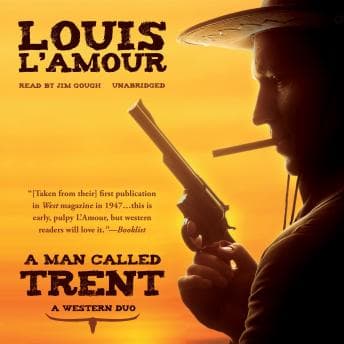

What makes a man ride away from his own reputation? That's the question at the heart of both stories in this Louis L'Amour duo, and honestly, it's a question I've turned over in my own head more than once - though my version involved trading a colonel's eagles for a consultant's business card.
I picked this one up on a whim. Was sitting in the waiting room at the vet's office - Ranger needed his hips checked, because apparently German Shepherds and retired soldiers have that in common - and I needed something to fill dead time. Almost ten hours of L'Amour seemed about right.
The Gunfighter Who Just Wants to Be Left Alone
Lance Kilkenny is the fastest gun in the West, and he hates it. That's the setup for both stories here, and L'Amour doesn't waste time getting to the action. In "A Man Called Trent," nester Dick Moffitt gets gunned down by King Bill Hale's riders, and his kids - Jack and adopted daughter Sally - flee to a cabin belonging to a man they know only as Trent. Of course, Trent is Kilkenny hiding under an alias, trying to dodge the very kind of trouble that just showed up at his door.
The second story, "The Rider of Lost Creek," runs a similar play: Kilkenny owes a debt to a man named Mort Davis, who's caught between feuding ranchers trying to swallow his land. Different setting, same DNA. Kilkenny rides in, reluctantly picks up his guns, and handles business.
Now look - L'Amour wrote these originally for pulp western magazines, and you can feel that. The prose is lean, almost spartan. Chapters are short. Conflict arrives fast. There's no 45-page philosophical detour about the meaning of the frontier. You get setup, confrontation, resolution. It's efficient storytelling, and for windshield time or waiting rooms, that efficiency is a feature, not a bug.
But here's what I didn't expect: L'Amour actually gives Kilkenny some interior life. The man doesn't want the fight. He's tired of being defined by what he's good at rather than who he is. There's a quiet moment in "A Man Called Trent" where Kilkenny watches the Moffitt kids settle into his cabin, and you get this sense that he's looking at the life he can't have. That hit me somewhere I wasn't prepared for. I've known guys like that - operators who were brilliant at the job but couldn't figure out how to be anything else once they hung it up.
Jim Gough Rides Steady, If Not Spectacular
Gough's got a good western voice. Solid. The kind of voice you'd hear narrating a documentary about the Chisholm Trail and think, "Yeah, that fits." He keeps the pace moving and handles the action scenes with enough energy that you don't zone out during gunfights - which, in a western, is pretty much the minimum requirement.
Here's where I landed on it though: I couldn't always tell characters apart by voice alone. In scenes with multiple ranchers talking, I occasionally had to rewind a few seconds to figure out who was speaking. Gough doesn't really give each character a distinct vocal signature - it's more like one narrator doing variations on a theme rather than distinct people. For a two-story collection that runs just under ten hours, that's a minor issue. But if you're listening while driving (which I did for chunks of this), you notice.
At 1.25x, the pacing was just right. Gough doesn't drag, but his natural pace sits a hair below what my brain wants for action sequences. Speed bump solved that nicely.
Who Should Saddle Up - And Who Should Ride On
If you're a L'Amour fan, this is solid mid-tier work from the man. Not his absolute best (that's still "Last of the Breed" for my money), but these Kilkenny stories are well-constructed and satisfying. Rocky Mountain Christmas scratches a similar itch if you want another short western collection that doesn't overstay its welcome. If you've never read L'Amour and you're curious, this isn't a bad entry point - you get two complete stories, so you'll know by the end of the first one whether you want to keep going.
If you need complex character development, morally ambiguous antagonists, or literary prose - ride on. This is pulp western done well, and it knows exactly what it is. King Bill Hale is bad. Kilkenny is good. The resolution involves guns. That's the contract L'Amour makes with you, and he honors it.
For my fellow vets: there's something satisfying about a character who's dangerous but disciplined, who'd rather walk away but won't abandon people who need him. Kilkenny's not some bloodthirsty gunslinger. He's a professional who gets pulled back in. Sound familiar?
Ranger's Debrief
Worth your time? Here's the debrief: it's comfort food. A solid western duo with a reliable narrator, perfect for road trips or any situation where you need something engaging but not demanding. I wouldn't burn my last Audible credit on it, but if you catch it on sale or have a subscription that covers it, it's a good listen. Ranger slept through most of it at the vet's office, but he perked up during the gunfights. I'll count that as a qualified endorsement.