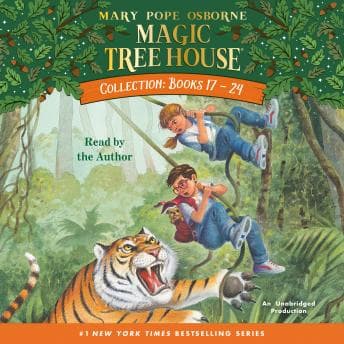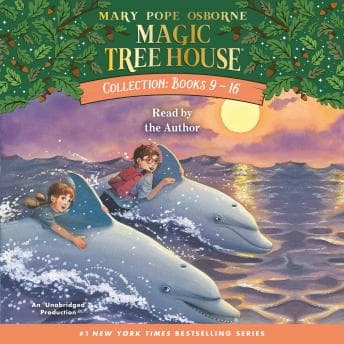

Is there anything more humbling than realizing a children's book series does a better job teaching history than half the textbooks I've assigned over twenty years?
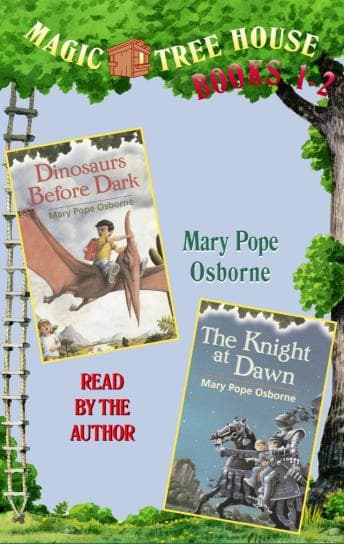
I came to this collection sideways. A colleague mentioned her kid was obsessed with Magic Tree House, and I'd never actually listened to one. Twenty years teaching English, and I'd somehow missed this phenomenon that's sold over 134 million copies. (My students would call this a "massive L." They're not wrong.)
When the Author Becomes the Voice
Here's what makes this collection genuinely special: Mary Pope Osborne narrates her own work. And look—author narration can go either way. Sometimes writers have no business behind a microphone. But Osborne? She understands something fundamental about her own prose. Her delivery is what I'd call "teacherly" in the best sense—warm, unhurried, never condescending.
She reads at exactly the pace a child needs. Not the breathless energy of cartoon voice actors, not the dramatic flourishes of audiobook celebrities. Just... steady. Soothing. The kind of voice that makes a kid feel safe while they're learning about Pompeii's volcanic destruction or the dangers of the African savanna. That's a harder balance to strike than it sounds.
What struck me most is her knack for characterization. Jack and Annie sound distinct without her doing wild vocal gymnastics. Jack's the researcher, the cautious one with his notebook. Annie's the impulsive adventurer. Osborne differentiates them through rhythm and tone rather than cartoon voices. It's subtle work—the kind of thing kids absorb without noticing, which is exactly the point.
History Through the Back Door
Okay, here's where the teacher in me gets excited. (Don't tell my students I said that—they think I'm perpetually bored.)
These eight books cover an absurd amount of ground. We're talking dolphins and marine biology, Wild West ghost towns, African wildlife, Arctic survival, Pompeii's eruption, imperial China, Dark Age Ireland, and ancient Greek Olympics. That's... a lot. And somehow Osborne makes each setting feel specific without drowning kids in exposition.
The framing device is clever. Morgan le Fay—yes, from Arthurian legend—sends Jack and Annie on quests. Books 9-12 have them solving riddles to become "Master Librarians." Books 13-16 task them with saving stories lost to history. As a literature teacher, I appreciate the meta-narrative here. Stories matter. Books are worth saving. It's a message wrapped in adventure rather than a lecture.
Now, some parents worry about the supernatural elements mixing with historical facts. Fair concern. But honestly? I've watched teenagers struggle to engage with straight historical fiction for two decades. The Great Influenza does something similar for adults—wrapping real history in narrative urgency that makes you forget you're learning. If a magic tree house gets an eight-year-old curious about what really happened at Pompeii, I'll take it. You can sort out fact from fantasy later. First you have to care.
Forty Minutes Per Adventure
Five hours and twenty-four minutes for eight books. That's about forty minutes per story—perfect for car rides, bedtime routines, or (and I'm speaking from experience here) when you need to grade papers but your neighbor's kid is visiting and needs entertainment.
The production is clean. No weird audio glitches, no jarring transitions between books. Just Osborne's voice, steady and clear, moving through adventure after adventure.
I listened at 1.0x because—well, you know my position on speed. But also because this isn't meant to be rushed. The pacing is deliberate. Kids need time to visualize the tree house spinning, the new world appearing, the danger approaching. Osborne gives them that space.
Who Needs a Magic Tree House (And Who Doesn't)
Parents with reluctant readers—this is your secret weapon. The audiobooks work as a gateway. Kids get hooked on Jack and Annie's adventures, then want to read ahead on their own. I've seen this pattern with struggling readers in my classroom. Sometimes they just need a story that meets them where they are.
Teachers and librarians already know this series. But if you haven't tried the audio versions for classroom quiet time or library programs, you're missing out. Osborne's narration adds a layer of engagement that struggling readers especially need.
If you're an adult without kids? Probably not for you. Unless you're like me and occasionally need a reminder that learning can be joyful and uncomplicated. That history doesn't have to feel like homework.
Skip this if you need complex character arcs or morally ambiguous protagonists. Jack and Annie are good kids having good adventures. That's the whole deal.
Class Dismissed
My students would definitely roast me for listening to this. But you know what? Osborne understands something I try to teach every semester: the best way to make someone love reading is to give them something worth reading. Or in this case, worth listening to.
These books have sold 134 million copies for a reason. And it's not because kids are easily impressed. It's because Mary Pope Osborne respects her audience enough to give them real adventures, real history, and real stakes—all wrapped in a voice that makes them feel like they're right there in the tree house, watching the world spin into something new.