
What if the actual explanation for rainbows is more magical than any myth about gods and bridges to heaven?
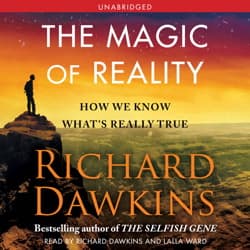
I've been wrestling with this question since I finished Dawkins' audiobook somewhere between Millbrae and San Mateo last Tuesday. The 6AM brain fog was real, but here's the thing—this book is basically "How Stuff Works" meets comparative mythology, and it's designed to be accessible enough that my half-asleep state wasn't a problem.
Science as the Better Story
Dawkins does something clever here. Each chapter starts with various cultural myths explaining natural phenomena—why do we have seasons, what causes earthquakes, how did life begin—and then pivots to the scientific explanation. The structure is almost algorithmic in its predictability, but it works. You get the Greek myth, the Norse myth, maybe a Hebrew or Aboriginal story, and then Dawkins walks you through the actual physics or biology.
The ROI on this audiobook is solid if you're looking for a refresher on high school science with better storytelling. If you want that same "accessible science storytelling" vibe but with more chemistry chaos, Disappearing Spoon delivers weird historical anecdotes about the periodic table that actually stick in your brain. I found myself nodding along during the evolution chapters (obviously his wheelhouse) and actually learning new details about plate tectonics I'd forgotten since my last earthquake drill at the office.
Here's what surprised me: the book was originally written for younger audiences, and you can tell. The explanations are patient, the analogies are concrete. But that's not a bug—it's a feature for audiobook listening. When you're trying to follow complex concepts while some guy's backpack is jammed against your shoulder on a packed Caltrain, you need that clarity.
The Narrator Situation (It's Complicated)
Dawkins narrating his own work? Excellent choice. His voice has this grandfatherly warmth that makes even discussions of atomic structure feel like a fireside chat. The moderate pacing is perfect for absorbing information without needing to rewind constantly.
But then Lalla Ward jumps in. And look—she's a fine narrator. The problem is the switches happen without warning. You're cruising along with Dawkins explaining how we know the universe is 13.8 billion years old, and suddenly it's a different voice reading the next section. It's jarring in a way that feels like a production decision someone should have reconsidered.
I listened at 1.5x and it was fine. Could probably push to 1.75x for the myth sections since those are more narrative, but I'd drop back down for the science explanations. The dual narrator thing makes speed adjustment trickier because their natural paces are slightly different.
Who This Is (and Isn't) For
This isn't a book that demands your full attention, but it rewards it. I caught myself zoning out during a few of the longer explanations and had to rewind maybe twice across my three commutes to finish it. That's pretty good for science content.
The 6.5 hour runtime is ideal—long enough to feel substantial, short enough that you're not committing to a multi-week project. I knocked it out in about four days of commuting.
One thing that might bug some listeners: Dawkins has a particular... let's call it confidence about the superiority of scientific thinking over mythological thinking. If you're coming to this hoping for a balanced "all ways of knowing are valid" approach, that's not what you're getting. He's respectful of myths as cultural artifacts but pretty clear about which explanations he thinks are correct. I personally found this refreshing (I debug distributed systems for a living, I like things that are verifiably true), but your mileage may vary.
Listen if: you want accessible science with a side of mythology and don't mind a narrator who's confident about empirical truth. Skip if: you're looking for deep philosophical nuance or the narrator-switching thing sounds like it'll drive you nuts.
Bottom Line: Worth the Commute Hours?
This is basically "Cosmos" for the skeptic crowd, with better myth coverage. At 6.5 hours, it's a reasonable time investment for brushing up on how we actually know what we know about the universe. The production quality is clean, no weird audio issues, just that narrator handoff quirk.
If you've already read The Selfish Gene or The God Delusion, this covers similar philosophical territory but with a gentler, more educational approach. It's Dawkins in teacher mode rather than debate mode. I finished it feeling like I'd attended a really good lecture series—not life-changing, but satisfying in a "my brain is slightly more organized now" way.
Kevin asked what I was listening to and I tried to explain the rainbow chapter to him over dinner. He glazed over by minute three. But honestly? That's on him. The actual science of light refraction through water droplets IS more interesting than Bifrost.









![Steve Jobs [unabridged audiobook] audiobook cover](/_next/image?url=https%3A%2F%2Fcovers.audiobooks.com%2Fimages%2Fcovers%2Ffull%2F9788499923406.jpg&w=1920&q=75)