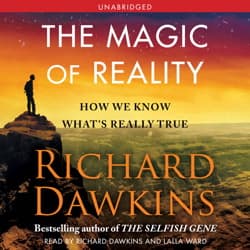

Okay, let's be real for a second. I listened to most of this while aggressively chopping vegetables for a curry I knew I wouldn't finish. There is something deeply ironic about listening to Richard Dawkins dismantle the concept of a higher power while I'm using my mother's coriander-heavy recipe—a woman who literally prays to three different deities before breakfast.
(Don't tell her I listened to this. She still thinks my psychology degree is just a phase before I settle down.)
Here's the thing about The God Delusion. I went in expecting a shouting match. Dawkins has this reputation, right? "Darwin's Rottweiler." I expected 14 hours of being yelled at by an angry British man. But that's not what I got. Not entirely.
The Voice of Reason (Literally)
First off, the narration. It's primarily Lalla Ward. If you're a sci-fi nerd like me (no shame), you know her as Romana from Doctor Who. If you aren't, just imagine the most crisp, articulate, soothing British voice possible.
Psychologically, this was a brilliant move.
If Dawkins had read the whole thing himself with that infamous intensity, I would have tapped out. Too much cortisol. But Ward? She delivers these absolute scathing critiques of religion with the tone of someone reading a bedtime story. It creates this fascinating cognitive dissonance. You're hearing about the "sex-obsessed tyrant" of the Old Testament, but the delivery feels like a warm cup of tea. It makes the arguments slip past your defenses.
Dawkins does pop in for snippets and the bonus conversation at the end, and hearing them together is... interesting. It's like attending a faculty mixer where two tenure-track professors are cornering you near the cheese plate. Intellectual, intense, slightly exhausting.
When Logic Misses the Human Element
Look, the arguments are rigorous. Obviously. The man is brilliant. He dissects the "Celestial Watchmaker" theory with the precision of a surgeon. From a purely logical standpoint, it tracks.
But—and here is where Dr. Sharma, Psychologist, has to intervene—he misses the why.
Dawkins treats religion like a faulty hypothesis. A logic error. But as someone who studies narratives for a living, I can tell you: stories aren't about logic. They're about survival. Identity. Coping.
I found myself shouting at my Bluetooth speaker: "Richard, people don't believe because the math adds up! They believe because the world is terrifying!" (My neighbors probably think I'm fighting with a boyfriend named Richard. Let them talk.)
Honestly, Surrender Experiment: My Journey into Life's Perfection explores that need from the opposite angle—what happens when someone leans into faith as a life strategy rather than dissecting it.
He eviscerates the arguments for God, but he doesn't really have much empathy for the need for God. It's a classic case of high IQ, lower EQ regarding human emotional needs. My therapist would have a field day analyzing why he needs to be so right about this.
That tension between intellect and emotional peace is something Untroubled Mind tackles too, though from a much gentler angle.
The Verdict from the Couch
Did I enjoy it? Yes. Actually, way more than I expected.
It's a brain workout. Even if you don't agree with him—or if you're like me, stuck in the agnostic middle ground of "I believe in science but also really love the mythology"—it forces you to sharpen your own thinking. You can't just passively consume this book. You have to argue back.
The production is clean. No weird background noises, though a few sections felt a bit dry—like, textbook dry. I zoned out once or twice during the more technical evolutionary biology bits. (I'm a psychologist, not a biologist, sue me.)
Who Should Listen (And Who Should Skip)
If you want your beliefs challenged—or you enjoy watching someone systematically demolish arguments like an intellectual wrecking ball—this is for you. Skip it if you need your philosophy served with emotional nuance, or if you're looking for a balanced "both sides" approach. Dawkins doesn't do balance.
But honestly? It's refreshing. In a world where everyone tiptoes around beliefs, Dawkins just kicks the door down. Whether you walk through it is up to you.