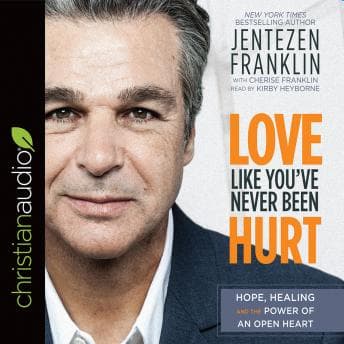

Can you actually will yourself into loving someone who destroyed you? Not in the abstract, greeting-card sense, but in the messy, gut-wrenching, I-still-flinch-when-my-phone-rings way?
That's the question Jentezen Franklin tries to answer in Love Like You've Never Been Hurt, and honestly, I spent a good chunk of this audiobook arguing with him in my kitchen while making dal makhani at 9 PM on a Tuesday. Which — look, when a book makes me talk back to it while I'm tempering cumin seeds, it's doing something right. Even if I don't always agree with the something.
The Psychology of Open-Hearted Vulnerability (And Its Limits)
Franklin's central thesis is straightforward: the walls we construct to protect ourselves from relational pain are the same walls that prevent healing and genuine connection. As a psychology researcher, I found myself nodding at the underlying mechanism — avoidance coping is well-documented in the literature, and the research actually shows that emotional avoidance predicts worse long-term outcomes in relationship trauma. He's not wrong about the pattern.
What makes Franklin's approach more interesting than your standard forgiveness-industrial-complex book is that he leads with his own pain. He doesn't just quote scripture from a pastoral lectern. He talks about his family, his struggles, the specific relational wounds that made him want to shut down. The protagonist here — because yes, I treat memoiristic self-help authors like characters, fight me — exhibits classic wounded healer dynamics. He's asking people to do the hard thing because he's done it himself, not because it's a tidy theological principle.
But here's where I started arguing with my stovetop: Franklin organizes the book around different types of relational disappointment — marital, familial, church community, friendships — and while the biblical stories he pairs with each are well-chosen, the modern-day examples sometimes lack the specificity that would make the psychological advice land harder. I found myself asking: why does the book repeatedly emphasize choosing to forgive as if it's a single moment rather than a messy, recursive process? Forgiveness research (Worthington, Enright, the whole field) consistently shows it's iterative, not a light switch. Franklin gestures at this but doesn't quite commit to the messiness.
That said — the section on loving people who haven't asked for forgiveness? Genuinely powerful. He doesn't pretend reconciliation is always possible, which I appreciated. My therapist would have thoughts about this distinction, and they'd mostly be approving.
Kirby Heyborne at 1.25x (Trust the Listeners on This One)
Here's the thing about Kirby Heyborne's narration: it's clear, it's warm, and it is slow. Not contemplative-pause slow. Not let-the-wisdom-sink-in slow. Just... unhurried to the point where I could feel my attention drifting toward my spice cabinet. Multiple listeners have flagged this, and they're right. At regular speed, the 7 hours and 40 minutes feel like they're fighting you.
At 1.25x? A different experience entirely. Heyborne's voice has a gentle, pastoral quality that actually benefits from a slight bump — it removes the drag without losing the emotional warmth. His delivery during Franklin's personal stories carries genuine feeling; you can hear him leaning into the vulnerable moments. But this is a book written by a pastor with a very specific preaching cadence, and Heyborne — not being the author — sometimes smooths over the moments that probably land differently when Franklin himself delivers them from a stage. A few listeners noted they'd have preferred author narration, and I get that. There's something about a wounded healer telling their own story that a proxy narrator can't quite replicate.
No sound effects, no production gimmicks. Clean audio. Just a man reading to you about why love requires courage. Simple.
Who This Is For (And Who Should Sit This One Out)
This is a fascinating case study in faith-based self-help that actually engages with real psychological pain instead of slapping a Bible verse on a wound and calling it healed. If you're a person of faith working through relational hurt — betrayal by a spouse, estrangement from a parent, disappointment in your community — Franklin meets you where you are with genuine empathy.
But if you're looking for evidence-based therapeutic frameworks, this isn't it. Franklin is a pastor, not a clinician, and the book operates within a Christian worldview that assumes certain things about forgiveness as divine mandate. That same faith-forward framing of surrender and purpose runs through Kept for the Master's Use, though that one leans even harder into the devotional lane — less psychology, more total yielding. If that framing doesn't speak to you, the core message (stop building walls, risk vulnerability) will feel familiar from a dozen secular psychology books that cover similar ground with more empirical rigor.
Psychologically, the book tracks where it counts: hurt people do hurt people, avoidance compounds pain, and choosing to love again is an act of courage, not naiveté. Franklin understands human nature in the way that good pastors do — through thousands of hours of sitting with broken people.
My Clinical Note
I finished this while scrubbing the dal pot, which feels metaphorically appropriate — sometimes the thing that nourishes you also leaves the most stubborn residue. Franklin's book won't replace therapy, and it shouldn't try to. But it does something therapy often can't: it gives you permission to try again, framed in a language that millions of people find deeply meaningful. Bump the speed. Let Heyborne's voice wash over you. And maybe — maybe — consider that the walls aren't protecting you anymore.